
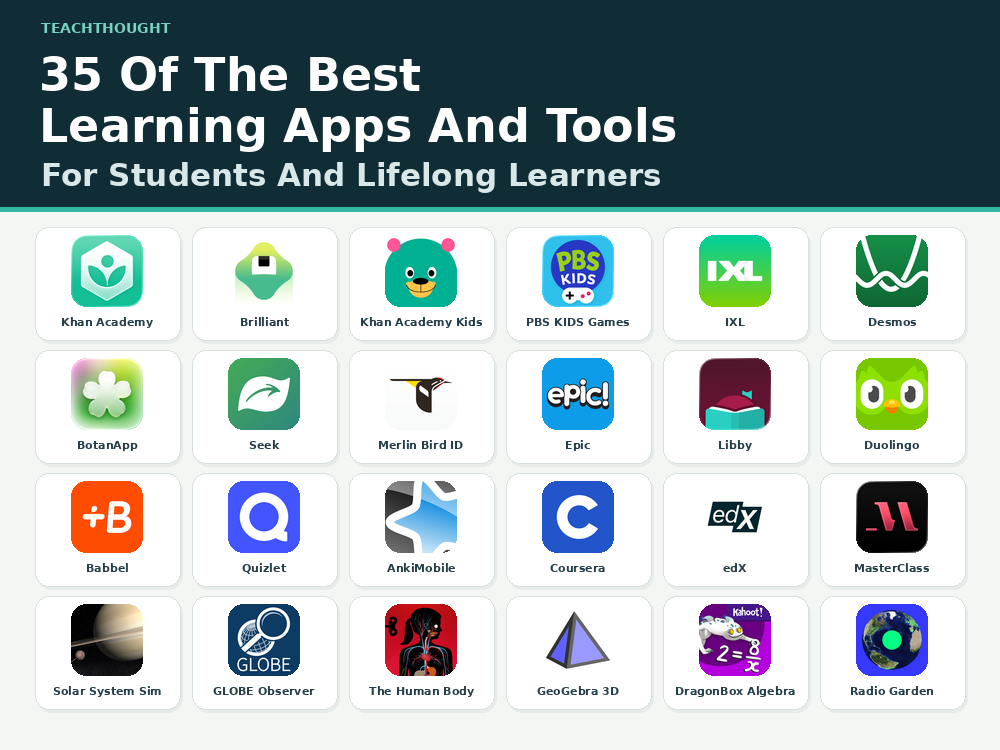
by TeachThought Staff
The best learning app depends on what you want to learn and how you want to learn it.
Some of the tools below explain a subject and offer practice. Others help you investigate the natural world, make something, read widely, contribute to research, or study material you have already encountered. This list includes mobile apps and browser-based tools; availability and features can differ between the two.
We tried to selected apps (and other tools) that offered clearly useful or otherwise engaging content, as well as a practical way to access them, and a distinctive reason to try them. The numbers organize the list rather than rank one kind of learning above another. Prices and access rules change, so check each provider before subscribing or assigning an app to students.
Khan Academy is a free learning platform with lessons and practice across mathematics, science, humanities, and other subjects.
- Short explanations and practice exercises make it useful for reviewing a specific concept or working through a course.
- Learners can track progress across devices; teachers can assign material and see where students need help.
Access: Web, iOS, and Android through the linked official download page.
Brilliant teaches mathematics, coding, data, and science through interactive problems rather than a lecture-first sequence.
- Visual puzzles and immediate feedback invite learners to test an idea before reading the explanation.
- Best suited to learners who want conceptual practice; full course access requires a subscription.
Access: Web, iOS, and Android through the linked official site.
Khan Academy Kids is a free early-learning app for young children, with books, games, and activities in reading, mathematics, and more.
- Designed for roughly ages 2–8, with activities that families and early-grade teachers can use.
- The app’s learning activities are free for families and individual teachers; school-level tools have separate terms.
Access: iOS and Android through the linked official page.
PBS KIDS Games brings together games based on familiar PBS characters for preschool and elementary-age children.
- Games span early mathematics, reading, science, and social skills, depending on the title.
- The games app is a better match for hands-on play than the separate PBS KIDS Video app.
Access: iOS and Android links are provided on the official apps page; many games can also be played on the web.
BrainPOP pairs short animated explanations with quizzes and activities across school subjects, primarily for grades 3–8.
- A topic can serve as a quick introduction before reading, discussion, or an investigation.
- Classroom and home access depend on the subscription or school license, so check what your account includes.
Access: Primarily web; see the official site for current mobile options.
IXL offers targeted practice in mathematics, language arts, science, social studies, and Spanish.
- Its many individual skills make it useful when a learner needs practice on one particular topic.
- Questions adapt and provide feedback, but the subscription and available subjects vary by plan.
Access: Web, iOS, and Android through the official site.
The Desmos Graphing Calculator is a free tool for exploring equations and mathematical relationships visually.
- Graph functions, plot points, use tables, and adjust sliders to see how a change in one value affects a graph.
- It works especially well when students use it to make a prediction and then test it.
Access: Web, iOS, and Android; start with the linked official calculator.
PhET offers free interactive simulations in science and mathematics from the University of Colorado Boulder.
- Learners can change variables and observe results in models of circuits, forces, molecules, fractions, and more.
- Teacher notes and activities help turn a simulation into an investigation with a question and a record of evidence.
Access: Free on the web; offline and mobile app options differ by device.
Scratch is a free block-based programming environment for creating interactive stories, animations, and games.
- Building a project asks learners to plan sequences, test behavior, and revise what does not work.
- Shared projects offer examples to inspect and remix, with community and account settings worth reviewing for younger users.
Access: Primarily web; an offline editor is available for supported desktop systems and Android tablets. There is no equivalent official iOS offline app.
Botan is a plant-identification and care app that uses a photograph to suggest a species and provide information about it.
- Plant profiles, care guidance, and problem-identification tools can prompt questions during a garden study or outdoor observation.
- Treat a photo identification as a lead to check against visible features and another source, especially when a plant may be harmful.
Access: Web, iOS, and Android through the linked official page; free access and premium features differ.
Seek helps users identify plants, animals, and fungi they encounter outdoors.
- The camera offers identification suggestions and information about organisms recorded nearby.
- Observation challenges can give a walk or field trip a focus; a suggested identification still merits a closer look.
Access: iOS and Android through the linked official page.
Merlin Bird ID is a free Cornell Lab of Ornithology app that helps users identify birds by appearance, photographs, or sound.
- Sound ID suggests birds it hears, making it useful for careful listening as well as visual observation.
- Photo ID and guided questions narrow possibilities; compare the result with location, season, and field marks.
Access: iOS and Android through the linked official page.
Epic is a digital reading library for children with ebooks, read-to-me books, and audiobooks.
- A broad selection lets young readers browse subjects and formats beyond a single classroom shelf.
- Teacher and family access work differently; check the current reading limits and subscription terms.
Access: Web, iOS, and Android through the linked official site.
Libby lets readers borrow ebooks, audiobooks, and magazines from participating public libraries.
- A library card provides access without an audiobook subscription, subject to the library’s catalog and lending limits.
- Reading settings, audio controls, and holds make it practical for sustained independent reading.
Access: iOS, Android, and web through the linked official page; a participating library card is needed.
Duolingo provides short, sequenced lessons for studying languages and practicing vocabulary and sentence patterns.
- Frequent review and listening, reading, speaking, or writing tasks make it easy to maintain a routine.
- Use conversation and authentic reading alongside it when the goal is to use a language beyond the app.
Access: Web, iOS, and Android through the official site; free and paid tiers are available.
Babbel offers structured language lessons with an emphasis on useful words, phrases, and conversations.
- Lessons build from common situations rather than relying only on isolated vocabulary drills.
- Course depth varies by language; check the language and subscription terms before committing.
Access: Web, iOS, and Android through the official site; primarily subscription-based.
Quizlet is a study tool for making, finding, and practicing digital flashcard sets.
- Learners can create their own sets, a useful step when deciding what a term or idea means in context.
- Practice and test modes offer different ways to retrieve information; review shared sets for accuracy before using them.
Access: Web, iOS, and Android through the official site; some study modes require payment.
Anki is a flashcard system that schedules review according to what a learner is likely to forget.
- Especially useful for material that must be retained over months, such as vocabulary, anatomy, or terminology.
- Making concise, accurate cards takes effort; the official AnkiMobile iOS app is paid, while the contributor-developed AnkiDroid Android app is free.
Access: Desktop and web, plus iOS and Android options linked from the official page.
Book Creator lets students and teachers make digital books that combine writing, images, audio, and video.
- Students can use the format to explain a concept, document research, or publish a story for an audience.
- A free teacher account has limits on library size; check collaboration and publishing settings before sharing student work.
Access: Browser-based creation and an iPad app; consult the official site for supported browsers and plans.
iCivics uses games, simulations, and classroom resources to teach how government and civic systems work.
- Games place students in roles involving elections, courts, lawmaking, and other civic decisions.
- Pair play with discussion or a written explanation so students connect game choices to actual civic concepts.
Access: Primarily web; some games offer tablet apps, as indicated on their individual pages.
Coursera hosts online courses and learning programs from universities, companies, and other providers.
- Courses can include video, readings, assignments, and longer certificate pathways for independent study.
- Access to materials, graded work, certificates, and financial aid differs by course or program; inspect the enrollment page.
Access: Web, iOS, and Android through the official site.
edX offers online courses in academic and professional subjects from universities and other institutions.
- Many courses allow an audit path for learning without a verified certificate, though access and duration vary.
- The mobile app supports course videos and progress tracking; some assessments must be completed in a browser.
Access: Web, iOS, and Android through the linked official mobile page.
MasterClass is a subscription video library in which notable practitioners teach subjects such as writing, cooking, music, and design.
- Lessons can expose learners to an expert’s decisions, methods, and perspective in a field.
- It is strongest as creative or professional enrichment; viewers will need to practice the skill beyond watching lessons.
Access: Web, iOS, and Android through the official site; subscription required for full access.
Solar System Sim is an iOS space sandbox for exploring celestial bodies and experimenting with gravity and orbital motion.
- Change or add bodies to see how their mass and motion affect a simulated system; the freedom to experiment is its main learning value.
- The physics sandbox is useful for asking “what if,” but distinguish playful simulations from precise predictions of real events.
Access: iPhone and iPad via the linked App Store listing; free download with in-app purchases.
NASA’s Eyes is a browser-based 3D environment for exploring the solar system, spacecraft, Earth, and other NASA data.
- Follow real missions and inspect where spacecraft and planetary objects are in a visual model.
- Pair the simulation with a research question, such as why a mission follows a particular path or what its instruments observe.
Access: Web browser; no separate iOS or Android app is required.
GLOBE Observer is a citizen-science app through which people record environmental observations for research.
- Guided protocols cover clouds, land cover, trees, and mosquito habitats, depending on location and current projects.
- Students can contribute observations from their own surroundings and discuss what makes data reliable and useful.
Access: iOS and Android links are on the official page; some activities require location and camera permissions.
OneZoom is a zoomable tree of life that visualizes relationships among species.
- Move from a broad branch to individual organisms to investigate how living things are related.
- It is particularly useful for questions about common ancestors, classification, and the limits of familiar “family tree” analogies.
Access: Web browser, including on many mobile devices.
Polypad is a digital mathematics workspace filled with movable shapes, fraction pieces, number tiles, and other manipulatives.
- Learners can build and change representations instead of only selecting an answer.
- Teachers can create visual tasks about fractions, algebra, geometry, probability, and patterns, then share the workspace.
Access: Web browser; free to use.
GeoGebra 3D Calculator lets learners create and manipulate three-dimensional objects, surfaces, and graphs.
- Rotating a construction can make spatial relationships visible that are difficult to infer from a flat diagram.
- It is strongest for geometry and later mathematics when learners test a conjecture by changing an object.
Access: Web, iOS, and Android; the official download page lists current apps.
The Human Body is an interactive model that lets children explore body systems by touching and changing what happens on screen.
- Users can investigate digestion, circulation, breathing, hearing, and vision through playful cause-and-effect interactions.
- Its open-ended design rewards curiosity; adults can help children turn observations into questions and explanations.
Access: iOS and Android via links on the official product page; purchase or in-app terms vary by version.
DragonBox Algebra 12+ turns algebraic transformations into a sequence of visual puzzles that gradually introduce formal notation.
- Moving and balancing elements gives learners a way to reason about equations before relying on memorized procedures.
- It is a focused algebra game rather than a broad mathematics curriculum; check the current Kahoot! account or subscription terms.
Access: iOS and Android options are linked from the official product page.
Musicca is a browser-based collection of interactive exercises for learning music theory and reading notation.
- Practice identifying notes, rhythms, intervals, chords, and other concepts with immediate feedback.
- Virtual instruments let beginners connect symbols to sounds, though playing a physical instrument adds another kind of practice.
Access: Web browser, including on mobile devices; core exercises are free.
Zooniverse connects volunteers with research projects that need people to classify images, transcribe records, or examine data.
- Projects span fields such as astronomy, ecology, history, and literature, giving learners a view of how evidence is collected.
- Choose a project that fits the learner’s age and reading level; not every project is available or equally usable in the mobile app.
Access: Web, iOS, and Android; begin with the linked official project directory.
Radio Garden is an interactive globe that lets listeners tune in to live radio stations around the world.
- Moving between cities makes a concrete starting point for exploring languages, music, local news, and time zones.
- A useful learning task is to compare what different stations broadcast at the same moment and investigate the places behind them.
Access: Web, iOS, and Android; live broadcasts are uncurated and may include advertising or unsuitable content.
Explore.org hosts live camera feeds from wildlife habitats and other locations that users can observe remotely.
- Repeated observations can help learners notice animal behavior, seasonal change, and the limits of a single snapshot.
- A brief observation log or a question about what is happening makes the feed more useful than passive viewing.
Access: Web browser; live feeds and schedules vary.
The right choice may be a free simulation for one lesson, a library app used all year, or a course pursued over several months. Begin with the learning goal, the learner’s age, and the kind of practice or feedback the tool actually provides.
Related reading: The Best Education Apps for Android. That separate list focuses on Android choices; the entries above cover learning tools across platforms.
Recent Comments