
 Lake George, NY resident Harrison Bird (1910-2003) belonged to a rare class of historians, those whose situate the local within the continental and, indeed, the global.
In four books published by Oxford University Press – Navies in the Mountains (1962), March to Saratoga (1963), Battle for a Continent (1965) and Attack on Quebec (1968) – Bird wrote about Lake George, Lake Champlain, Fort Ticonderoga, Saratoga, Quebec and the northern waterways not as isolated historic sites, but as parts of one strategic corridor: the route by which empires, armies, navies and ambitions moved between Canada and the Hudson Valley.
Harrison K. Bird Jr.’s own life helps explain the authority of his historical imagination. Born in 1910, educated at Deerfield Academy and Williams College, he later crossed into Canada during the Second World War and enlisted in the Canadian Army’s Lake Superior Regiment. He served as Captain Harrison Bird and was decorated for meritorious service, including two Military Crosses.
 After the war he lived and worked in Europe before settling with his wife on his family’s Lake George homestead. He was active in regional institutions, including Fort Ticonderoga, the Lake George Park Commission and The Company of Military Historians.
He was not merely writing about a landscape; he lived within it, served organizations dedicated to preserving it, and understood military life from within.
The four books produced by Bird Between 1962 and 1968 form a sustained interpretation of the Lake Champlain-Lake George-Hudson River corridor in the eighteenth century.
Navies in the Mountains told the story of naval warfare on Lake Champlain and Lake George from Samuel de Champlain’s era through the War of 1812.
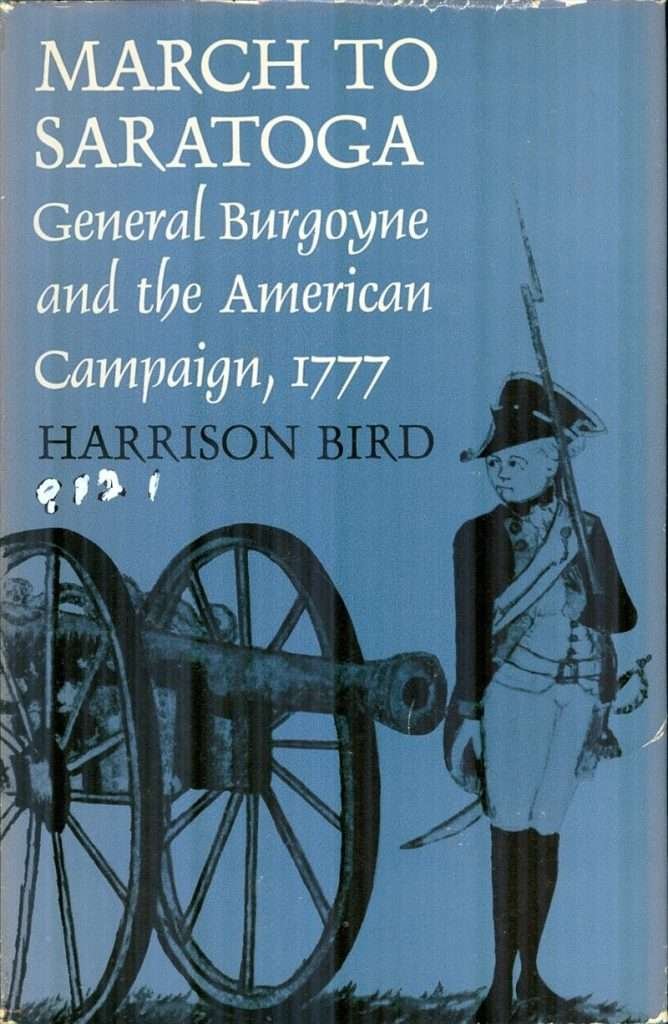
March to Saratoga narrowed the focus to Burgoyne’s 1777 campaign, the British attempt to move south from Canada and split the colonies by controlling the Hudson River.
Battle for a Continent widened the lens to the French and Indian War, presenting the North American conflict as a struggle whose outcome would determine the fate of empire.
Attack on Quebec returned to the northern invasion route in the first year of the Revolution, when American hopes of bringing Canada into rebellion ended before Quebec’s walls.
The reviews of Bird’s books show how he was received in his own time. Reviewers repeatedly emphasized his gifts as a narrative historian. He was praised for making military campaigns vivid, intelligible and human.
March to Saratoga was commended for combining the skill of a novelist with the accuracy of a trained historian. Battle for a Continent was described as vivid historical reporting, distinguished by command of military detail and attention to the personalities who shaped events.
 Even where reviewers were more cautious, as with Attack on Quebec, they recognized Bird as an authority on the American Revolution and acknowledged the usefulness of his work for students.
Bird’s chief contribution was to make Northern New York visible as a central theater of eighteenth-century history. Popular accounts of the French and Indian War and the American Revolution often gravitate toward Quebec, Boston, Philadelphia, Yorktown or the Ohio Valley.
Bird insisted, through repeated narrative attention, that Lake George, Lake Champlain, Ticonderoga, Crown Point, Fort Edward, Saratoga and the routes toward Montreal and Quebec were not peripheral. They were the hinges on which imperial and revolutionary strategy turned.
He also helped readers understand that the region’s geography was destiny. The lakes were not scenic backdrops; they were highways. The portages, rivers, forts and narrow passages governed what armies could attempt and what navies could control.
In Bird’s telling, Northern New York was a military landscape shaped by water, weather, terrain, logistics and human endurance. Campaigns succeeded or failed not only because of grand strategy but because boats could be built, bateaux moved, roads cut, supplies delivered, soldiers fed, and commanders persuaded to act before the season closed.
Bird’s histories were not primarily analytical in the academic sense. Their strength lay elsewhere: in narrative reconstruction, character, movement and scene. He made generals, rangers, sailors, militia, regulars, Indigenous allies and provincial leaders part of a continuous drama.
His prose brought readers close to the march, the siege, the lake crossing, the fort, the winter road and the battlefield. That accessibility mattered. By translating complex campaigns into readable history, he helped preserve public understanding of events that shaped the region but could easily recede into specialist literature.
 His work also joined the French and Indian War to the American Revolution as connected chapters in the history of the northern corridor. The same places recur: Lake George, Lake Champlain, Ticonderoga, Fort Edward, the Hudson, Montreal, Quebec. The same strategic problem recurs: whoever controlled the corridor controlled the continent, or at least the parts that were inhabited.
For Lake George and its neighboring communities, Bird’s legacy is especially important. He gave the region a literature equal to its history. He showed that the familiar local names on roadsides, monuments and fort ruins belonged to a story of imperial rivalry and national creation.
His books remain valuable not because they represent the final word on these subjects, but because they made the corridor legible to general readers and restored drama, consequence and continuity to a landscape often treated as a collection of separate historic sites.
Harrison Bird’s contribution was, in the end, both historical and civic. He helped Northern New York remember itself as a place where the fate of empires and revolutions was contested by water and by land. He wrote with the instincts of a soldier, the attachment of a resident and the craft of a storyteller.
Through his books, the Lake Champlain-Lake George-Hudson River corridor emerges not as a remote frontier, but as one of the great avenues of eighteenth-century American history.
A version of this article first appeared on the Lake George Mirror, America’s oldest resort paper, covering Lake George and its surrounding environs. You can subscribe to the Mirror HERE.
Harrison Bird’s books are increasingly rare for copies connect to your local bookstore using Bookshop.org and support both your local independent bookstore and New York Almanack’s mission to report new publications relevant to New York State. Purchases via the Amazon links above also support the Almanack.
Recent Comments