
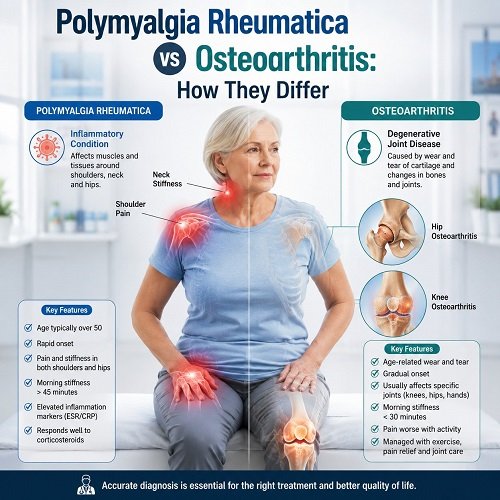
Pain and stiffness can become more common with age, but not all types of pain have the same cause. Polymyalgia Rheumatica vs Osteoarthritis is an important comparison because both conditions can cause discomfort, stiffness and difficulty with everyday movement, yet they affect the body in very different ways.
Polymyalgia rheumatica (PMR) is an inflammatory condition that typically causes aching and stiffness around the shoulders, neck and hips. It usually develops relatively quickly and is particularly common in adults over 50. Osteoarthritis (OA), on the other hand, is a long-term joint condition associated with changes and breakdown of cartilage and other joint tissues. It commonly affects the knees, hips, hands and spine.
Understanding the differences between these conditions can help you recognise important warning signs and know when to seek medical advice.
What is Polymyalgia Rheumatica?
What is Polymyalgia Rheumatica? Polymyalgia rheumatica is an inflammatory condition that mainly causes pain and stiffness around the shoulders, neck and hips. It generally affects adults over 50 and is particularly common among older adults. PMR is very uncommon in people younger than 50.
Unlike osteoarthritis, Polymyalgia Rheumatica is not primarily caused by gradual structural damage inside a joint. Inflammation is an important part of the condition. The tissues around the shoulders and hips, including bursae, may contribute to the pain and stiffness associated with PMR.
Polymyalgia Rheumatica Symptoms can appear fairly quickly, sometimes over several days or weeks. Both sides of the body are usually affected. Morning stiffness is particularly characteristic and often lasts more than 45 minutes.
Some people also experience:
- Significant tiredness
- Reduced appetite
- Unintentional weight loss
- Low mood
- Difficulty getting dressed
- Difficulty getting out of a chair or car
- Difficulty raising the arms
The sudden development of severe shoulder and hip stiffness in an older adult should therefore not automatically be attributed to normal ageing or osteoarthritis.
What Is Osteoarthritis?
Osteoarthritis is the most common form of arthritis. It develops as the tissues within a joint change and break down over time. Although it is sometimes described simply as “wear and tear”, osteoarthritis is more complicated than ordinary mechanical wear. Changes can affect cartilage, bone, tendons, ligaments and the joint lining.
OA can affect almost any joint, but the knees, hips, hands, neck and lower back are among the commonly affected areas. Symptoms often develop gradually and may initially affect only one or a few joints.
Common osteoarthritis symptoms include:
- Joint pain
- Joint stiffness
- Tenderness
- Swelling
- Reduced range of movement
- A grinding or crackling sensation
- Joint instability in some cases
The pattern of pain can also provide clues. OA pain often becomes worse when the affected joint is used and may improve with rest, particularly in earlier disease. Morning stiffness is generally brief, often lasting less than 30 minutes.
Polymyalgia Rheumatica vs Osteoarthritis: The Main Difference
The simplest way to understand Polymyalgia Rheumatica vs Osteoarthritis is to consider what is driving the symptoms.
PMR is primarily an inflammatory condition, whereas osteoarthritis is primarily associated with structural changes and degeneration within joints.
| Feature | Polymyalgia Rheumatica | Osteoarthritis |
| Main problem | Inflammation | Joint tissue changes and damage |
| Typical age | Usually over 50 | More common with increasing age |
| Onset | Often relatively rapid | Usually gradual |
| Main areas | Shoulders, neck and hips | Knees, hips, hands, spine and other joints |
| Distribution | Usually both sides | Often one or several joints |
| Morning stiffness | Often prolonged, commonly >45 minutes | Usually brief, often <30 minutes |
| Pain pattern | Often prominent at rest and in the morning | Often worse with joint use |
| Whole-body symptoms | Fatigue, appetite loss or weight loss may occur | Usually less prominent |
| Blood inflammation markers | Often elevated, although not always | Usually not a defining feature |
| Typical treatment approach | Corticosteroids under medical supervision | Exercise, lifestyle measures, pain relief and other joint treatments |
This comparison is useful, but symptoms can overlap. A doctor may need to consider several possible causes before making a diagnosis.
How Does the Pain Differ?
Pain location and behaviour are important when comparing these conditions.
Polymyalgia Rheumatica pain
Polymyalgia Rheumatica commonly produces aching and stiffness in the shoulders and upper arms, neck and hip region. Symptoms are frequently symmetrical, meaning both sides are affected.
The stiffness is often particularly severe after waking. A person may struggle to turn over in bed, get dressed, raise their arms or stand up from a chair.
Importantly, PMR can cause significant discomfort without producing the obvious joint changes associated with osteoarthritis. The American College of Rheumatology notes that PMR does not typically cause joint swelling.
Osteoarthritis pain
OA pain is usually more closely related to the affected joint. For example, knee OA may cause pain while walking, climbing stairs or standing up. Hip OA can cause pain around the hip or groin and may limit movement.
Hands affected by OA may develop characteristic bony enlargements and changes in joint shape over time. Knee OA can cause grinding or crackling sensations during movement.
This difference in pain behaviour can be useful, but it is not enough to diagnose either condition on its own.
Morning Stiffness: A Key Clue
Morning stiffness is one of the most useful clues when considering Polymyalgia Rheumatica vs Osteoarthritis.
With PMR, stiffness can be intense and prolonged. NHS guidance identifies morning muscle stiffness lasting longer than 45 minutes as a major symptom.
In osteoarthritis, stiffness after waking or periods of inactivity is generally shorter. NIAMS reports that OA stiffness typically lasts less than 30 minutes.
For example:
PMR:
A person wakes up feeling extremely stiff and finds it difficult to get dressed or raise their arms. The stiffness gradually improves as they become more active.
OA:
A person may feel stiff when first getting out of bed or after sitting for a while, but the stiffness often improves relatively quickly with movement.
These patterns are helpful clues, not definitive diagnostic tests.
Which Joints Are Usually Affected?
The distribution of symptoms is another important distinction.
Polymyalgia rheumatica
Polymyalgia Rheumatica mainly affects areas around:
- Shoulders
- Upper arms
- Neck
- Hips
- Thighs
Both sides are commonly affected.
Osteoarthritis
OA can affect many different joints, especially:
- Knees
- Hips
- Hands
- Fingers
- Neck
- Lower back
Unlike PMR, OA often begins in one joint or a small number of joints.
Therefore, an older person with sudden, symmetrical shoulder and hip stiffness may have a different problem from someone with slowly worsening knee or hand pain.
Causes and Risk Factors
The causes of Polymyalgia Rheumatica and OA are also different.
The exact cause of PMR remains uncertain. Researchers believe genetic and environmental factors may contribute to its development. It is strongly associated with older age.
Osteoarthritis has multiple risk factors. Increasing age is important, but previous joint injury, excess body weight, abnormal joint structure, family history and repetitive stress can also increase the likelihood of developing OA.
This means that simply being older does not mean every new episode of joint pain is osteoarthritis.
How Are They Diagnosed?
Neither condition should be diagnosed based solely on symptoms found online.
Diagnosing Polymyalgia Rheumatica
Doctors generally consider:
- The person’s age
- Speed of symptom development
- Location and pattern of pain
- Duration of morning stiffness
- Physical examination
- Blood tests for inflammation
- Other possible diagnoses
Tests such as erythrocyte sedimentation rate (ESR) and C-reactive protein (CRP) can help identify inflammation. However, there is no single test that independently confirms PMR.
Doctors may also need to rule out other conditions that can produce similar arthritis symptoms or muscle and joint pain.
Diagnosing osteoarthritis
OA is commonly diagnosed using symptoms, medical history and physical examination. X-rays may show changes such as narrowing of the joint space, bone remodelling and bone spurs. Blood tests are sometimes used to rule out other causes rather than to directly diagnose OA.
Not everyone with OA needs imaging immediately. The diagnosis depends on the overall clinical picture.
Treatment Differences
One of the most important differences between PMR and OA is their treatment.
Treating polymyalgia rheumatica
Corticosteroids are the main treatment for Polymyalgia Rheumatica. Prednisolone is commonly prescribed, and symptoms can improve significantly within a few days when treatment is effective. The dose is usually reduced gradually under medical supervision.
Because corticosteroids can cause side effects, people taking them for an extended period need appropriate monitoring. Possible concerns include osteoporosis, high blood pressure, weight gain, cataracts and other complications.
Treatment should therefore always be guided by a healthcare professional.
Treating osteoarthritis
There is currently no cure that reverses established OA, but many treatments can reduce symptoms and improve function.
Management may include:
- Regular physical activity
- Strengthening exercises
- Weight management when appropriate
- Physiotherapy
- Pain-relieving medicines
- Topical treatments
- Supportive devices
- Joint injections in selected circumstances
- Surgery, including joint replacement, when severe joint damage significantly affects quality of life
Exercise is considered one of the most important treatments for OA because it can improve muscle strength, mobility and pain.
Can You Have Both PMR and Osteoarthritis?
Yes. Having osteoarthritis does not prevent someone from developing polymyalgia rheumatica.
This can make diagnosis more challenging, particularly in older adults who already have chronic knee, hip or hand pain.
For example, a person might have longstanding knee osteoarthritis but then suddenly develop severe morning stiffness in both shoulders and hips. The new symptoms should not automatically be blamed on existing OA.
Similarly, someone with PMR may also have age-related joint changes.
The key is to assess the new pattern of symptoms, rather than assuming that every new episode of pain comes from a previously diagnosed condition.
When Should You See a Doctor?
Persistent or unexplained pain and stiffness should be assessed by a healthcare professional, particularly when symptoms interfere with normal activities.
Seek medical advice if:
- Shoulder, hip or neck stiffness persists
- Morning stiffness is prolonged
- Pain develops suddenly over several days or weeks
- You experience unexplained weight loss
- You have unusual fatigue or loss of appetite
- Joint pain is progressively worsening
- Pain interferes with sleep, walking or daily activities
There is an especially important warning for people with suspected or diagnosed Polymyalgia Rheumatica.
PMR can occur alongside giant cell arteritis, a condition that can require urgent treatment. New headaches, scalp tenderness, jaw pain while eating or speaking, double vision or vision loss require urgent medical attention.
Polymyalgia Rheumatica vs Osteoarthritis: What Should You Remember?
The distinction between these conditions becomes clearer when you consider the overall pattern.
PMR typically produces rapid-onset, symmetrical aching and prolonged morning stiffness, particularly around the shoulders, neck and hips. It is an inflammatory condition and is strongly associated with older age.
Osteoarthritis usually produces gradually developing pain and stiffness in specific joints, particularly the knees, hips, hands and spine. Symptoms often become more noticeable with activity, and morning stiffness tends to be shorter.
The difference between inflammatory pain and pain associated with structural joint changes can provide an important clue, but symptoms can overlap. A healthcare professional may need blood tests, imaging or additional investigations to determine the cause.
Frequently Asked Questions
Is polymyalgia rheumatica the same as osteoarthritis?
No. PMR is an inflammatory condition that mainly causes pain and stiffness around the shoulders, neck and hips. Osteoarthritis is a joint condition involving changes and breakdown of tissues within affected joints.
Which causes worse morning stiffness?
PMR generally causes more prolonged morning stiffness. It commonly lasts longer than 45 minutes, whereas OA stiffness is usually shorter.
Can osteoarthritis cause shoulder pain?
Yes. Osteoarthritis can affect the shoulder, although knees, hips, hands and other joints are more commonly involved. Shoulder pain can also have many other causes, so persistent symptoms should be assessed.
Does Polymyalgia Rheumatica cause joint damage?
PMR is primarily an inflammatory condition affecting tissues around the shoulders, hips and other areas rather than being a degenerative joint-damage disorder like osteoarthritis.
Does exercise help Polymyalgia Rheumatica?
Once PMR is appropriately treated and symptoms are controlled, maintaining appropriate physical activity can support mobility and general health. However, people with significant new pain and stiffness should obtain medical advice before starting or changing an exercise programme.
Can Polymyalgia Rheumatica go away?
PMR often improves over time, but treatment may be required for an extended period. Symptoms can return after treatment has stopped, so medical follow-up is important.
Final Thoughts
When comparing Polymyalgia Rheumatica vs Osteoarthritis, the most important differences involve the cause, symptom pattern, affected areas and treatment.
PMR tends to develop relatively quickly and causes pronounced, symmetrical shoulder and hip stiffness, particularly in the morning. Osteoarthritis usually develops gradually and produces pain and stiffness focused around affected joints.
Because both conditions can occur in older adults, distinguishing between them is important. New or rapidly developing symptoms should not simply be dismissed as ageing or existing arthritis.
If you are experiencing persistent joint pain, prolonged morning stiffness or other unexplained arthritis symptoms, speak with a healthcare professional. An accurate diagnosis is the first step towards receiving appropriate treatment and protecting your mobility and quality of life.
Medical disclaimer
This article is for general educational purposes and does not replace an assessment by a qualified healthcare professional. Persistent or unexplained pain and stiffness should be evaluated by a doctor.
Recent Comments