
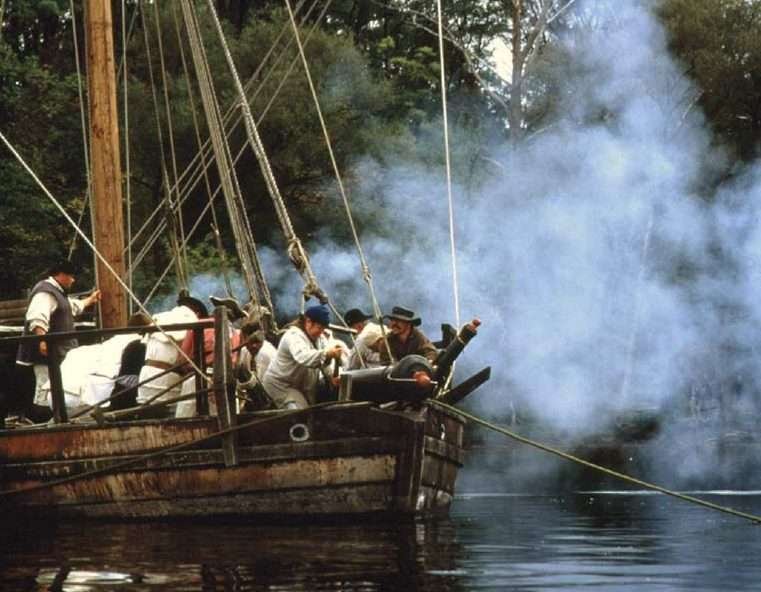
 Towards the evening of the Battle of Valcour Bay on October 11, 1776, the HMS Inflexible got within point-blank shot of the Americans, “when five broadsides,” wrote Sir Charles Douglas, “silenced their whole line.”
One fresh ship, with scantling [a design] for sea-going, and a concentrated battery, has an unquestioned advantage over a dozen light-built craft, carrying one or two guns each, and already several hours engaged in battle.
[HMS Inflexible was a British sloop-of-war built at St John’s and launched October 1, 1776, ten days before the battle. It had been partially pre-fabricated in England, dismantled, hauled overland in sections and reassembled. It measured about 60 feet by 20 feet with a displacement and was armed with 18 twelve-pounder cannons. During the Battle of Valcour Island she was commanded by John Schank.]
[Sir Charles Douglas (1727–1789) served as the Captain-of-the-Fleet (Chief-of-Staff) and chief advisor to British Admiral George Brydges Rodney during the American War of Independence. He was later well-known for the part he played in the Battle of the Saintes (aka the Battle of Dominica), fought between the British and French navies on April 9–12, 1782 off the small Caribbean Island of Dominica.]
At nightfall the Inflexible dropped out of range, and the British squadron anchored in line of battle across the southern end of the passage between the island and the main; some vessels were extended also to the eastward, into the open Lake Champlain.
“The best part of my intelligence,” wrote General John Burgoyne the next day from St. John’s, to Douglas at Quebec, “is that our whole fleet was formed in line above the enemy, and consequently they must have surrendered this morning, or given us battle on our own terms. The Indians and light troops are abreast with the fleet; they cannot, therefore, escape by land.”
T he British squadron sharing this confidence, a proper look-out was not kept. The American leader Benedict Arnold immediately held a conference with his officers, and decided to attempt a retreat, “which was done with such secrecy,” writes Brigadier General David Waterbury [(1723–1801), from Connecticut], “that we went through them entirely undiscovered.”
The movement began at 7 pm, a galley leading, the gondolas and schooners following, and Arnold and his second bringing up the rear in the two heaviest galleys. This delicate operation was favored by a heavy fog, which did not clear till next morning at eight.
As the Americans stole by, they could not see any of the hostile ships. By daylight they were out of sight of the British. German Major General Friedrich Adolf Riedesel, speaking of this event, says, “The ships anchored, secure of the enemy, who stole off during the night, and sailing round the left wing, aided by a favourable wind, escaped under darkness.”
[Baron Friedrich Adolf Riedesel zu Eisenbach (1738–1800) was a general officer of the Principality of Brunswick-Wolfenbüttel who commanded the Brunswick Corps in the Northern theater of the Revolutionary War. His wife Charlotte famously kept a journal of her travels with him.]
The astonishment next morning, Riedesel continues, was great, as was Sir Guy Carleton’s rage. The latter started to pursue in such a hurry that he forgot to leave orders for the troops which had been landed; but, failing to discover the fugitives, he returned and remained at Valcour till nightfall, when scouts brought word that the enemy were at Schuyler’s Island, eight miles above.
 [General Sir Guy Carleton was the Governor General of Canada and commander of the British northern forces, he was the strategic mastermind behind the push down Lake Champlain.]
The retreat of the Americans had been embarrassed by their injuries, and by the wind coming out ahead. They were obliged to anchor on the 12th to repair damages, both hulls and sails having suffered severely.
Arnold took the precaution to write to Crown Point for bateaux, to tow in case of a southerly wind; but time did not allow these to arrive. Two gondolas had to be sunk on account of their injuries, making three of that class so far lost.
[The Americans had rowed about eight miles south up Lake Champlain to Schuyler Island where the sank the damaged gunboats Providence and Jersey.]
The retreat was resumed at 2 pm on October 12th, but the breeze was fresh from the southward, and the gondolas made very little way. At evening the British chased again. That night the wind moderated, and at daybreak the American flotilla was 28 miles from Crown Point, — 14 mile from Valcour Island – having still five miles’ head start.
Later, however, by Arnold’s report, “the wind again breezed up to the southward, so that we gained very little either by beating or rowing. At the same time the enemy took a fresh breeze from northeast, and, by the time we had reached Split Rock, were alongside of us.”
The galleys of Arnold and Waterbury, the Congress and the Washington, had throughout been kept in the rear, and now received the brunt of the attack, made by the Inflexible and the two schooners, which had entirely distanced their sluggish consorts.
This fight was in the upper narrows, where the Lake is from one to three miles wide; and it lasted, by Arnold’s report, for five glasses (two hours and a half), the Americans continually retreating, until about ten miles from Crown Point.
There, the Washington having struck [surrendered] some time before, and final escape being impossible, Arnold ran the Congress and four gondolas ashore in a small creek on the east side; pulling to windward, so that the enemy could not follow him — except in small boats with which he could deal.
[This was at Buttonmould Bay (historically spelled Button-Mould or Buttonmold Bay), a shallow, rocky inlet on the Vermont shore in what is now Ferrisburgh. Today, the exact site where he ran the vessels aground is known as Arnold’s Bay.]
 There he set his vessels on fire, and stood by them until assured that they would blow up with their flags flying. He then retreated to Crown Point through the woods, “despite the savages,” he wrote.
In three days of fighting and retreating the Americans had lost one schooner, two galleys, and seven gondolas [gunboats], — in all, ten vessels out of fifteen.
The killed and wounded amounted to over 80, twenty-odd of whom were in Arnold’s galley. The original force, numbering 700, had been decimated.
Considering its raw material and the recency of its organization, words can scarcely exaggerate the heroism of the resistance, which undoubtedly depended chiefly upon the personal military qualities of the leader. The British loss in killed and wounded did not exceed 40.
The little American navy on Lake Champlain was wiped out; but never had any force, big or small, lived to better purpose or died more gloriously, for it had saved the Lake for that year.
Whatever deductions may be made for blunders, and for circumstances of every character which made the British campaign of 1777 abortive and disastrous, thus leading directly to the American alliance with France in 1778, the delay, with all that it involved, was obtained by the Lake Champlain Campaign of 1776.
Read more about the Lake Champlain Campaign of 1776
This essay is an excerpt from A.T. Mahan’s The Major Operations of the Navies in the War of American Independence (1913). It has been lightly edited for clarity and annotated by John Warren.
Illustrations, from above: Battle of Valcour Island reenactors fire a cannon on board the Lake Champlain Maritime Museum’s replica gunboat Philadelphia II (courtesy LCMM); Portrait of Benedict Arnold by Thomas Hart, 1776 (Anne S.K. Brown Collection at Brown University); and Benedict Arnold and his men make fro Crown Point in a painting by Colonel Charles Waterhouse.
Recent Comments