
 In 1775, only fifteen years had elapsed since the expulsion of the New France from Canada following the French and Indian War (1754-1763). The concentration of French power in the valley of the St. Lawrence had impressed upon the minds of colonial leaders the importance of Lake Champlain, of its tributary Lake George, and of the Hudson River, as forming a consecutive, if not continuous, water line of communications from the St. Lawrence River to the city of New York.
The strength of Canada against attack by land lay in its remoteness, in the vast forests to be traversed before it was reached, and in the strength of the line of the St. Lawrence, with the fortified posts of Montreal and Quebec on its northern bank.
 The Northern Forest offered passive resistance to attacks from Canada, as well as to attacks upon it; but when it had been traversed, there were to the southward no such strong natural positions confronting the assailant.
Attacks from the south fell upon the front, or at best upon the flank, of the line of the St. Lawrence. Attacks from Canada took New York and its dependencies in the rear.
[The most important natural strongpoints in New York were just three: the narrowing of Lake Champlain at Crown Point (Forts St. Frederic and Crown Point); a further narrowing at the confluence of the lakes at Ticonderoga (Forts Carillon and Ticonderoga); and the narrowing of the Hudson River at West Point (Fortress West Point).]
[Between Fort George (formerly William Henry) at the southern end of Lake George and Albany, numerous other smaller fortifications and fortified buildings of varying degrees of readiness and usefulness could be found along the upper Hudson River Valley. Read about them here.]
These elements of natural strength, in the military conditions of the North, were impressed upon the minds of the Americans by the prolonged resistance of Canada to the greatly superior numbers of the British Colonists in the previous wars.
Regarded as a base for attacks of a kind with which they were painfully familiar, but to be fought now by colonials under disadvantages of numbers and power never before experienced, it was desirable to gain possession of the St. Lawrence and its posts before they were strengthened and garrisoned.
At this outset of hostilities, the American insurgents, knowing clearly their own minds, possessed the advantage of the initiative over the British government, which still hesitated to use against those whom it styled rebels the preventive measures it would have taken at once against a recognized enemy.
Taking Forts Ticonderoga & Crown Point
Under these circumstances, in May, 1775, a body of two hundred and seventy Americans, led by Ethan Allen and Benedict Arnold, seized the posts of Ticonderoga and Crown Point, which were inadequately garrisoned.
These are on the upper waters of Lake Champlain, where it is less than a third of a mile wide; Ticonderoga being on a peninsula formed by the lake and the inlet from Lake George, Crown Point on a promontory twelve miles lower down [north, as Champlain flows north].
They were positions of recognized importance, and had been advanced posts of the British in previous wars. A schooner being found there, Benedict Arnold, who had been a seaman, embarked in her and hurried to the foot of the lake. The wind failed him when still thirty miles from St. John’s, another fortified post on the lower narrows in Canada, where the lake gradually tapers down to the Richelieu River, its outlet to the St. Lawrence.
 Unable to advance otherwise, Arnold took to his boats with thirty men, pulled through the night, and at six o’clock on the following morning surprised the post, in which were only a sergeant and a dozen men. He reaped the rewards of celerity.
The prisoners informed him that a considerable body of troops was expected from Canada, on its way to Ticonderoga; and this force in fact reached St. John’s on the next day. When it arrived, Arnold was gone, having carried off a sloop which he found there and destroyed everything else that could float.
By such trifling means two active officers had secured the temporary control of the lake itself and of the approaches to it from the south. There being no roads, the British, debarred from the water line, were unable to advance.
Sir Guy Carleton, Governor and Commander-in-Chief in Canada, strengthened the works at St. John’s, and built a schooner; but his force was inadequate to meet that of the Americans.
The Invasion of Quebec
The seizure of the two posts, being an act of offensive war, was not at once pleasing to the Continental Congress, which still clung to the hope of reconciliation; but events were marching rapidly, and ere summer was over the invasion of Canada was ordered.
General Richard Montgomery, appointed to that enterprise, embarked at Crown Point with two thousand men on September 4th, and soon afterwards appeared before St. John’s, which after prolonged operations capitulated on the 3rd of November. On the 13th Montgomery entered Montreal, and thence pressed down the St. Lawrence to Pointe aux Trembles, twenty miles above Quebec.
There he joined Arnold, who in the month of October had crossed the northern wilderness, between the head waters of the Kennebec River and St. Lawrence. On the way he had endured immense privations, losing five hundred men of the twelve hundred with whom he started; and upon arriving opposite Quebec, on the 10th of November, three days had been unavoidably spent in collecting boats to pass the river.
 Crossing on the night of the 13th, this adventurous soldier and his little command climbed the Heights of Abraham by the same path (Anse-au-Foulon) that had served British General James Wolfe so well sixteen years before in 1759.
With characteristic audacity he demanded surrender, and of course was refused; but that Sir Guy Carleton did not fall at once upon the little band of seven hundred that bearded him shows by how feeble a tenure Great Britain then held Canada.
Immediately after the junction Montgomery advanced on Quebec, where he appeared on the 5th of December.
Winter having already begun, and neither his numbers nor his equipment being adequate to regular siege operations, he decided to try the desperate chance of an assault upon the strongest fortress in America.
This was made on the night of December 31st, 1775. Whatever possibility of success there may have been vanished with the death of Montgomery, who fell at the head of his men.
The Arrival of the British Fleet
Following the failed attack on Quebec City, the American army retired three miles [west] up the St. Lawrence River, went into winter-quarters, and established a land blockade of Quebec, which was cut off from the sea by the ice.
 “For five months,” wrote Sir Guy Carleton to the British Secretary for War on the 14th of May, 1776, “this town has been closely invested by the rebels.”
From this unpleasant position it was relieved on the 6th of May, when signals were exchanged between it and the Surprise, the advance ship of a squadron under Captain Charles Douglas, which had sailed from England on the 11th of March.
[Sir Charles Douglas (1727–1789) served as the Captain-of-the-Fleet (Chief-of-Staff) and chief advisor to British Admiral George Brydges Rodney during the American War of Independence. He was later well-known for the part he played in the Battle of the Saintes (aka the Battle of Dominica), fought between the British and French navies on April 9–12, 1782 off the small Caribbean Island of Dominica.]
Arriving off the mouth of the St. Lawrence River on the morning of April 12th, Douglas found ice extending nearly twenty miles to sea, and packed too closely to admit of working through it by dexterous steering. The urgency of the case not admitting delay, he ran his ship, the Isis, with a speed of five knots, against a large piece of ice about ten or twelve feet thick, to test the effect.
The ice, probably softened by salt water and salt air, went to pieces. “Encouraged by this experiment,” continues Douglas, somewhat magnificently, “we thought it an enterprise worthy an English ship of the line in our King and country’s sacred cause, and an effort due to the gallant defenders of Quebec, to make the attempt of pressing her by force of sail, through the thick, broad, and closely connected fields of ice, to which we saw no bounds towards the western part of our horizon.
“Before night (when blowing a snow-storm, we brought-to, or rather stopped), we had penetrated about eight leagues into it, describing our path all the way with bits of the sheathing of the ship’s bottom, and sometimes pieces of the cutwater, but none of the oak plank; and it was pleasant enough at times, when we stuck fast, to see Lord Petersham exercising his troops on the crusted surface of that fluid through which the ship had so recently sailed.”
[Charles Stanhope, Viscount Petersham (1753-1829), commanded the 29th Regiment of Foot’s Grenadier company and was an aide-de-camp to General John Burgoyne.]
It took nine days of this work to reach Anticosti Island, after which the ice seems to have given no more trouble; but further delay was occasioned by fogs, calms, and head winds.
The Retreat from Quebec
Upon the arrival of the ships of war the Americans at once retreated. During the winter, though reinforcements must have been received from time to time, they had wasted [away] from exposure, and from small-pox, which ravaged the camp.
[Smallpox victims from this expedition have been found buried along the route south to Albany. A major smallpox epidemic broke out between 1775 and 1782 that killed an estimated 130,000 colonists with about 400,000 infected, about 1/16th all North American colonists.]
[One important smallpox hospital was located on the shore of Lake George at Fort George. It’s estimated that smallpox killed far more people during the American Revolution than the enemy.]
On the 1st of May the returns showed nineteen hundred men present, of whom only a thousand were fit for duty. There were then on hand but three days’ provisions, and none other nearer than St. John’s.
The inhabitants would of course render no further assistance to the Americans after the ships arrived. A navy had again decided the fate of Canada, and was soon also to determine that of Lake Champlain.
 When two hundred troops had landed from the ships, Carleton marched out, “to see,” he said, “what these mighty boasters were about.” He found the enemy busy with preparations for retreat, and upon his appearance they abandoned their camp.
Their forces on the two sides of the river being now separated by the enemy’s shipping, the Americans retired first to Sorel, where the Richelieu enters the St. Lawrence, and thence continued to fall back by gradual stages.
It was not until June 15th that Arnold quit Montreal; and at the end of June the united force was still on the Canadian side of the present border line. On the 3d of July it reached Crown Point, in a pitiable state from small-pox and destitution.
Both parties began at once to prepare for a contest upon Lake Champlain. The Americans, small as their flotilla was, still kept the superiority obtained for them by Allen and Arnold’s promptitude a year before in taking Forts Ticonderoga and Crown Point.
On the 25th of June the American General Philip Schuyler, commanding the Northern Department, wrote:
“We have happily such a naval superiority on Lake Champlain, that I have a confident hope the enemy will not appear upon it this campaign, especially as our force is increasing by the addition of gondolas, two nearly finished. Arnold, however,” — whose technical knowledge caused him to be entrusted with the naval preparations, —”says that 300 carpenters should be employed and a large number of gondolas, row-galleys, etc., be built, twenty or thirty at least. There is great difficulty in getting the carpenters needed.”
Arnold’s ideas were indeed on a scale worthy of the momentous issues at stake. “To augment our navy on the lake appears to me of the utmost importance. There is water between Crown Point and Pointe au Fer for vessels of the largest size. I am of opinion that row-galleys are the best construction and cheapest for this lake. Perhaps it may be well to have one frigate of 36 guns. She may carry 18-pounders on the Lake, and be superior to any vessel that can be built or floated from St. John’s.”
Unfortunately for the Americans, their resources in men and means were far inferior to those of their opponents, who were able eventually to carry out, though on a somewhat smaller scale, Arnold’s idea of a sailing ship, strictly so called, of force as yet unknown in inland waters.
Such a ship, aided as she was by two consorts of somewhat similar character, dominated the Lake as soon as she was afloat, reversing all the conditions. To place and equip her, however, required time, invaluable time, during which Arnold’s two schooners exercised control.
Baron Friedrich Riedesel, the commander of the German contingent with Carleton, after examining the American position at Ticonderoga, wrote, “If we could have begun our expedition four weeks earlier, I am satisfied that everything would have been ended this year (1776); but, not having shelter nor other necessary things, we were unable to remain at the other [southern] end of Champlain.”
[Baron Friedrich Adolf Riedesel zu Eisenbach (1738–1800) was a general officer of the Principality of Brunswick-Wolfenbüttel who commanded the Brunswick Corps in the Northern theater of the Revolutionary War. His wife Charlotte famously kept a journal of her travels with him.]
So delay favors the defense and changes issues. What would have been the effect upon the American cause if, simultaneously with the loss of New York, August 20th-September 15th, had come news of the fall of Fort Ticonderoga, the repute of which for strength stood high?
In a contemporary English paper occurs the following item:
“London, September 26th, 1776. Advices have been received here from Canada, dated August 12th, that General Burgoyne’s army has found it impracticable to get across the lakes this season. The naval force of the Provincials is too great for them to contend with at present. They must build larger vessels for this purpose, and these cannot be ready before next summer.
“The design was that the two armies commanded by Generals Howe and Burgoyne should cooperate; that they should both be on the Hudson River at the same time; that they should join about Albany, and thereby cut off all communication between the northern and southern Colonies.”
 As Arnold’s more ambitious scheme could not be realized, he had to content himself with gondolas and galleys, for the force he was to command as well as to build. The precise difference between the two kinds of rowing vessels thus distinguished by name, the writer has not been able to ascertain.
The gondola was a flat-bottomed boat, and inferior in nautical qualities — speed, handiness, and seaworthiness — to the galleys, which probably were keeled. The latter certainly carried sails, and may have been capable of beating to windward. Arnold preferred them, and stopped the building of gondolas.
“The galleys,” he wrote, “are quick moving, which will give us a great advantage in the open lake.” The complements of the galleys were eighty men, of the gondolas forty-five; from which, and from their batteries, it may be inferred that the latter were between one third and one half the size of the former.
The armaments of the two were alike in character, but those of the gondolas much lighter. American accounts agree with Captain Douglas’s report of one galley captured by the British. In the bows, an 18 and a 12-pounder; in the stern, two 9’s; in broadside, from four to six 6’s. The gondolas had one 12-pounder and two 6’s. All the vessels of both parties carried a number of swivel guns.
Amid the many difficulties which lack of resources imposed upon all American undertakings, Arnold succeeded in getting afloat with three schooners, a sloop, and five gondolas, on the 20th of August.
He cruised at the upper end of Lake Champlain [the southern end, for Champlain flows north] till the 1st of September, when he moved rapidly north, and on the 3d anchored in the lower narrows, twenty-five miles above St. John’s, stretching his line from shore to shore.
Scouts had kept him informed of the progress of the British naval preparations, so that he knew that there was no immediate danger; while an advanced position, maintained with a bold front, would certainly prevent reconnaissances by water, and possibly might impose somewhat upon the enemy. The latter, however, erected batteries on each side of the anchorage, compelling Arnold to fall back to the broader lake.
He then had soundings taken about Valcour Island, and between it and the western shore; that being the position in which he intended to make a stand. He retired thither on the 23rd of September.
The British Obstacles
The British on their side had contended with no less obstacles than their adversaries, though of a somewhat different character. To get carpenters and materials to build, and seamen to man, were the chief difficulties of the Americans, the necessities of the seaboard conceding but partially the demands made upon it; but their vessels were built upon the shores of the Lake, and launched into navigable waters.
A large fleet of transports and ships of war in the St. Lawrence supplied the British with adequate resources, which were utilized judiciously and energetically by Captain Douglas; but to get these to the Lake was a long and arduous task. A great part of the Richelieu River was shoal, and obstructed by rapids.
The point where lake navigation began was at St. John’s, to which the nearest approach, by a hundred-ton schooner, from the St. Lawrence, was Chambly, ten miles below. Flat-boats and long-boats could be dragged up stream, but vessels of any size had to be transported by land; and the engineers found the roadbed too soft in places to bear the weight of a hundred tons.
Under Douglas’s directions, the planking and frames of two schooners were taken down at Chambly, and carried round by road to St. John’s, where they were again put together. At Quebec he found building a new hull, of one hundred and eighty tons. This he took apart nearly to the keel, shipping the frames in thirty long-boats, which the transport captains consented to surrender, together with their carpenters, for service on the Lake.
Drafts from the ships of war, and volunteers from the transports, furnished a body of seven hundred seamen for the same employment, — a force to which the Americans could oppose nothing equal, commanded as it was by regular naval officers.
The largest vessel was ship-rigged, and had a battery of eighteen 12-pounders; she was called the Inflexible, and was commanded by Lieutenant John Schanck.
The two schooners, Maria, captained by Lieutenant John Starke, and Carleton, by Lieutenant James Richard Dacres, carried respectively fourteen and twelve 6-pounders. These were the backbone of the British flotilla.
[HMS Maria would serve as the fleet flagship, carrying both British commander Captain Thomas Pringle and the Governor of Quebec, General Guy Carleton.]
There were also a radeau, the Thunderer, and a large gondola, the Loyal Convert, both heavily armed; but, being equally heavy of movement, they do not appear to have played any important part. Besides these, when the expedition started, there were twenty gunboats, each carrying one fieldpiece, from 24’s to 9-pounders; or, in some cases, howitzers.
“By all these means,” wrote Douglas on July 21st, “our acquiring an absolute dominion over Lake Champlain is not doubted of.”
The expectation was perfectly sound. With a working breeze, the Inflexible alone could sweep the Lake clear of all that floated on it.
But the element of time remained. From the day of this writing till that on which he saw the Inflexible leave St. John’s, October 4th, was over ten weeks; and it was not until the 9th that Carleton was ready to advance with the squadron.
By that time the American troops at the head of the Lake had increased to eight or ten thousand. The British land force is reported as thirteen thousand, of which six thousand were in garrison at St. John’s and elsewhere.
Arnold’s last reinforcements reached him at Valcour on the 6th of October. On that day, and in the action of the 11th, he had with him all the American vessels on the Lake, except one schooner and one galley.
His force, thus, was two schooners and a sloop, broadside vessels, besides four galleys and eight gondolas, which may be assumed reasonably to have depended on their bow guns; there, at least, was their heaviest fire.
Thus reckoned, his flotilla, disposed to the best advantage, could bring into action at one time, two 18’s, thirteen 12’s, one 9, two 6’s, twelve 4’s, and two 2-pounders, independent of swivels; total thirty-two guns, out of eighty-four that were mounted in fifteen vessels.
To this the British had to oppose, in three broadside vessels, nine 12’s and thirteen 6’s, and in twenty gunboats, twenty other brass guns, “from twenty-four to nines, some with howitzers;” total forty-two guns.
In this statement the radeau and gondola have not been included, because of their unmanageableness. Included as broadside vessels, they would raise the British armament — by three 24’s, three 12’s, four 9’s, and a howitzer — to a total of fifty-three guns. Actually, they could be brought into action only under exceptional circumstances, and are more properly omitted.
These minutiæ are necessary for the proper appreciation of what Captain Douglas justly called “a momentous event.” It was a strife of pigmies for the prize of a continent, and the leaders are entitled to full credit both for their antecedent energy and for their dispositions in the contest; not least the unhappy man who, having done so much to save his country, afterwards blasted his name by a treason unsurpassed in modern war.
Energy and audacity had so far preserved the Lake to the Americans in the taking of Ticonderoga and Crown Point and the attack on Quebec; Arnold determined to have one more try of the chances.
He did not know the full force of the enemy, but he expected that “it would be very formidable, if not equal to ours.” The season, however, was so near its end that a severe check of the British forces bearing down on them would equal a defeat, and would postpone the British advance to the next spring.
Besides, what was the worth of such a force as the American, such a flotilla, under the guns of Ticonderoga, the Lake being lost? It was eminently a case for taking chances, even if the detachment should be sacrificed, as it was at the Battle of Valcour Island.
Read more about the Lake Champlain Campaign of 1776
This essay is an excerpt from A.T. Mahan’s The Major Operations of the Navies in the War of American Independence (1913). It has been edited for clarity and annotated by John Warren.
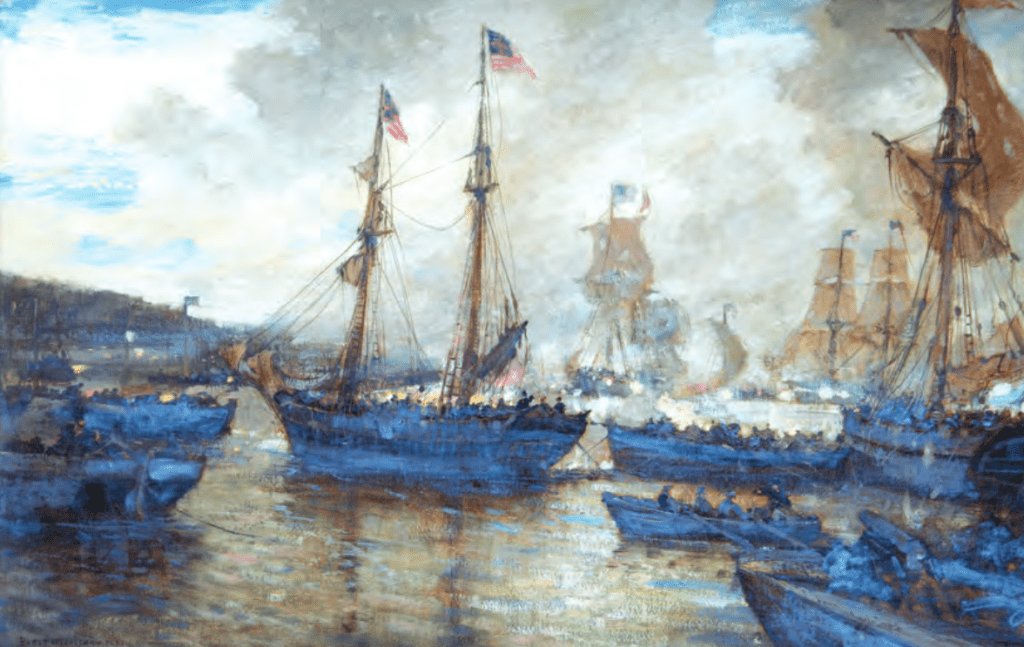
Illustrations, from above: Carlton T. Chapman’s “The Battle of Lake Champlain,” 1925 (Fort Ticonderoga); a map of the Lake Champlain, Lake George and Hudson River Corridor; an idealized version of the “Capture of Fort Ticonderoga” attributed to Alonzo Chappel, probably ca. 1853 (Fort Ticonderoga); “Wolfe’s Cove” by Winslow Homer, 1895 where Wolfe (1759) and Bendict Arnold (1776) both began their climb to the Plains of Abraham and Quebec City; William Faden’s “Plan of the City and Environs of Quebec with its Siege and Blockade by The Americans from the 8th of December 1775 to the 13th of May 1776” (larger version here); Baron H. de Dirckinck Holmfeldt’s portrait of Guy Carleton; and the scene at Skenesborough, NY, (now Whitehall) where large quantities of white oak, spruce, and pine were cut for Arnold’s lake fleet.
Recent Comments