
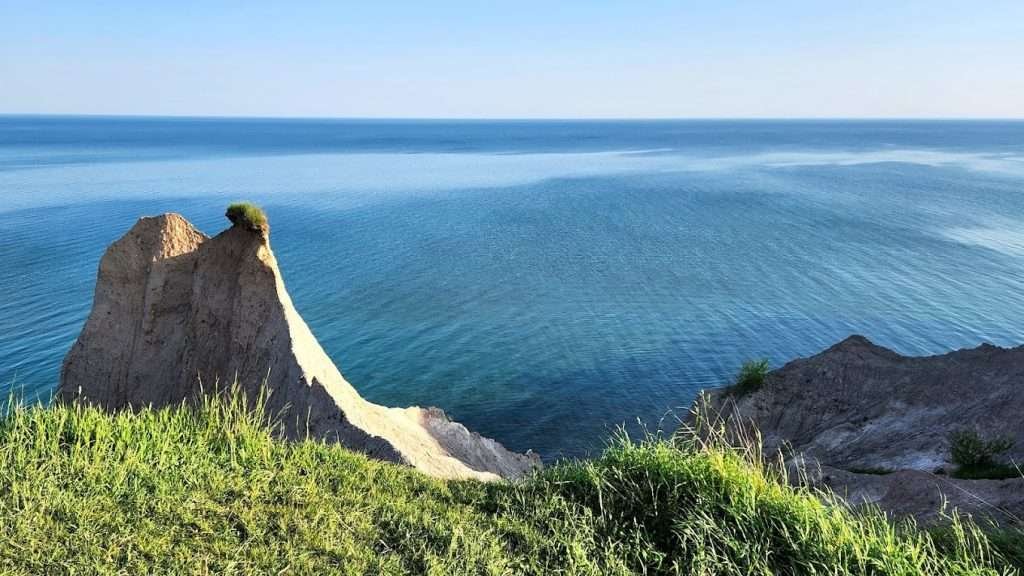
 Last week, Donald Trump claimed to have renamed Lake Ontario to Lake America. He didn’t. What he did do – in an effort to troll our biggest trading partner – was sign an executive order (14420) directing federal agencies and the U.S. Geographic Names Information System (GNIS) to use the new name:
“Within 30 days of the date of this order, the Secretary of the Interior (Secretary) shall, in coordination with the Board on Geographic Names and consistent with 43 U.S.C. 364 through 364f, take all appropriate actions to rename as ‘Lake America’ the body of water currently named as Lake Ontario, bounded on the south and east by the State of New York, and on the north, west, and southwest by the Canadian province of Ontario,” the executive order states.
“The Secretary, conjointly with the Board on Geographic Names, shall subsequently update the Geographic Names Information System (GNIS) to reflect the renaming of the Lake and remove all references to Lake Ontario from the GNIS, consistent with applicable law. The Board on Geographic Names shall provide guidance to ensure all Federal Government references to Lake Ontario, including on executive department and agency maps, contracts, and other documents and communications, shall reflect its renaming.”
 The name Ontario derives from the area’s indigenous inhabitants, predating both the Declaration of Independence and the Confederation of Canada. Secretary of the Interior Doug Burgum has already issued Secretary’s Order 3453 directing the Board on Geographic Names to immediately make the change.
The impacts will be expansive, and expensive, costing millions of dollars to the myriad of federally-related organizations that connect with the lake, and the federal agencies who deal with Lake Ontario.
Among those are the US Geological Survey (USGS), the National Oceanic and Atmospheric Administration (NOAA), the National Park Service (NPS), the US Coast Guard and the US Fish and Wildlife Service.
Although New York State Governor Kathy Hochul said the state will not make the change, it will have to use resources to make changes in joint state and federal efforts related to the lake.
The announcement has led to considerable mockery aimed at the President, whose attempt to change the name of the Gulf of Mexico on his first day in office in 2025 was met with derision. When signing the latest order, Trump joked that the Atlantic and Pacific could be next.
Some Americans took it in stride. “Don’t mess with the lyrics of The Wreck of Edmund Fitzgerald!,” demanded one social media commenter.
The Canadians are less amused. “We know that America is changing. Their trading relationships, their foreign policies, their national monuments, their hydronyms. Canadians also know that naming reality means calling it Lake Ontario – then, now and always,” said Prime Minister of Canada Mark Carney.
Google Maps and Apple Maps immediately made the change, though under no obligation to do so. MapQuest which rightly describes itself as “the OG of online mapping” announced it will not make the change. The mapping service shot to the #1 most-downloaded free app on the Apple App Store in Canada.
Trump’s escalation of hostilities with Canada has already led to a dramatic loss of tourism in Northern New York. One multi-generational Adirondack saw mill operator, a Trump supporter, told the Almanack last year that they had lost 80% of their business due to the Canadian trade and troll war.
At nine trillion dollars, the Great Lakes Region would be the third largest economy in the world if it were a country according to the Council of the Great Lakes Region.
“Ensuring the Great Lakes region’s long-term competitiveness and sustainable development — a crucial mission for the future of the region and the US -Canada relationship — demands a new era of collaborative actions that will build a strong regional economy for all while preserving the Great Lakes and our environment,” the Council website says.
A Strategic Disaster in the Making
If the upwards of $40 billion war against Iran is any indication, the potential for a greater strategic disaster is increasing. Despite their claims otherwise, the Trump Administration has demonstrably lost control of trade through the Strait of Hormuz.
(It could be much worse – retired four-star U.S. Army General Barry McCaffrey has said the U.S. “probably permanently lost access to 15 Persian Gulf bases.”)
 A similar, though hopefully less-militarized, situation could develop with Canada’s Welland Canal, on which $26.3 billion of U.S. trade depends.
The 27-mile canal is located wholly within Canada and connects Lake Ontario and Lake Erie, avoiding the falls of the Niagara River.
The on-going conflict with Canada could result in skyrocketing tolls for canal transit, or cut oceanic trade with the rest of the Great Lakes entirely.
“FAFO, or ‘Jouer avec le feu et en payer le prix,’ [play with fire and pay the price] as we say in Canada,” declared a Canadian pointing out the potentially disastrous results.
“The argument that Trump invaded Canada today is more compelling than many realize. The border between Canada and the U.S. runs through the middle of Lake Ontario. By claiming to have the power to rename the entire lake, Trump is claiming the lake. That’s invasion by declaration,” wrote Seth Abramson about the feeling among many Canadians.
“The Rush-Bagot Treaty in 1817 demilitarized Lake Ontario,” another observer noted. “It was an important step in building a shared friendship after War of 1812. I guess that common history is over now and both sides can start commissioning warships on the lake again.”
New York Almanack will not be changing the name of Lake Ontario. But this article will cost the Almanack, so please support this independent publication by making a contribution today.
Illustrations, from above: a view of Lake Ontario from the Sterling Nature Center, 2023; an AI-created meme image of a modern George Washington taking a smoke break circulating around the Lake Ontario controversy; and a map of the Welland Canal.
Recent Comments