

The Rangers made significant improvements this offseason as Chris Drury attempts to thread the needle to get the Rangers back to the playoffs. The cutoff for the playoffs was 98 points in the Metro Division and 99 points for the wild card, so it’s safe to say 100 points is the cutoff. So how can the Rangers get to 100 points this season? They finished the 2025-2026 season with a lowly 77 points, so we are talking about a 23 point swing to get them into the discussion. That’s no small task, but there is a path to success.
Using 100 points seems fair, but it could be closer to 102 since we are now at an 84 game season. Sticking with 100 points for now, but wanted to call out that change for this coming season.
Health – specifically Adam Fox and Igor Shesterkin
Believe it or not, the Rangers were a .500 team at the Winter Classic last season. They were 19-18-5 heading into the game, and wound up at 20-18-15 after the win. Then both Adam Fox and Igor Shesterkin went down with fairly significant injuries and the entire season imploded.
The Rangers went 2-11-1 in their next 14 games. Last year’s team would struggle without one of their top two players, and clearly could not survive without both. Having those two healthy for a full 84 games likely turns that 2-11-1 stretch into a .500 stretch, let’s call it 6-7-1, which adds 8 points to the standings already and puts the Rangers at 85 points. That’s in line with their record up through that point, and it’s fair to keep that assumption.
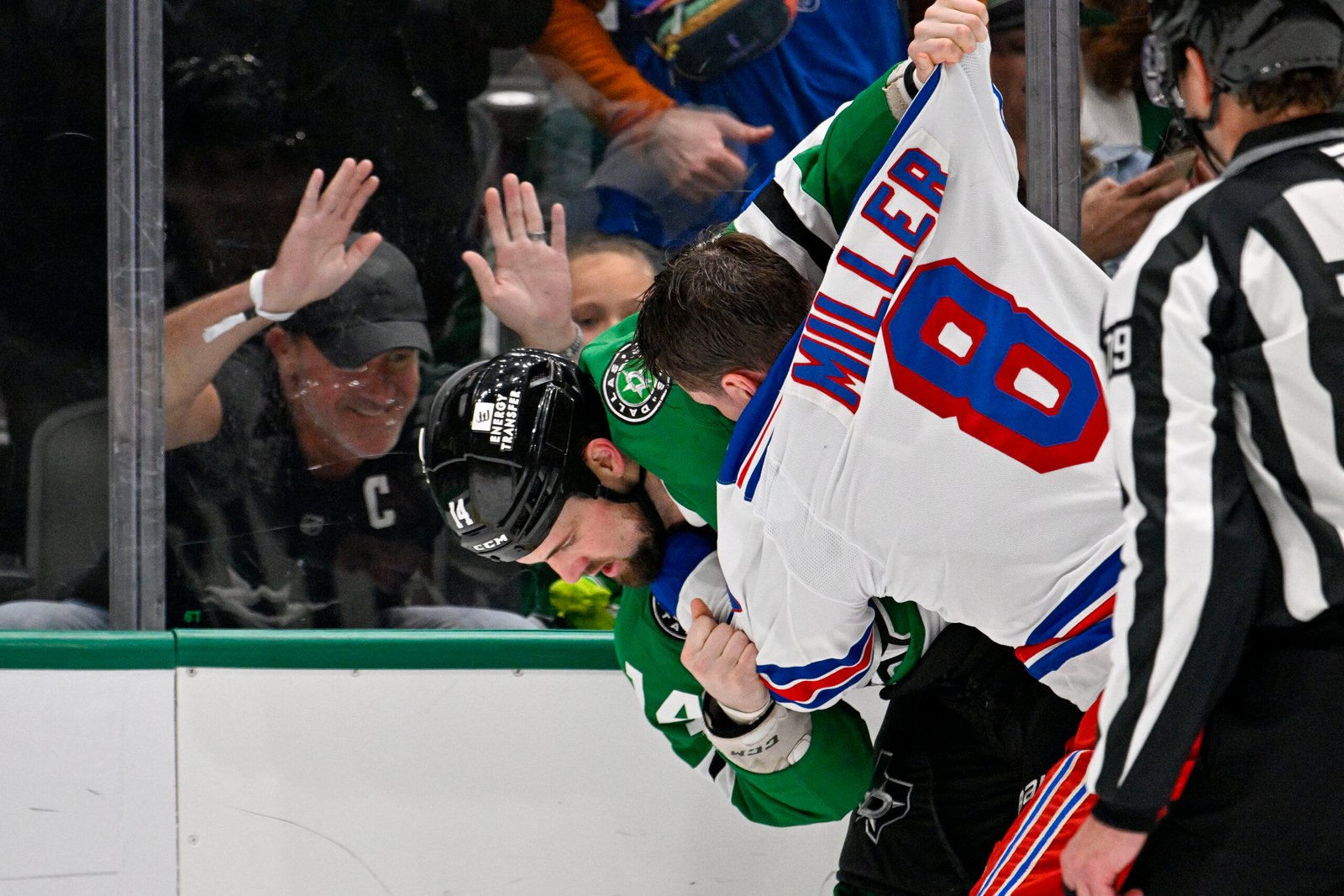
JT Miller’s health was clearly an issue throughout most of last season as well. We can’t necessarily quantify the impact of him playing fully healthy though.
If the Rangers get to 100 points, they will be a fully healthy team.
If the Rangers get to 100 points, they will have scored much more
The Rangers finished last season with 238 goals, 235 goals without the 3 “gimme” goals for shootout wins. Outside of the Flyers’ 250 goals, the rough average was 285 goals, so the Rangers need to find a whopping 50 goals. This is the toughest challenge if the Rangers get to 100 points. They can’t just magically make goals appear out of thin air. They also need to find those 50 goals plus Artemi Panarin’s 19 goals before he was traded. In theory, the Rangers need to find 69 (nice) goals next season.
There are three key areas that can help the Rangers get to 100 points:
- Pavel Dorofeyev needs to continue to improve and become a 45+ goal scorer.
- Gabe Perreault and Alexis Lafreniere continue to flourish.
- JT Miller and Oliver Bjorkstrand rebound from down years.
Dorofeyev is the key, and if this misses then we can kiss any success of this retool goodbye. That doesn’t mean the trade was bad, it was a well thought out trade that addressed the biggest need of the offseason. But he needs to be a 45 goal scorer if the Rangers get to 100 points. That means the Rangers need another 22 goals–on top of their stats last year, minus Bjorkstrand–from the other four players mentioned.
Naturally, the focus will be on JT Miller. If the Rangers get to 100 points and 280 goals, he will either need to get back to his 30 goal form or cede ice time to those who will outproduce him. Assuming the former, that’s 13 extra goals from his 17 goals last season. This is perhaps the biggest stretch, as the hope is Miller was hurt last season and not that his game fell off a cliff.
Should it be the latter, where Miller’s game fell off a cliff, then the focus shifts to Perreault (12 goals) and Lafreniere (24 goals). The Lafreniere-Zibanejad-Perreault line was something of a marvel last season, and we are all banking on that trio continuing their reimagining of the GAG line. In the scenario where Miller’s game falls off a cliff, the Rangers get to 100 points by leaning on this trio to produce at 5v5 as 1L and as PP1 with Dorofeyev and Adam Fox. Lafreniere should be able to get to 30 goals, though Perreault is less predictable.
In theory, the Perreault and Lafreniere duo should be able to go from 36 goals combined to a minimum of 50 goals combined. That’s about the same wash as Miller getting back to 30 goals. I think one scenario is viable, but not both. If Miller returns to form, then he commands and deserves the ice time warranted to top players. If not, then it’s on Mike Sullivan to give that ice time, specifically on PP1, to more deserving players.
Either scenario (plus Dorofeyev above) brings the Rangers to within single digits of their 280 goal mark, something Bjorkstrand can certainly make up on his own. Expected improvements from Will Cuylle, Noah Laba, and full seasons of Adam Sykora, Tye Kartye, and Jaro Chmelar likely bridge that gap too.
Blue line improvements do matter
Outside of Dorofeyev, the biggest adds were on the blue line. The Rangers went from one puck mover in Adam Fox to at least three, adding both Sean Durzi and Marcus Pettersson to the mix. Regardless of what you think of the trades, both as the second pair (presumably) are miles, miles better than last year’s starting second pair of Carson Soucy and Will Borgen.
The key with both Pettersson and Durzi is they can both play in transition and are good at getting the puck out of the zone. Both players have their strengths and weaknesses, but both provide secondary options for transition and should truly help with an underreported weakness of the Rangers the last few years. Without Fox on the ice, the Rangers were one of the worst possession teams in the league in both xG and CF. Durzi and Pettersson help mightily.
It won’t happen early in the season, but ideally the Rangers eventually get to a point where they feel comfortable splitting up either Gavrikov-Fox or Pettersson-Durzi to bring more balance to the force Rangers. All that offense the Rangers sorely need begins in their own zone and ensuring they can actually break out effectively. Transition play from all three defense pairs will be critical if the Rangers get to 100 points.
Wildcards
If the Rangers get to 100 points, it means all three of the above points hit. It’s certainly doable, but it comes with a lot of “what ifs” throughout the season. The more likely scenario is we get partial hits on all three, meaning some wildcards need to come into play.
First and foremost is Dylan Garand over Jonathan Quick as the backup. Quick wasn’t good last season, sporting a sub-.900 save percentage for the second straight season. Garand simply posting a better SV% should give the Rangers more stability in net, improving on Quick’s 6-17-2 record.
Though to be fair, simply not having a stretch of games where Spencer Martin starts is an improvement. That’s worth a few points in the standings, right?
Alberts Smits is another big wildcard, as he is light years better than Matthew Robertson, no slight to Robertson, and gives the Rangers far more flexibility to break up that top-four and add a bit more balance to the force lineup. Smits may or may not be a part of the team if the Rangers get to 100 points, but he would certainly help the situation.
If the Rangers get to 100 points, they will need a combination of good fortune and a near complete return to production for some key players. It’s doable, especially in a weak Metro Division. But it’s a tall order.
Recent Comments