
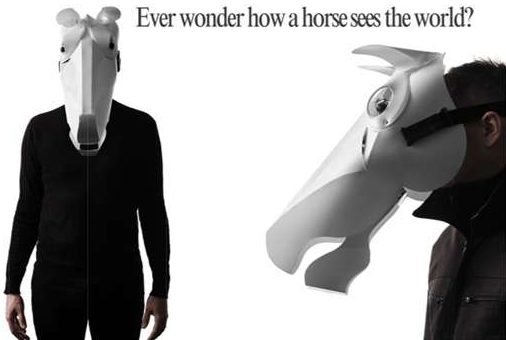
 In late July the National Museum of Racing in Saratoga Springs debuted a new one-of-a-kind exhibition, “Equine Eyes,” during an open house.
The exhibit is an interactive, research-driven presentation designed to simulate how horses perceive the world.
This exhibit is rooted in extensive research by Dr. Alan Hook of Ulster University (UK) and aims to foster empathy, safety awareness, and inter-species connection. The exhibition is funded in part through the support of a grant from the Thoroughbred Education Research Foundation (TERF).
Utilizing a specially developed headset with mounted cameras, the “Equine Eyes” experience provides visitors with an immersive visual and sensory perspective of equine vision. This technology highlights key differences in depth perception, color spectrum, and motion sensitivity compared to human vision, offering a deeper understanding of how horses navigate their environment.
Dr. Hook visited the National Museum of Racing during July and demonstrated the technology, educating guests about the research and process involved with developing Equine Eyes.
 The discussion of thoroughbred vision also arose during the 1920s, when oculist Ernest E. Emons suggested the on-track behavior and performance of horses could be improved, if their eyes were examined to determine visual acuity, with the possibility of providing eyesight correction.
Dr. Emons, practicing in Akron, Ohio, was established in improving visual senses, being an influential inventor in the early 20th century, filing several US and Canadian patents. His designs transformed eyewear by relocating the temples (arms) higher up on the frames. This eliminated blind spots and provided an unobstructed field of side vision.
Naturally enough, Ernest Emons wanted to promote his refinements to athletes, yet his ideas were not accepted very enthusiastically until it was realized that correcting ocular faults would result in improved performances.
This same logic was applied by optometrist Emons to thoroughbred horses. He visited Saratoga in 1927 and tested the vision of a number of horses belonging to Colonel Edward R. Bradley (1859–1946), who was very interested in optometric development. Emons found 10% of the Bradley stock required spectacles.
 In their August 15, 1927 issue, Time magazine wrote; “Mr. Bradley announced (and he did not want anyone to laugh about it) that four of his horses, Barosa, Benedict’s Vow, Billy Burke and Beneficient, were wearing spectacles.”
The same article continues; “Racemen at Saratoga are converted. They see it all now, like the horses. But serious-minded veterinarians, skeptical, demand further, exhaustive tests.”
A horse, of course, could not use the vision charts which the oculist uses for testing human eyesight, so Dr. Emons devised a way of testing their eyes by means of a powerful light and special instruments.
According to a 1927 report in Optometric Weekly, Dr. Emons was working with an illuminated retinoscope, a handheld ophthalmic tool used by eye doctors to objectively measure a patient’s refractive error (like nearsightedness, farsightedness, or astigmatism).
This device works by projecting a beam of light into the pupil and analyzing how the light reflects off the retina. The light was moved side to side, with the speed and direction of the moving light reflection inside the pupil telling the doctor exactly how the eye focuses light, and then placing different lenses in front of the eye until the light reflection focuses directly, revealing the exact correction prescription.
This method is still effective in our time, as the patient is not required to read an eye chart, an imperative for examining infants, young children, and patients with speech or cognitive impairments.
Once the eyes of a horse were tested, lenses were ground according to the requirements of its eyes, and Dr. Emons mounted the lenses in special blinkers. Experiments were carried out at the Bradley Idle Hour Stables near Lexington, Kentucky. Tests showed that the glasses served to reduce thoroughbreds running time an average of one second for each quarter mile.
The horses did not object to the unusual device strapped over their eyes, immediately giving indications of being able to see better. A secondary positive result was that nervous and hard-to-ride horses were rendered gentle by being able to see clearly for the first time.
 During the 1928 track season, Dr. Emons returned to Saratoga Springs, and took rooms at the Race View boarding house at 75 Nelson Avenue, at the corner of Crescent Street, directly across from the racetrack with a suitable barn (both structures are still standing).
He offered free demonstrations to horsemen, as he claimed that trainers or jockeys would never recognize horses with poor vision.
Dr. Emons told Scientific American that the most important result, however, of the newly developed method of testing vision is not the fitting of glasses, but instead, the proper diagnosis of trouble will “permit the breeding of mounts in such a way that poor vision, which is hereditary in horses as well as in man, will not be transmitted.”
He advocated vision being another of the confirmation points judged in thoroughbred horses. He also suggested the testing of yearlings before the annual Saratoga Yearling Sale.
Dr. Emons, perhaps growing sensitive to not being taken seriously, ran strident advertisements during 1928 in the Saratogian, displaying his testing methods while examining Sam Riddle’s son of Man o’ War, Crusader, stating “The Blind, Breeding The Blind, For The Blind.”
Another advertisement read; “Barnum Was Right. Be sure and get your share of half-blind horses at the sales. No charge for testing the horses eyes.”
Naturally, horses wearing spectacles elicited all types of humor at a racetrack, with comments bandied about like, “now we can teach them to knit,” and “aren’t the ones who need glasses the readers of the form sheets?” In the early 1930s Dr. Emons would attempt to prove his methods at Hialeah Racetrack in Miami.
By that time, it appears that Dr. Emons’ theories had fallen out of favor. When a horse owned by Sonny Whitney ran poorly and myopia was blamed, it provoked criticism by Hall of Fame Turf Writer George F.T. Ryall in the New Yorker‘s June 20, 1936 issue:
“Frankly, I’m opposed to spectacles for horses. Some years ago an oculist from Akron, Ohio, convinced Ed Bradley that sixty-eight percent of the thoroughbreds racing had defective vision. He made some glasses for Bradley’s horses, attaching them to the hoods of blinkers, but the contraptions didn’t work out very well.”
Certainly, much progress has been made in understanding equine vision since that time, with a lot more to learn. Dr. Hook’s device, Equine Eyes, at the National Museum of Racing will add so much more to what we already comprehend from those early investigations.
A demonstration of Dr. Hook’s specially developed headset will take place at the National Museum of Racing, 191 Union Avenue in Saratoga Springs, each Saturday morning from 9 until 11 am, during 2026 track season.
Read more about Horse Racing in New York State.
Illustrations, from above: detail from a National Museum of Racing Equine Eyes announcement; Dr. Emons examines a thoroughbred’s eyes (Scientific American, December 1927); Emons’ blinker mounted corrective lenses on a Bradley horse (Popular Science, December 1927); and an advertisement for Emons’ horse corrective lenses (Saratogian, August 9, 1928).
Recent Comments