
 In a July 4, 1862 speech to an audience of about 2,000 people in Himrod’s Corner, in Yates County, NY, Frederick Douglass described what we now remember as the American Civil War as a “slaveholders’ mutiny.”
As a recent New York Times op-ed pointed out, naming that war is very much a political decision that shapes and is shaped by our view of the past and American history. During the war it was usually referred to as an “insurrection” or a “rebellion.” Civil War is a more neutral term that avoids placing blame for ripping the country apart or branding the Southern actions as treasonous and ignores the future of slavery in the United States as the fundamental cause of the war.
Woodrow Wilson, elected President in 1912, was the first Southerner elected President in the post-war era. As a historian, he promoted the idea that the Southern rebellion was a noble “Lost Cause.”
As part of national reconciliation during his Presidency, the 50th anniversary of the Battle of Gettysburg was celebrated with a “Great Reunion” of Union and Confederate veterans at the park.
 Wilson attended and delivered a July 4th address where he praised the “valor” of the “gallant men in blue and gray” who “met upon this ground in grim and deadly struggle.” In his speech Wilson ignored the causes of the war, made no reference to slavery or rebellion, and fixated on the unity of the former enemies.
In 1914, Wilson commemorated a Confederate Memorial at Arlington National Cemetery. It was removed in 2023, but Secretary of Defense Hegseth has ordered that it be returned in 2027 as part of the Trump administration’s effort to rewrite American history.
Douglass at Himrod
Himrod’s Corner, now simply known as Himrod, is a hamlet along the western shore of Seneca Lake south of Geneva. Seneca Lake and the entire Finger Lakes Region was connected to the Erie Canal via the Cayuga-Seneca Canal.
Douglass arrived in Himrod’s Corner by train so he must have traveled from Rochester on a New York Central line running to Canandaigua, a 30 mile trip that took about two hours in the 1860s.
He would have switched trains in Canandaigua and traveled south another thirty-five miles to Himrod’s Corner on the Canandaigua and Corning Railroad. Douglass delivered his speech outdoors in a wooded area that could accommodate the number of people who traveled there to hear him.
An article about the event in the August 1862 issue of Douglass’ Monthly was headlined THE SLAVEHOLDERS’ REBELLION: AN ADDRESS DELIVERED IN HIMROD’S, NEW YORK, ON 4 JULY 1862.
 Douglass did not call it a “Civil War” or a “War Between the States.”
In the speech Douglass was very clear that this was a rebellion led by slaveholders who wanted the South to secede from the United States to preserve the institution of chattel slavery that enriched them while imprisoning, exploiting, and dehumanizing Africans held in bondage in the United States.
They believed their wealth was at risk because of the election of Abraham Lincoln in November 1860.
In this July 4th speech, Frederick Douglass saw the war as a “conflict between liberty and slavery, between civilization and barbarism, between enlightened progress and stolid indifference.”
He argued “It is hardly necessary at this very late day of this war, and in view of all the discussion through the press and on the platform which has transpired concerning it, to enter now upon any elaborate enquiry or explanation as to whence came this foul and guilty attempt to break up and destroy the national Government.
“All but the willfully blind or the malignantly traitorous, know and confess that this whole movement, which now so largely distracts the country, and threatens ruin to the nation, has its root and its sap, its trunk and its branches, and the bloody fruit it bears only from the one source of all abounding abomination, and that is slavery.”
Douglass dismissed claims by “rebels, in the smooth disguise of loyal men,” who “promulgate a very opposite explanation of the origin of this war.” He was especially outraged by “one false theory of the origin of the war” blaming abolitionists for “their insane and unconstitutional attempt to abolish slavery.”
Douglass responded “[T]he slaveholders came into the union with their eyes wide open, subject to a constitution wherein the right to be abolitionists was sacredly guaranteed to all the people. They knew that slavery was to take its chance with all other evils against the power of free speech, and national enlightenment. They came on board the national ship subject to these conditions, they signed the articles after having duly read them, and the fact that those rights, plainly written, have been exercised is no apology whatever for the slaveholders’ mutiny.”
Douglass believed that most rebellions in history including the American Revolution challenged injustice. However, he said:
“The pronounced and damning peculiarity of the present rebellion, is found in the fact, that it was conceived, undertaken, planned, and persevered in, for the guilty purpose of handing down to the latest generations the accursed system of human bondage. Its leaders have plainly told us by words as well as by deeds, that they are fighting for slavery.
 “They have been stirred to this perfidious revolt, by a certain deep and deadly hate, which they warmly cherish toward every possible contradiction of slavery whether found in theory or in practice. For this cause they hate free society, free schools, free states, free speech, the freedom asserted in the declaration of independence, and guaranteed in the constitution. Herein is the whole secret of the rebellion.
“The plan is and was to withdraw the slave system from the hated light of liberty, and from the natural operations of free principles. While the slaveholders could hold the reins of government they could and did pervert the free principles of the constitution to slavery, and could afford to continue in the union, but when they saw that they could no longer control the union as they had done for sixty years before, they appealed to the sword and struck for a government which should forever shut out all light from the southern conscience, and all hope of Emancipation from the southern slave.
“This rebellion therefore, has no point of comparison with that which has brought liberty to American, or with those of Europe, which have been undertaken from time to time, to throw off the galling yoke of despotism. It stands alone in its infamy.”
In the speech Douglass was also critical of the Lincoln Administration and its conduct of the war. Douglass stated:
“There is plausibility in the argument that we cannot reach slavery until we have suppressed the rebellion. Yet it is far more true to say that we cannot reach the rebellion until we have suppressed slavery. For slavery is the life of the rebellion.
“Let the loyal army but inscribe upon its banner, Emancipation and protection to all who will rally under it, and no power could prevent a stampede from slavery, such as the world has not witnessed since the Hebrews crossed the Red Sea.
“I am convinced that this rebellion and slavery are twin monsters, and that they must fall or flourish together, and that all attempts at upholding one while putting down the other, will be followed by continued trains of darkening calamities, such as make this anniversary of our national Independence, a day of mourning instead of a day of transcendent joy and gladness.”
 Douglass reminded his audience in what was clearly also a message to Lincoln and the federal government in Washington:
“This slavery begotten and slavery sustained, and slavery animated war, has now cost this nation more than a hundred thousand lives, and more than five hundred millions of treasure. It has weighed down the national heart with sorrow and heaviness, such as no speech can portray. It has cast a doubt upon the possibility of liberty and self Government which it will require a century to remove.…
“By urging upon the nation the necessity and duty of putting an end to slavery, you put an end to the war, and put an end to the cause of the war, and make any repetition of it impossible.
“But, just take back the pet monster again into the bosom of the nation, proclaim an amnesty to the slaveholders, let them have their slaves, and command your services in helping to catch and hold them, and so sure as like causes will ever produce like effects, you will hand down to your children here, and hereafter, born and to be born all the horrors through which you are now passing . . . and American Republicanism will become a hissing and a by-word to a mocking earth.”
Slaveholders Rebellion
Frederick Douglass was not the first to label the war “The Slaveholders’ Rebellion.” On July 16, 1861 during the first session of the 37th Congress, Senator Samuel C. Pomeroy, Republican from Kansas, a former teacher and an ardent abolitionist, introduced a bill in the Senate to “suppress the Slaveholders’ Rebellion.”
The bill never passed after heated opposition led by Senator John Breckinridge (1821-1875) of Kentucky who argued it created “odium and prejudice against a particular interest.” Breckinridge, who was a former Vice-President of the United States and the Southern Democrat candidate for President in 1860, was later expelled from the Senate and joined the Confederacy where he was appointed a Brigadier General in the Confederate Army. He later served as Secretary of War in the rebel government.
New York State was represented in the Senate during the 37th Congress by two Republicans, Ira Harris (1802-1875) of Albany and Preston King (1806-1865) from Ogdensburg in the North Country. Neither participated in the debate over Pomeroy’s “Slaveholders’ Rebellion” bill, although at one point during the session King supported Lincoln’s decision to blockade Southern ports as legitimate to prevent smuggling.
Samuel C. Pomeroy (1816-1891) was amongst the most radical of the Radical Republicans. In 1863, he escorted Frederick Douglass to a meeting at the War Department with Edwin Stanton where Douglass argued that African American soldiers should receive the same wages as white troops.
 Pomeroy later called for citizenship and voting rights for formerly enslaved persons and unsuccessfully championed a Constitutional Amendment ensuring women the right to vote.
According to a New York-Times Washington DC correspondent, “There are no white-glove touches in this bill, but it names the Southern revolt the “Slaveholders Rebellion.”
Never was language more appropriate, and through all time “shall this strife be signaled as the ‘Slaveholders’ Rebellion.’ The term will be as comprehensive in the future as has been that of the “irrepressible conflict” in the recent past… We must yet learn, that the only effective remedy for this rebellion, is to remove the cause.”
In an editorial, published on the same day, the New-York Times reported:
“The title of this bill was subsequently commented on with some feeling by Mr. BRECKINRIDGE, who maintained that the revolt which the Government is about to exert its entire power to suppress, is not a slaveholder’s rebellion, but a movement in which all classes in the Southern States — non-slaveholders as well as slaveholders — equally participated.
“The fact adduced by Mr. BRECKINRIDGE is, in the main, undoubtedly correct. The great rebellion of the South is not confined to the slaveholders, or to any other class, but pervades in some degree, all shades of society, without reference to possessions or occupations.
“Yet, notwithstanding this indisputable fact, it would be impossible to characterize the wicked insurrection which now prevails in the slaveholding States, more aptly and truly in the brief title of a bill, than by the words which have been employed by the Senator from Kansas, — THE SLAVEHOLDER’s REBELLION.
“It is, in fact, an insurrection against the peace of society, which had its origin in the especial interest of the slaveholder, and which has been promoted, encouraged and fired, at every step of its progress, under an open demand for the extension of the area of Slavery, and the increase of the political power of the slaveholding class.”
In 1865, John Harvey of Pleasant Plain, Iowa published an 84-page long epic poem that he called “The slaveholders’ rebellion, and the downfall of slavery in America.” Harvey wrote:
“There never yet among the earthly powers
Arose a better Government than ours,
With the exception that it spared the sin,
Which had a cause of ceaseless trouble been,
‘Till its influence in league with hell, Inspired the friends of slavery to rebel,
And fire, and sword with murd’rous hands employ,
The Government designing to destroy,
That on its ruins they might build their own,
With negro slavery for its corner stone,
And in its superstructure, human rights
Denied to many children of the whites.”
Harvey concluded his poem with a prayer to God to “act with justice towards the class who now no more in chains… And find the future blest a thousand fold beyond the times when men were bought and sold; And for Thy work of mercy, gracious God! Which freed the bondsman from the tyrant’s rod, And raised him from chattel to a man….”
In the opening to his July 4, 1862 speech, Douglass commented that the founding fathers probably never “dreamed that this hallowed day could possibly be made to witness the strange and portentous Events now transpiring before our eyes, and which even now cast a cloud of more than midnight blackness over the face of the whole country. We are the observers of strange and fearful transactions.”
As the United States celebrates the 250th anniversary of the signing of the Declaration of Independence, it is worth considering what the founders would think about the state of democracy in the United States today.
Read more about the American Civil War in New York.
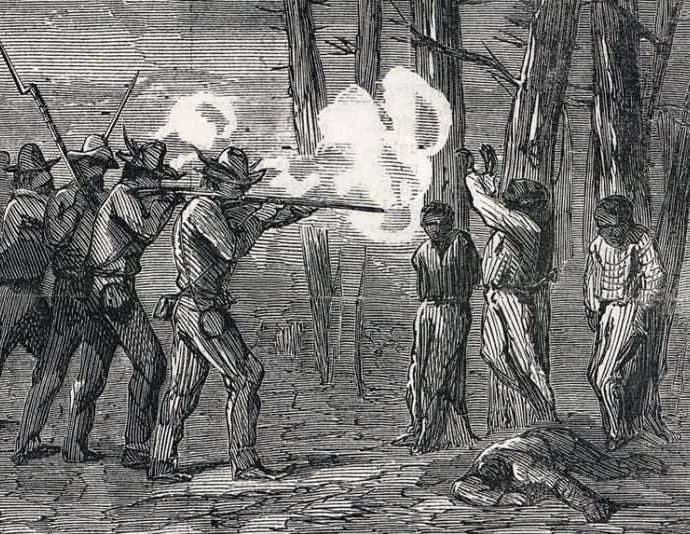
Illustrations, from above: “Rebel Atrocities,” Harper’s Weekly Magazine, May 21, 1864; Detail of a photo showing President Woodrow Wilson at the 50th Anniversary Blue & Gray Reunion of Civil War Veterans at Gettysburg in 1913 (Library of Congress); Frontispiece in My Bondage and My Freedom by Frederick Douglass, 1855; “The war in Tennessee: Confederate massacre of black Union troops after the surrender at Fort Pillow, April 12, 1864,” Frank Leslie’s Illustrated Newspaper, May 7, 1864; “Kidnapping” by Alexander Rider, published in Jesse Torrey’s 1817 book A Portraiture of Domestic Slavery; “Contraband Decision,” 1861, depicting Major General Benjamin Butler meeting with Frank Baker, Shepard Mallory, and James Townsend at Fort Monroe (“Freedom’s Fortress”) where Butler refused to return the Black men to slaveholders, classifying them as “contraband of war” instead of returning them under the Fugitive Slave Act. This decision effectively began the process of freedom for thousands of enslaved people who escaped to United States lines during the Civil War.
Recent Comments