
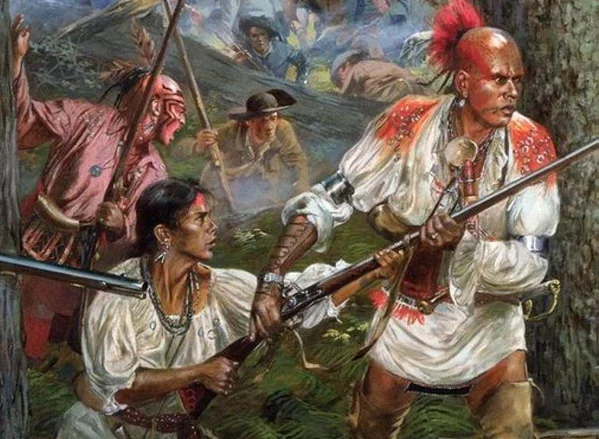
 August 6th marks the anniversary of the 1777 Battle of Oriskany. Fought as an American relief column marched to aid the besieged Fort Stanwix, about 800 Tryon County militiamen and 60 allied Oneida warriors under Brigadier General Nicholas Herkimer were ambushed by British, Loyalist, and Indigenous forces (including Mohawk and Seneca warriors).
The resulting engagement is considered one of the bloodiest of the Revolution War, with American casualties reaching roughly half to two-thirds of the fighting force, and ultimately leading to the death of Herkimer.
The British withdrawal from Fort Stanwix after the battle however, along with the surrender of General John Burgoyne at the Battles of Saratoga, served as important turning points on the path toward bringing French aid to the American Revolution, and was an important boost to revolutionary morale.
Nicholas Herkimer
A son of Johan Jost and Catherine Petrie Hercheimer (Herkimer), Nicholas was descended from those who took part in the Palatine exodus from the southern Rhine Valley in a German principality of the Holy Roman Empire.
This was due to persecution by King Louis XIV and the brutal winter of 1708–1709 which froze the Rhine River, destroyed crops and caused widespread deprivation and starvation.
After fleeing to Holland and then to England, in 1710 Queen Anne made arrangements to send roughly 3,000 of these refugees on ten ships to the Hudson River Valley in what was then the British Province of New York. There they were mostly set to work making naval stores to supply the British Navy in order to pay for their passage.
 Johan Jost Herkimer and about 94 others eventually petitioned the Queen for land of their own and the result was the purchase of 9,428 acres of the Burnetsfield Patent of 1725 in the Mohawk Valley between Frankfort and Little Falls.
Governor William Burnet‘s patentees paid an annual rent of 2 shillings and 6 pence, with the condition that they cultivate at least three acres for every 50 acres they acquired within three years.
Nicholas Herkimer was born in 1727. He married twice, first to Maria Madeline “Lany” Dygert and later to her niece, Maria “Myra” Dygert; he had no surviving children.
In 1740, Fort Kaouri (Fort Bear) was built at the Herkimer homestead on the Mohawk River‘s south side, opposite the mouth of West Canada Creek, in what is now German Flatts.
Herkimer is believed to have seen his first combat when French forces attacked the area in 1757 and 1758 during the French and Indian War. The raids resulted in the capture of more than 100 people and destroyed houses and farms.
Fort Stanwix was built in 1757 at what today is Rome, NY, the culmination of several outposts constructed to defend the Oneida Carry between Wood Creek and the Mohawk River. Herkimer received a military commission in 1758 at Schenectady.
The Revolution
In the run-up to the Revolutionary War, Herkimer served on the Tryon County Committee of Safety representing the Canajoharie District. This body was an extra-legal shadow government established by revolutionaries on August 27, 1774 and led by Christopher Yates and Isaac Paris, among others.
On August 22, 1775, Herkimer was elected head of the regiment from the Canajoharie District and later commander of all the militias of the five districts in Tryon County. The State appointed him Brigadier General on September 5, 1776.
By this time, Sir William Johnson had died in 1774 and the Loyalist members of his family and their supporters had fled to Canada.
Fort Ticonderoga had been captured from the British in May 1775, and the battles at Lexington and Concord in Massachusetts had occurred in April.
 Fort Dayton was built at what is now Herkimer, NY, on the north side of the Mohawk River in 1776 by troops of the Fourth New Jersey Regiment under the command of Colonel Elias Dayton (1737-1807).
British Lieutenant Colonel Barrimore “Barry” St. Leger arrived at Oswego to the west from Montreal around July 25, 1777. There he met with Native American leader Joseph Brant and hundreds of warriors.
On July 17, 1777 Herkimer, as head of the Tryon Committee, issued a proclamation to mobilize calling on “every male person, being in health, from 16 to 60 years of age, in this our county, shall, as in duty bound, repair immediately, with arms and accoutrements, to the place to be appointed in my orders [Fort Dayton], and will then march to oppose the enemy with vigor, as true patriots, for the just defense of their country.” Unfit men were ordered to assemble to protect women and children in the settlements.
St. Leger and his 34th Regiment of British regulars, German Hessians, Onondaga and Seneca Warriors, and Loyalists began marching on Fort Stanwix, part of what was supposed to be a three-pronged attack to take Albany and the Mohawk and Hudson River valleys.
The southern attack never materialized, but about 8,500 troops under John Burgoyne recaptured Fort Ticonderoga on July 5-6th and on July 7th the British defeated an American rear guard at the Battle of Hubbardton. By the end of July 30 Burgoyne had occupied Fort Edward, the last major fortification before Albany.
The Battle of Oriskany
St. Leger arrived at Fort Stanwix and began laying siege to the fort on August 2nd, a siege that would drag on for 20 days. He underestimated the tenacity of the Americans defending the fort under the command of Peter Gansevoort.
Herkimer’s roughly 800 to 900 men — along with a large supply train of ox carts meant to replenish Fort Stanwix – left Fort Dayton on August 4, marching west along the north side of the Mohawk River.
They spent the first night just west of Sterling Creek, before crossing to the south side of the river. Mohawk District Militia under Frederick Visscher (1741-1809) served as a rear guard.
Alerted to Herkimer’s advance by Joseph Brant’s sister Molly Brant, St. Leger sent Brant and Sir John Johnson to set a trap. As the Patriot militia marched into a ravine near Oriska on the morning of August 6th the ambush started.
 Leading the 1st Regiment, Colonel Ebenezer Cox (1741-1777) was shot and killed during the first volley of the enemy and Herkimer was hit in the leg and carried to a place under a beech tree where he continued to direct his men. For about an hour a heavy rain interrupted the battle on the hot August day.
At around 4 pm both sides left the field, leaving their dead behind. About 500 of the 800 Americans were killed, wounded or captured.
Herkimer survived the battle but died ten days later on August 16, 1777 from complications from a poorly performed amputation of his shattered leg.
Markers were placed along Herkimer’s route around 1910 period (including one in front of the Whitesboro Library on Main Street and one in downtown Utica). They relate the battle as the turning point in the Revolution.
Meanwhile, more than 5,000 Patriot soldiers were consolidating at Van Schaick Island, just above Albany. Major General Benedict Arnold was sent there by General George Washington and arrived at the camp in mid-August 1777.
While there, news arrived of the Siege of Fort Stanwix. When General Philip Schuyler (then commander of the Northern Department) asked for a volunteer officer to lead a risky relief column, Arnold stepped forward.
He assembled roughly 700 to 900 men from the encampment’s ranks and marched west into the Mohawk Valley.
Arnold used Hon Yost Schuyler (1744-1810) to spread exaggerated numbers to the British camp. When this false intelligence that 3,000 men were marching to break the siege reached St. Ledger, he order a withdrawal finally ending the Siege of Fort Stanwix.
Read more about the Siege of Fort Stanwix and the Battle of Oriskany.
Illustrations, from above: Two Kettles fighting by her husband’s side during the Battle of Oriskany (courtesy Oneida Indian Nation – Don Troiani); Home of Nicholas Herkimer; Fort Dayton; and “Herkimer at the Battle of Oriskany, August 6 1777” by Frederick Coffay Yohn (F.C. Yohn).
Recent Comments