
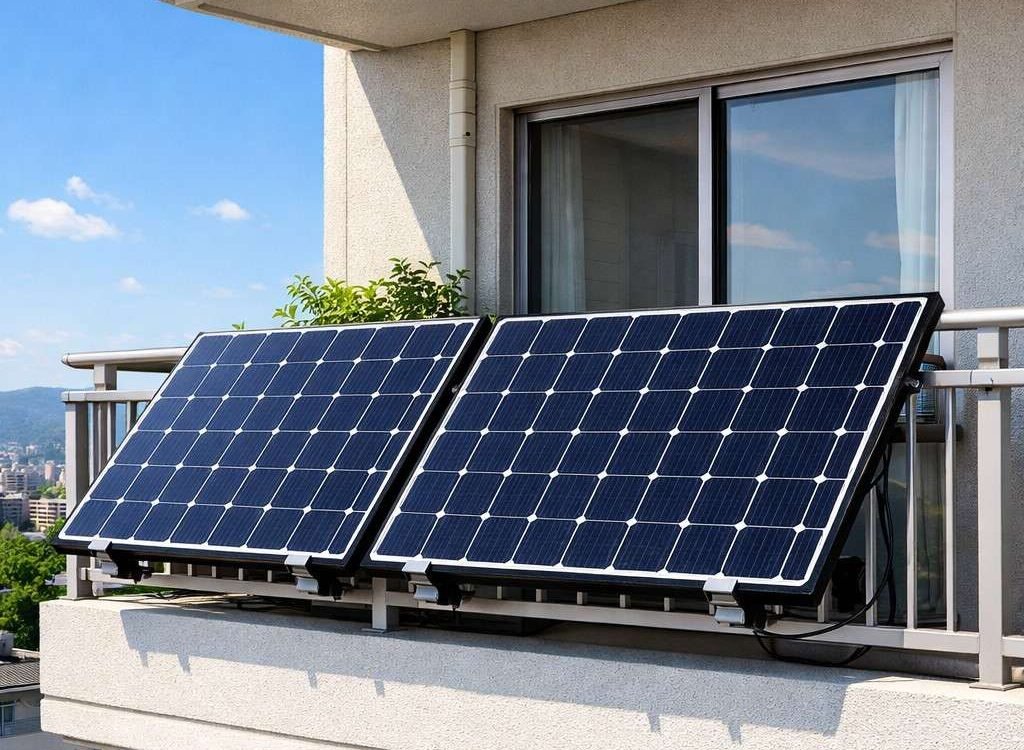
 Back on May 28, 2026 the New York State Legislature passed the Solar Up Now New York (SUNNY) Act (A.9111C/S.8512C), which would remove red tape and legalize “balcony solar,” the small, plug-in solar panels that everyday families can use to lower their energy bills and generate renewable energy.
After two months, the bill is still awaiting Governor Kathy Hochul‘s signature.
Many New Yorkers are among the 53 million households nationwide who cannot install solar power. They may not be able to afford rooftop solar, or they may live in a rental without rooftop access. For those who face financial, physical, or regulatory restrictions, plug-in solar offers an affordable solution.
Balcony solar systems — also known as plug-in or plug-and-play solar — allow homeowners and renters to generate electricity by mounting up to a few lightweight panels and plugging them directly into a standard 120V wall outlet. A typical 400W–800W kit costs $500–$1,500 and saves $13–$50 monthly by offsetting baseline appliance loads.
New York Falling Behind
 If Governor Hochul signs the bill, the law will bring New York State in line with other states including Utah, Connecticut, Maryland, Maine, Virginia, Colorado, and New Hampshire that have all passed similar bills in the last year. Legislation has been introduced in 30 other states.
“The SUNNY Act will open the door for millions more New Yorkers to have access to cheap, clean solar power, be part of the solution to the climate crisis, and shave a little bit off their electricity bill every month,” lead Senate sponsor Liz Krueger said in announcing the bill’s passage.
“Once the market for plug-in solar fully matures, like it already has in Germany, New Yorkers will be able to simply walk into a store, pay a few hundred bucks for a system, take it home and plug it in like any other appliance, and start saving hundreds of dollars every year,” she said.
About three million households are currently using balcony solar systems in Germany.
Activists Led The Way
The Legislature’s passage of the SUNNY Act comes after months of work from advocates and everyday people to educate New Yorkers about how plug-in solar panels can save families money on their bills while reducing their emissions.
 Back in May, New Yorkers from across the state rallied with environmentalist Bill McKibben to share their plug-in solar panel success stories, and held a press conference with state lawmakers at the Capitol to urge the Legislature to pass the bill before the end of session.
Advocates also held demonstrations across the state in April to show how New Yorkers can easily use plug-in solar panels to generate renewable power, running a blender for smoothies, a cooling fan and a radio for passers-by.
Nearly 30 New York City elected officials and climate change groups have been urging the Governor to sign the bill. Major utility companies like Con Edison have also issued memos supporting the legislation.
SUNNY Act Requirements
The SUNNY Act would exempt plug-in solar panels from existing interconnection and net metering requirements. The Act provides a ban on utilities charging fees or requiring special approval to use safety-tested and certified small devices in homes or apartments.
 It requires no installation of additional controls or equipment beyond what is integrated into the device. The Act also requires the state’s construction codes to allow for portable solar generation devices to be connected to a building’s wiring through an electrical outlet.
Underwriters Laboratory (UL), the standard-setter for consumer appliance safety, issued safety guidelines for plug-in solar panels in April, and manufacturers are currently submitting their products for UL certification.
The SUNNY Act has a limit of 1,200 watts, the same as most other state’s laws, although Colorado set a national high limit of 1,920-watts and includes protections against HOA restrictions.
Hochul has until the end of 2026 to sign or veto the legislation. Her office has stated that the bill is currently under review.
If the Governor signs the bill, it will officially become law and take effect 90 days after enactment.
Read more about Solar Power in New York State.
Illustrations, from above: A balcony solar installation (courtesy Europe Solar Innovation by Copilot); map showing the status of States allowing plug-in solar July, 2026 (see current map here); activists demonstrate for balcony solar and the SUNNY Act in the spring of 2026; and a typical plug in solar system diagram.
Recent Comments