
 In horse racing vernacular, the “post parade” at a track is just before the start of the equine competition. It is the grand procession of racehorses and jockeys passing in front of the viewing stands on their way to the starting gate.
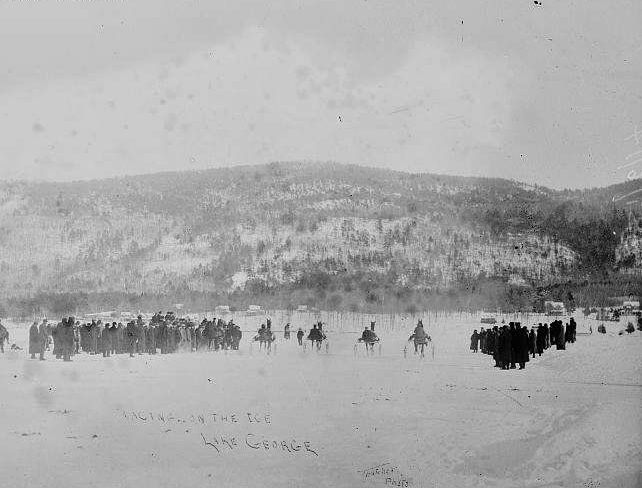
Arguably, some of the most historic post parades are at the thoroughbred track in Saratoga Springs. Yet, you could say that during harness racing on frozen Lake George in the 19th and 20th centuries, those post parades were unique, too.
It was not unusual at Lake George to have harness racing on the frozen waterway during winter festivities. In February 1947, each trotter with sulky and driver entered onto the ice by crossing from stables on the grounds of Fort William Henry Hotel.
Those post parades went past the remains of an 18th-century military dock located just off the Beach Road in Lake George Village.
In 1947, after an absence of several years, there was a return to harness racing on the ice of Lake George. Up to 1,000 people attended each day’s wintertime sprints.
In promoting the contests, organizers announced that harness horses as well as spectator automobiles would enter onto ice-covered Lake George “near the old military dock on the Beach Road.”
The “old military dock” was constructed in late 1758 by British army engineers and soldiers. The wharf was used in 1759 by British General Jeffery Amherst and his 11,000-man army that traversed the full length of Lake George in a massive armada.
 The fleet consisted of several hundred bateaux and other warships on their way north to neutralize the French threat in the Champlain Valley.
This colonial pier was originally rectangular in shape. It was made of logs fashioned into cribs. Rocks were placed into those cells to provide structural stability.
Archaeologists refer to this type of construction as a solid-crib wharf. Sometime later, an offshore pier section, perpendicular to the original dock, was added making the structure T-shaped.
In 2003, mapping of the underwater feature, begun several years earlier, was completed by Bateaux Below underwater archaeologists directed by myself, a registered professional archaeologist. Bateaux Below’s Bob Benway created a CAD image of it.
For years in the first half of the 20th century, the derelict sunken wharf from the French & Indian War (1755–1763) was marked by a sign that read “The Old Dock.” That wooden placard was removed in the early 1950s, during the construction of Million Dollar Beach.
In 1992, a replacement sign was erected by the Lake George Historical Association and Bateaux Below. The blue-and-yellow metal marker reads: “Military Dock During the French and Indian War, British and Provincial troops used a dock near here for loading soldiers, artillery, and supplies.”
In 2010, the 1758-built wharf was featured in Pepe Productions’ award-winning documentary “Wooden Bones–The Sunken Fleet of 1758.”
Horse racing in the “Spa City” dates to 1863. However, historically speaking, the winter post parades of harness horses in 1947 that passed the remnants of the 1758-constructed military dock at Lake George rival that of the Saratoga Race Course.
Illustrations, from above: A deatil from a photo showing harness horse racing on the ice of Lake George, ca. 1910-1915 (Library of Congress); and the British sloop Earl of Halifax and some bateaux at a dock at Lake George in 1758 or 1759 (courtesy Mark L. Peckham).
Recent Comments