
 The purely economic decision by Finch Paper in Glens Falls, now part of a global company, to stop purchasing Adirondack regional trees for its pulp to paper operation and to instead acquire its pulp from far beyond New York’s borders is serious – and deserves the attention it’s getting at New York Almanack, and the worries from forest product industries, harvesters, truckers, suppliers, and landowners elsewhere.
That the pulp mill has sourced a portion of their pulp from the global marketplace for many years, now exclusively so, does not make their recent decision any easier to swallow. While residents of Glens Falls will no longer have to breathe the sulfide smell from mill-pulping Adirondack trees, there are broadly negative effects further north.
Environmental interests also have a big stake in this matter. If a large, regional, formerly reliable market for low-grade (poor form, smaller diameter trees with no potential for valuable saw timber) pulp trees is suddenly eliminated, then the reduced income and opportunities for future management threatens the quality, diversity, and sustainability of Adirondack forests.
It also threatens the loss of Adirondack forest-related employment up and down the supply chain, as well as forest fragmentation and loss of wildlife habitats due to sale, subdivision, and subsequent development. None of these results are good for the greater Adirondack community.
If opportunities for better, more ecologically suitable, and sustainable forestry is an Adirondack Park objective, and if the recent Finch decision limits those opportunities, this may be important – but not breaking news. We have had this conversation before.
In 2015, for example, forest landowners, industrial and smaller, met informally on several occasions with representatives from environmental groups, the Adirondack Park Agency (APA), and the Department of Environmental Conservation. It was called the Silvicultural Working Group.
Its goal was to improve Adirondack forestry through dialogue, applied forest science, and regulatory and statutory updates that all parties could live with. It was a rare moment for open, safe, candid dialogue about the future of private forestry.
At issue was a 2014 proposal by the APA to issue a General Permit for what the APA law defines as clear-cutting of private forests. APA argued it would be more efficient. Groups like Adirondack Wild argued that administrative efficiency should not be the goal.
We wanted APA to reject a General Permit in favor of continuing the practice of reviewing individual permits for clear-cutting (as defined in the law and regulation) 25 acres or more – and strengthening clear-cutting regulations to encourage more science-based, ecological forestry.
The existing APA clear-cutting rules were created in the early 1980s and badly needed updating.
 Forest managers around the 2015 dialogue table pointed out that small and large harvest operations purposefully avoided the APA clearcut threshold by an acre and then were incentivized to “cut the best and leave the rest,” known as “high grading,” or cutting the most merchantable, valuable sawtimber trees while leaving few strongly growing, mature trees to re-seed and regenerate the next forest.
The largest forest landowners subject to conservation easements and forest certification standards pointed out all the disincentives to ruin their forest’s future potential.
Sustainable forestry was necessary for their investor return on investment, while future development was off the table since their conservation easement prohibited it. They wanted more flexibility and efficiency to schedule and manage forest harvests to ensure a decent return.
They argued that on these large owner-ships, adequate environmental protection of wildlife habitats and waterways was built into the conservation easement and certification standards.
Also, they reminded me and others that managing and harvesting the public’s Adirondack Forest Preserve land is constitutionally prohibited; therefore, harvesting and management opportunities on private lands are important for creating age diversity in Adirondack forests.
I am a bird watching enthusiast, so I was listening when Audubon representatives reminded the group that many Adirondack migratory birds prefer to forage and nest in younger forests created through forest harvesting – as well as by natural forest disturbances such as blow-down.
Those concerned about creating diverse wildlife habitats should not demonize forest harvesting of larger overstory or canopy trees so long as sufficient regeneration in the understory is present, they said.
All parties meeting in 2015 agreed that incentives to high-grade and leave the forest in that degraded condition for decades to come were the worst possible outcome, especially for smaller owner-ships unprotected by an easement or certification requirements.
Leaving a poor “residual forest” leaves a landowner with a low value forest, and limited management options in the years ahead other than land sales, subdivisions, and residential developments – in short, a fragmented, “forever unforested” condition.
There was broad consensus that all “next steps” in the silvicultural dialogue should avoid incentivizing that negative outcome. Some of those next-step objectives of the diverse members of the working group were summarized by the APA in late winter, 2015. They included:
- statutory changes to replace the definition of “clearcut” with a goal statement of “Sustainable Forestry;”
- new timber harvesting regulations to give the legal change practical, achievable regulatory meaning, and enforcement teeth;
- new harvesting standard of leaving sufficient growing stock or regeneration to ensure a healthy future forest;
- market based incentives to practice sustainable forestry, broadening certification, creating new private forest land subsidies and tax abatements;
- new forest harvest notification requirements so that neighbors know what to expect.
Unfortunately, the Silvicultural Working Group stopped working later in 2015. All parties seemed to move on to other pressing priorities and emergencies.
Dialogue is time and energy consuming, especially if the time horizon for achieving consensus on even small steps forward seem distant. Retirements of key individuals in the dialogue may have contributed.
However, the notes taken and objectives outlined in 2015 still have much relevance today. Finch’s decision to eliminate all Adirondack sources of its pulp, as well as a dramatic 680-acre clear-cutting application now before the Adirondack Park Agency (see Adirondack Wild’s Comment Letter to APA) suggests that it is time to invest in more Adirondack forestry dialogue.
It may again be time to consider together, in today’s economic and actual climate, how to keep private Adirondack forests intact and sustainably managed in the late 2020s.
Read more about Forestry in New York State.
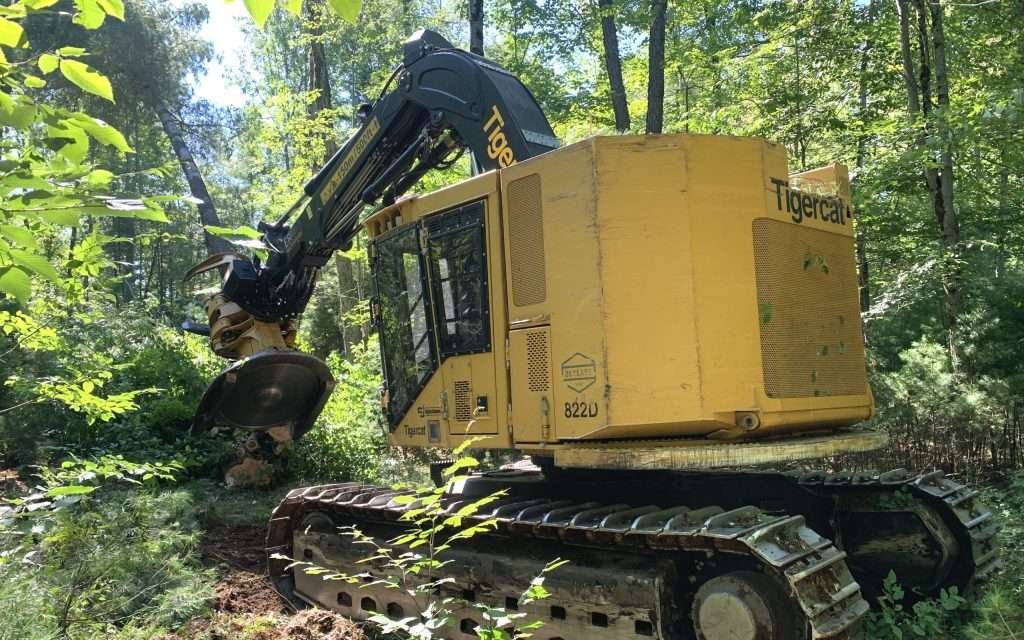
Photos, from above: A Tigercat 822E track feller buncher operating during logging operations in the Adirondacks (Timberline Magazine); and an APA field visit to Lyme Timber logging operations (David Gibson).
Recent Comments