
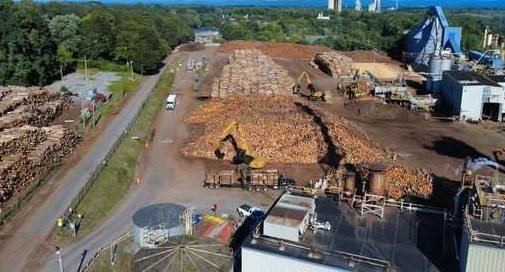
 The Finch Paper mill in Glens Falls, NY, a facility which has been buying pulp wood from the region’s loggers since 1865, has announced they will stop making their own pulp from local logs and will transition to buying it from suppliers outside the area.
Finch has been blending its own pulp with about 20% outside purchases. Going forward Finch is likely to source all its pulp from Canada, or buy market pulp, eliminating the work associated with the 45-50 log trucks who arrived at the mill daily.
The company said halting pulp production would allow them to focus entirely on paper making and expand their product offerings. Last year their parent company, the private equity firm Atlas Holdings, purchased and then took the parent company of Office Depot and Office Max private in a reported billion dollar deal.
 Hourly employees working in the pulp mill and the associated wood-yard, as well as other affected salaried staff, are being offered positions elsewhere in the company, they said. There is however, no guarantee about future lay-offs.
Forestry & Logging Effects
Finch has long claimed a “feet-in-the-forest philosophy,” and has required at least 90% of its fiber come from Sustainable Forestry Initiative (SFI) or Forest Stewardship Council (FSC) certified sources.
“We believe that knowing first-hand where your paper fiber comes from is the first step in reducing your environmental impact,” their website says. “Finch’s professional foresters manage forests for public and private landowners.”
“We have a stringent chain-of-custody program in place to track the sources of our wood and ensure it comes from responsibly managed North American forests rather than from endangered forests thousands of miles away,” the company website says.
Closing the log-yard will dramatically affect local logging companies. The vast majority of Adirondack logging operations rely heavily on supplying pulp wood – lower-grade wood tree tops and smaller trees – cleared during timber harvests, making it economically feasible for loggers to operate.
Hauling pulpwood long distances is highly cost prohibitive, leaving few remaining consumers, most notably the Sylvamo mill in Ticonderoga (formerly International Paper, the new company was spun off in 2021).
 That mill processes about 100 truckloads of wood daily, about 75% harvested in New York, with the remainder coming from Vermont and New Hampshire. Historically, Finch Paper saw about 55 to 60 log trucks per day (averaging around 20,000 trucks annually).
Finch will stop buying from the independent loggers who supplied pulp wood, some for generations. The parent company Atlas also owns Millar Western, an Alberta, Canada-based pulp producer, which makes the kind of pre-processed pulp sheets Finch said it would be buying in the future.
“When Finch transitions to purchased pulp, it will no longer be necessary for the company to purchase large quantities of logs from wood suppliers in the Northeast and New England,” the company said.
They said they will still purchase wood for use in their much smaller biomass co-generation facility. That process converts bark, sawdust, and wood scraps into high-pressure steam used to dry paper during production.
Finch currently employs about 600 workers. A company spokesperson told the Glens Falls Post Star that the transition will have “the beneficial effect of reducing odors associated with the Finch operation” in and around Glens Falls.
 Some History
Founded in 1865 by Jeremiah Finch, Daniel Finch, and Samuel Pruyn as Originally known as Finch, Pruyn & Co., a family-owned sawmill, lumberyard, and black marble quarry.
Around 1870, the Hudson River Pulp & Paper Company in Corinth, NY, along with the Remington family in Watertown, NY, pioneered the use of ground-wood pulp in paper-making, which dramatically lowered production costs and allowed for mass publishing.
Finch, Pruyn built a pulp mill in 1905 and transitioned to producing newsprint and wallpaper. In 1965 Finch expanded and modernized becoming a major producer of high-quality, bright white fine papers for printing.
After 142 years of local family ownership, the company was acquired by Atlas Holdings and Blue Wolf Capital, who renamed it Finch Paper in 2007.
 As part of the sale, 161,000 acres of its Adirondack forest lands were sold to The Nature Conservancy. This $110 million transaction prevented large contiguous forests in the Adirondack Park from being sold to developers.
Instead, 69,000 acres was added to the Adirondack Forest Preserve, including now popular recreation areas like the MacIntyre Tracts, the Essex Chain of Lakes, OK Slip Falls and the Hudson River Gorge, including the confluence of the Indian River with the Hudson, and the Boreas Ponds Tract.
The remaining 92,000+ acres was designated as Conservation Easement Lands. Bought by institutional timberland investors, these parcels remain private but are protected by permanent legal agreements that ban real estate development, protect water quality, and have sustainable logging guarantees.
 In 2019, Finch acquired the historic French Paper Company mill in Michigan, adding custom-colored premium papers.
Finch’s primary lines include Finch Fine and Finch Opaque, alongside specialized inkjet and technical specialty papers.
Read more about the history of Adirondack Logging.
Illustrations, from above: Finch Paper’s wood-yard and pulp mill buildings in Glens Falls; logger Evan Nahor of Long Lake, NY stands with his log skidder (photo courtesy of Evan Nahor, 2021); Raw Bulk Market Wood Pulp; Men gathered around a paper milling machine at a local paper mill, ca 1910, Glens Falls, NY (courtesy of the Chapman Museum); a map of the Finch Purchase in 2007 (provided by the Nature Conservancy); and raw bulk market wood pulp.
Recent Comments