
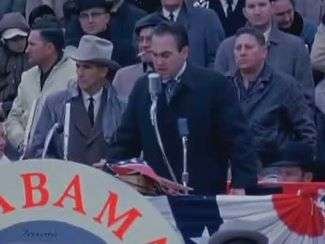
 On January 14, 1963, after being overwhelmingly elected by white Alabama voters, George Wallace, the infamous segregationist and white supremacist, delivered his inaugural address and called for “Segregation now! Segregation tomorrow! Segregation forever!” Throughout his speech he condemned integration and criticized federal intervention in state affairs.
Running for office almost a decade after Brown v. Board of Education, Wallace’s 1962 campaign used the slogan “Stand up for Alabama,” and he vowed to fight integration at the University of Alabama.
Six months later,he launched himself into the national spotlight by physically blocking two Black students, Vivian Malone and James Hood, from enrolling at the University of Alabama.
The dramatic “stand in the schoolhouse door” was broadcast on national television, and within a week, Wallace received over 100,000 telegrams from white people commending his actions.
Wallace developed a political identity that combined racial demagoguery and fiery rhetoric to defend segregation under the veneer of “states’ rights.” By appealing to racial sentiments, Wallace gained the support of voters who felt threatened by civil rights being extended to Black Americans.
Wallace in New York
During the 1968 presidential election campaign, a year fraught with racial injustice after, among other things, the assassination of Dr. Martin Luther King Jr., Wallace ran as an independent candidate appealing to white supremacy.
At a campaign stop where he was asked about the year’s protests against racial injustice, Wallace said: “We don’t have riots in Alabama! They start a riot down there, first one of ’em to pick up a brick gets a bullet in the brain, that’s all. And then you walk over to the next one and say, ‘All right, pick up a brick. We just want to see you pick up one of them bricks now!’”
In New York, Wallace often shifted from overt segregationist talk to coded language, attacking “pointy-headed bureaucrats” and “marauding criminals.”
 One of the most notorious events in New York political history occurred on October 24, 1968, when Wallace held a campaign rally at Madison Square Garden in New York City.
Over 3,000 police officers were deployed as some of the 16,000 supporters – including many neo-Nazis and Klansmen – clashed with anti-segregationist protesters outside on West 34th Street.
Inside, pro-Wallace attendees chanted “White Power” and “Kill ’em” while attacking protesters who had made it into the arena with folding chairs and sticks. Wallace himself taunted protesters from the stage, famously telling a long-haired youth, “I have a new word to teach you: S-O-A-P.”
“Today you cannot even go to the school systems of the large cities of our country without fear,” Wallace claimed during his speech.
“This is a sad day when in the greatest city in the world, there is fear not only in Madison Square Garden, but in every school building in the state of New York, and especially in the City of New York.
“Why has the leadership of both national parties kowtowed to this group of anarchists that makes it unsafe for your child and for your family? I don’t understand it. But I can assure you of this — that there’s not ten cents worth of difference with what the national parties say other than our party. Recently they say most of the same things we say.”
As the candidate for the American Independent Party (listed as “Courage” on the New York ballot) in the 1968 election Wallace won 5.29% of the vote in New York State, 358,864 votes in all.
He did the best downstate in the New York City suburbs, including in Putnam (9.82%), Staten Island (9.22%), Suffolk (8.35%), Orange (8.08%), Greene (7.90%), Schuyler (7.80%), Niagara (7.53%), Erie (7.37%), and Chemung (7.10%) counties all polling over 7%.
He fared worst in Manhattan (2.45%), and then in the Northern New York counties of Jefferson (3.07%), St. Lawrence (3.11%) and Franklin (3.49%).
Wallace was wildly popular with Southern white people and became the most successful and popular independent candidate in modern presidential election history — receiving almost 10 million votes (13.5 %) during the general election and winning the electoral votes of five states: Alabama, Arkansas, Georgia, Louisiana, and Mississippi.
While Wallace failed to win New York in 1968 his impact was significant, he successfully tapped into the “white backlash” against civil rights progress, catalyzing racial and political tensions especially among urban and working-class populations.
Wallace targeted blue-collar neighborhoods in New York, challenging the dominance of liberal Democrats by campaigning against federal interference, school busing, and exploiting fears of crime.
This helped pressure mainstream candidates like Richard Nixon to adopt “law and order” messaging and the Southern Strategy.
The political legacy of four-time Alabama governor and four-time presidential candidate George Wallace is enduring and increasingly relevant today. A portion of Interstate 10 in Alabama and community colleges in the cities of Dothan and Eufaula still bear Wallace’s name.
Much of this essay was published by the Equal Justice Initiative (EJI). Read EJI’s report Segregation in America to learn more.
Photos, from above: George Wallace deliver his white supremacist inaugural address on January 14 1963; New York City Police confront demonstrators at the Wallace rally at Madison Square Garden in 1968.
Recent Comments