
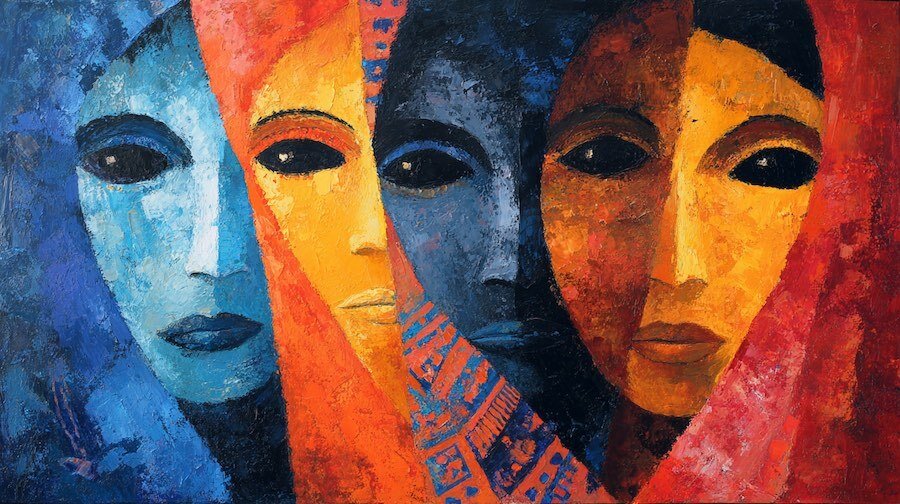

Right after finishing my OB/GYN residency at Northwestern, I worked at a public health clinic in San Diego County near Lemon Grove, California, where all of my patients were Somali immigrants and 100% of them had the most severe form of female genital mutilation (also called female circumcision.) Because I was their obstetrician and gynecologist, this meant I was up close and personal to the bodily torture these women experienced because they had been mutilated. Their vulvas had been cut off, their clitorises had been excised, and their vaginas had been sewn shut with the exception of a matchstick sized hole- all with no anesthesia, when they’re about 11 or 12. Many die from the procedure. Others are left incontinent or with chronic UTI’s and other gynecological issues, as well as difficult childbirths.
Not only was this FGM procedure meant to protect their virginity like a scarred up chastity belt that would prove they had been “deflowered” if they failed to obey the strict “no sex until marriage” rule of their religion and patriarchal culture. It was also a tradition the women passed on themselves, woman to woman, mother to child, revealing their own indoctrinated internalized patriarchy.
These Somali women grew near and dear to my heart during my time as their doctor. It was my job as a public health doctor to educate them, let them know FGM was illegal in the US, and help them understand how abusive it would be to put their own daughters through this kind of torture. But it was my job to learn their customs, to say yes when they invited me to their homes and restaurants, to let them tattoo my body with henna on my wedding day, as they insisted on doing.
These memories tug at my heartstrings as I read the news about how Somali immigrants are being treated by the Trump administration and his ICE henchmen. In moments like these — when a single community is singled out, vilified, and stripped of rights with breathtaking speed — I feel the familiar tug in my chest that tells me: Pay attention. This is not normal. This is not benign.
The recent attacks on Somali immigrants, including the administration’s inflammatory rhetoric and targeted enforcement in Minnesota, are not isolated political events. They are part of a recognizable pattern — one that students of history, trauma, and authoritarianism know well.It always begins with language, with “othering,” with blaming a vulnerable minority for the failings of those in power. And it never ends with the first group targeted.
When leaders use slurs to describe an entire population… when policies are weaponized to instill fear rather than uphold justice… when families who have fled war, famine, and persecution are treated as disposable — we are no longer in the domain of routine politics. We are in the early stages of an authoritarian playbook.
Authoritarianism depends on two things- a scapegoated group without enough political capital to defend itself, and a public too overwhelmed, numbed, or fatigued to push back. Somali immigrants — many of whom survived war trauma, displacement, and unimaginable loss — are now being publicly demeaned, stripped of legal protections, and subjected to sweeping enforcement actions. To be clear: these are our neighbors, our patients, our colleagues, our kids’ classmates. They are human beings who have already carried more than enough suffering for one lifetime.
People often imagine authoritarian collapse as a dramatic moment — a single catastrophic rupture. But in reality, it happens drip by drip. A speech here, using dehumanizing language.
A change in immigration policy there, stripping rights with the stroke of a pen. A few arrests, first quietly, then publicly, as intimidation. A community portrayed as criminals, burdens, or “garbage.” Then raids and the disappearance of human beings, without due process. Then murders in boats in the ocean in South America. Then murders of American citizens on the streets of Minnesota. Then..your street, your neighborhood, your kids, your neighbors- next.
If we don’t pause, look closely, and speak clearly, it’s easy for these moments to blend into the background of political noise. But when we zoom out, we see the pattern unmistakably. Oppression always starts with the marginalized, but its reach expands until no one is safe. Civil rights do not exist conditionally. They are not privileges reserved for those who “fit in,” speak perfect English, or come from the “right” countries. They are universal — or they are unstable.
When the government can terminate humanitarian protections, halt immigration processing from specific countries, or conduct sweeps targeting a single ethnic group, it sets a precedent that can be used — swiftly and unpredictably — against others. History teaches us that the erosion of rights never stops at one border, one community, or one category of people.
Empathy Is Not Optional — It Is a Civic Duty
I get tired of people who respond to emails like this with comments like “Stay in your lane.” So that’s why I want to tell you about Amina, Saraya, Fatima, and Sahra- my patients. As a physician who cares about public health, and as a spiritual seeker who cares about compassion and empathy, and as an activist who cares about justice- this is my lane. I’ve written a whole book now, RELATIONSICK, about the health implications of oppressive relationships and oppressive systems on human bodies. This shit makes us sick.
We live in a culture that too often narrows our circle of concern to “people like us.” But moral courage asks something much harder. It asks us to extend empathy beyond our immediate circles, to refuse to look away when vulnerable people are harmed, to see the interconnectedness of all of our destinies, and to hold perpetrators of oppression to account- with our votes, with your protests, with our consumer choices, and when possible, with legal action.
I send blessings every day to the hard working and underpaid lawyers at the ACLU, who are working their asses off right now to hold perpetrators of authoritarian oppression to account. And I send love and care through the air waves to Somali immigrants and immigrants everywhere — many of whom have endured violence, famine, displacement, and profound trauma , who deserve not only safety but belonging. They deserve policies rooted in dignity, not fear.
They deserve leaders who tell the truth, not those who weaponize lies for political gain.
They deserve communities willing to stand up and say, “No. Not on our watch.”
Thank God Minnesotans with the power and privilege to do so are doing just that, even as they risk being the next Renee Good or Alex Pretti. They give me hope, these brave courageous community members of Minnesota, who are coming together to protect those who are most vulnerable.
What We Do Now Matters
We are living through a moment that future generations will judge with clarity. They will ask-When our country demonized an already traumatized community, where did we stand?
When families were threatened with deportation, detainment, or separation, did we speak up or did we let ICE become the next Gestapo? When authoritarian tactics were deployed, did we shrink or step forward?
Silence is a choice. Enabling is a choice. Complicity is a choice. Empathy is also a choice — and it has never been more necessary.
The Somali mothers I cared for in Lemon Grove — the ones who arrived in the U.S. seeking safety, raising children between two cultures, surviving wars they did not choose and sexual assaults by warring tribespeople they did not know — are part of the story of who we are as a country. To defend them now is to defend the core of our shared humanity. To stand with them is to stand on the side of history that expands freedom rather than contracts it. To speak up is to resist the slow creep of authoritarianism that depends on our quiet. This is the moment to widen our circle — to let our empathy reach the people who need it most. Because when we protect the vulnerable, we protect everyone.
I will be at the next protest- and the next, and the next. And if ICE comes to my town, as I’m sure it will- I will be blowing whistles and risking my life to protect my neighborsI hope you will be too. May we stand in solidarity with the people of Minnesota who are courageously creating circles of care.
If you’re not following Civil Rights lawyer and activist Valarie Kaur, who was on the ground with the people of Minnesota when Alex Pretti was killed, I recommend watching this healing circle she held online, especially the field notes and call to action sections. Let us all be inspired- and get trained- so we can follow the lead of the Minnesota people when ICE shows up in our own towns.
Key Timestamps:
- 03:00 – Opening Meditation + Grounding — Valarie
- 13:29 – Song “Somebody’s Beloved” — MILCK
- 17:03 – Field Notes from Minneapolis + Why Minnesota is a blueprint of love — Valarie
- 37:41 – Conversation with Minneapolis faith leader Rev. Dewayne Davis
- 54:47 – A story of “love in action” after ICE attack
- 01:04:52 – Calls to Action: Organize locally and support Minnesota
- 1:09:39 – Song “Shine a Little Light” by Emma Kieran Schaefer
I also feel called to share a poem that always blooms in my heart when I hear racist people talk smack about immigrants.
Home
By Warsan Shire
no one leaves home unless
home is the mouth of a shark
you only run for the border
when you see the whole city running as well
your neighbors running faster than you
breath bloody in their throats
the boy you went to school with
who kissed you dizzy behind the old tin factory
is holding a gun bigger than his body
you only leave home
when home won’t let you stay.
no one leaves home unless home chases you
fire under feet
hot blood in your belly
it’s not something you ever thought of doing
until the blade burnt threats into
your neck
and even then you carried the anthem under
your breath
only tearing up your passport in an airport toilets
sobbing as each mouthful of paper
made it clear that you wouldn’t be going back.
you have to understand,
that no one puts their children in a boat
unless the water is safer than the land
no one burns their palms
under trains
beneath carriages
no one spends days and nights in the stomach of a truck
feeding on newspaper unless the miles travelled
means something more than journey.
no one crawls under fences
no one wants to be beaten
pitied
no one chooses refugee camps
or strip searches where your
body is left aching
or prison,
because prison is safer
than a city of fire
and one prison guard
in the night
is better than a truckload
of men who look like your father
no one could take it
no one could stomach it
no one skin would be tough enough
the
go home blacks
refugees
dirty immigrants
asylum seekers
sucking our country dry
niggers with their hands out
they smell strange
savage
messed up their country and now they want
to mess ours up
how do the words
the dirty looks
roll off your backs
maybe because the blow is softer
than a limb torn off
or the words are more tender
than fourteen men between
your legs
or the insults are easier
to swallow
than rubble
than bone
than your child body
in pieces.
i want to go home,
but home is the mouth of a shark
home is the barrel of the gun
and no one would leave home
unless home chased you to the shore
unless home told you
to quicken your legs
leave your clothes behind
crawl through the desert
wade through the oceans
drown
save
be hunger
beg
forget pride
your survival is more important
no one leaves home until home is a sweaty voice in your ear
sayingleave,
run away from me now
i dont know what i’ve become
but i know that anywhere
is safer than here
Recent Comments