
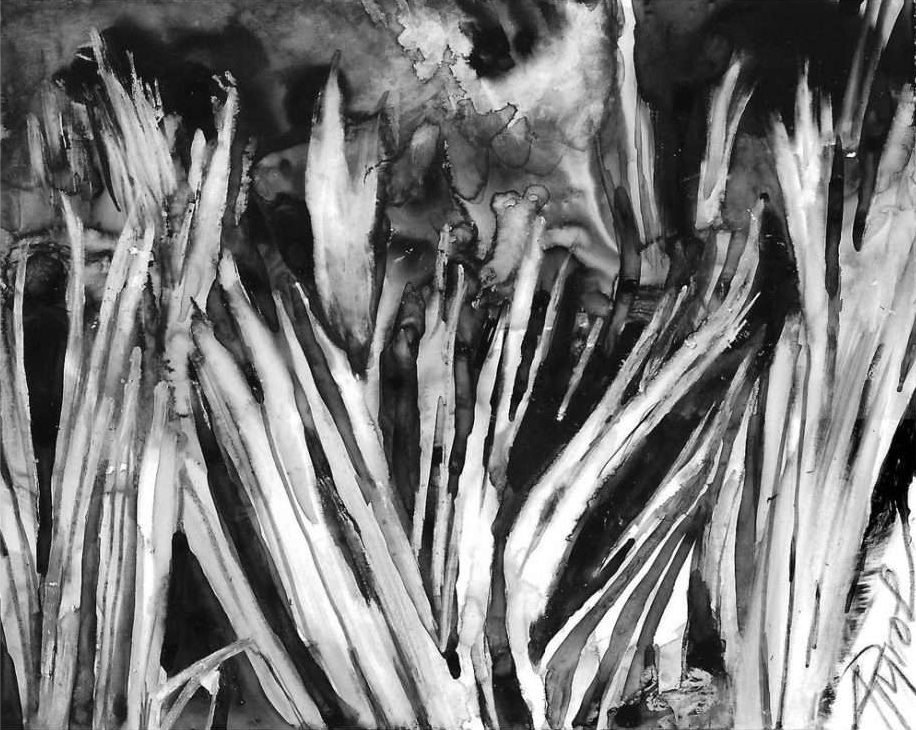
 On an early winter walk with my three-year-old in a local town forest, we heard our steps crunch on the frozen ground. The dirt of the trail had been pushed up on delicate columns of ice that looked like a pale sugar candy.
“Why is it like ribbon candy?” he asked. We were crunching through a forest of needle ice.
These needle-thin columns of ice extrude from the ground in rows and ribbons when the soil type and weather conditions are just right. To get needle ice, you need soil that is porous enough to allow water to move through it. Soils that support needle ice the most readily contain high percentages of organic content and silt – the mineral particles that are intermediate in size between clay and sand.
Next, you need below-freezing air temperatures paired with unfrozen ground. The water between the soil particles must still be liquid and able to flow. Right at the surface, where this water makes contact with the below-freezing air, it freezes into ice, expanding into the open space above ground. As it does, more liquid water is pulled upward to the soil surface by a phenomenon called capillary action.
Capillary action is the ability of liquids to defy gravity in very narrow spaces because their molecules stick to surfaces (like soil particles) and to each other. It occurs through the combined effects of adhesion, cohesion, and surface tension.
Adhesion is the attraction of different kinds of molecules to each other, causing them to stick together. As water moves through the soil, its molecules are attracted to the different kinds of molecules that make up the soil. At the same time, water has cohesion, which is the attraction between molecules of the same type. So, water will stick to itself.
This cohesion also gives it surface tension: water molecules at the surface of a blob of water are more attracted to the water molecules below them than to molecules in the air. That attraction pulls them inwards, causing molecules at the surface to act like a taut skin surrounding and holding the water blob together.
For capillary action to cause needle ice, water’s adhesion to soil molecules must be greater than its cohesion: the water must stick to soil better than to itself. That strong adhesion means the water molecules will be so sticky to the soil particles that they can migrate up through the tiny holes in a porous soil.
However, the water must have enough cohesion and surface tension that as some molecules begin to ooze upwards, their cohesion tugs even more along with them, then, as they flow slowly through the cracks and crannies of the soil, the “skin” of surface tension keeps them all together.
Needle ice can grow into spires of up to four inches, often lifting soil and small stones along the way. While it’s always measured in inches, it can have a big geological impact over long periods of time.
In places where needle ice formation happens frequently over thousands of years, like polar or alpine regions, these little spikes can sort the ground into complex patterns. Over many cycles of lifting and moving, pebbles of similar size tend to collect into sorted piles, which are often strikingly organized into shapes like circles, stripes, or labyrinths.
The unique organization of a specific pebble pile is shaped by the starting concentration of rocks in the area, plus the height that needle ice can grow under the conditions of that location. Rock patterns similar to those made by arctic needle ice have been spotted as far away as on Mars, lending evidence to the theory of past liquid water on our planetary neighbor.
If you want to see some needle ice, but don’t want to visit the tundra, look before the ground has frozen or during a cold snap after a period of thaw. I often see it along the sides of trails, where the ground hasn’t been compacted by many passing feet. If you keep an eye out, you’ll see it – it’s just a matter of time.
Read more stories about winter in New York State.
Rachel Sargent Mirus is a teaching artist and writer. Illustration by Adelaide Murphy Tyrol. The Outside Story is assigned and edited by Northern Woodlands magazine and sponsored by the Wellborn Ecology Fund of New Hampshire Charitable Foundation: nhcf.org.
Recent Comments