
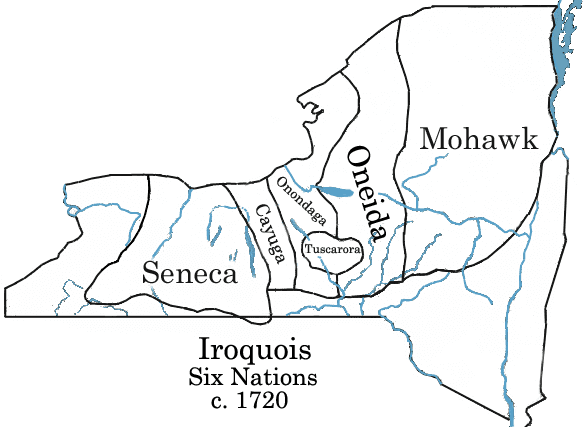
 In attempts to maximize proximity to valuable trade with the Haudenosaunee and other Indigenous nations, Europeans established outposts and forts farther and farther into the interior of Haudenosaunee territory and the Great Lakes.
The French followed the St. Lawrence River into the Great Lakes and discovered that the Oswego River provided a water route inland to the Oswego-Oneida-Mohawk Carry, a trail using the largest portage connecting the Great Lakes and the Atlantic Ocean.
French colonizers and traders quickly established a supply and trade route down the Oswego River and attempted to establish a fort on the shore of Onondaga Lake as early as the 1650s. The harsh winters, remote location, and raids from the Haudenosaunee led the French to abandon the idea.
Indigenous Transportation
For centuries, today’s sovereign Native nations and their ancestors relied on multiple rivers and portages or “carries” (where boats, goods, and people transferred overland from one body of water to another) to move people, goods, and communications across a vast landscape.
The strategically important Oneida Carrying Place in today’s Rome, New York, allowed boat traffic between widely dispersed sites like the Hudson River to the east (including what is now Albany and New York City) and Lake Erie (e.g. Buffalo) and the Ohio River Valley to the west, as well as Canadian sites to the north via the Oswego River to Lake Ontario.
 This set of waterway connections from the ocean to the interior of North America was so economically, politically, and culturally important that it was later replicated at great expense in the early 19th century by the Erie Canalway system.
Through these associations, Oswego was a long-standing meeting place of great cultural, spiritual, political, military, and economic importance for the Haudenosaunee Confederacy and their ancestors. It was also part of the larger network of important meeting places along the extended system of interconnected waterways from the ocean to the continent’s interior.
From Native nations European colonizers came to understand the strategic importance of this network of waterways, portages, and sites to enable free passage by boat as well as key choke points to deny the advantage to opponents. In seeking to control the fur trade and establish territorial dominance, the British built forts along the waterways, including at key portage sites.
For example, the British built Fort Stanwix at the critical Oneida Carrying Place location. Similarly, to control the movement of people and goods through Lake Ontario via the Oswego River, the British eventually constructed three British forts in Oswego, including Fort Ontario.
Early Oswego Forts
In 1664, the British took control of the Dutch colony of New Amsterdam, and as early as 1678, Onondaga representatives suggested to the mayor of Albany that an English fort be constructed at Oswego to facilitate trade with the western Haudenosaunee. Colonial wars between Britain and France in North America came to a head in 1688 with King William’s War and continued into the 18th century.
In 1727, British Colonial New York Governor William Burnet ordered the establishment of a fortification on the western bank of the mouth of the Oswego River (on the opposite side of the river from the present-day Fort Ontario) in response to the French’s construction of Fort Niagara at the mouth of the Niagara River on the east end of Lake Erie.
 The British garrison named Fort Oswego was located on low ground that was vulnerable to artillery and difficult to access from other British outposts. It was also shoddily constructed as the British Empire decided to focus its wealth and attention on Atlantic fisheries and West Indian sugar plantations over the French-dominated Great Lakes fur trade.
For 28 years, from its 1727 construction to the 1750s, Fort Oswego on the western bank of the Oswego River was the only British fortification on the Great Lakes.
The colony of New York’s strategic importance gained the attention of French and English empires as hostilities between the European nations grew.
For a period from 1730 to 1815, the area that is now upstate New York — considered part of the northern frontier of 18th-century European colonialization and settlement — was one of the most contested landscapes in North America.
French and Indian War (1755–1763)
British Major General William Shirley arrived in Oswego in 1755 while the two European nations were on the verge of the Seven Years’ War (1756–1763). Upon his arrival, Shirley improved the defenses of Fort Oswego, constructed a royal dockyard to build a British naval fleet on the Great Lakes, and erected two additional forts: Fort George and Fort Ontario.
 Fort George was built on the highlands to the west of Fort Oswego and the Oswego River. Fort Ontario — also called the East Fort and the Fort of Six Nations — was constructed on the bluff east of the mouth of the Oswego River to provide strategic control of the harbor where the river meets Lake Ontario.
The first Fort Ontario was made of 18-inch-thick log palisades arranged in an eight-pointed star design. Wood barracks were built against the angles of the walls, and a gallery provided a platform to fire small arms over the walls.
Fort Ontario was the best fortified of the three forts located at Oswego, but all three fortifications were poorly constructed and vulnerable to cannon fire.
Following his March 1756 victory at Fort Bull at the Oneida Carry (in today’s Rome, New York, near Fort Stanwix and 60 miles southeast of Oswego), French Commander-in-Chief Louis Joseph, the Marquis de Montcalm, led nearly 4,000 French regulars, Canadians, and Haudenosaunee supporters in a siege of Oswego the morning of August 11, 1756.
Montcalm’s forces continued to fire on Fort Ontario until August 13, when the British garrison abandoned the fort and fled to the fortifications on the west side of the Oswego River. The battle continued after French forces occupied Fort Ontario. Montcalm’s forces continued to advance and fire from a bluff overlooking the western forts until British forces surrendered.
The Siege of Fort Ontario and Battle of Fort Oswego resulted in fewer than 50 British deaths and even smaller losses for the French. But between 1,300 and 1,700 British prisoners were briefly held at Fort Ontario before being taken to French Canada. Although relatively small in scale, the French attack destroyed all three forts as well as Britain’s naval fleet on the Great Lakes.
The victory at Oswego was featured on a 1758 medal commemorating French military successes around the globe.
 As the war raged on, British forces returned to Oswego in 1759 and built a temporary field fortification at the site of the burned Fort Ontario. The fortification became the base for a campaign against French forces at Fort Niagara. Construction began on the second Fort Ontario in August 1759.
The pentagon-shaped fort was large by colonial standards and had a much more complex design than the previous Oswego forts. Log casements and barracks were built into the walls. A key feature of the second fort was extensive outerworks; the defensive landscape around the stockade included a dry moat, demi-lunes, palisades, and sloping glacis.
During the spring of 1760, British forces gathered 10,000 men soldiers and 300 Native fighters at Fort Ontario to attack Montreal, the last major stronghold in New France. With the surrender of Montreal in September of that year, Canada became part of the British Empire.
The February 1763 Treaty of Paris officially ended the Seven Years’ War and removed the threat of French hostilities against British colonial outposts. With the French claims ceded to the British, the British government left Fort Ontario lightly garrisoned and shifted attentions to seaside colonial cities and the newly acquired, French-built Great Lakes forts farther west.
English and other European settlers pushed into Haudenosaunee and other Native lands, which increased tensions among all parties.
Read more about Oswego.
This essay was drawn from the National Park Service’s 2024 Fort Ontario Special Resources Study, available in it’s entirety with footnotes here.
Illustrations, from above: Iroquois Six Nations map, ca. 1720; “Iroquois Cantons In New York,” a map of 17th-18th century Mohawk Valley indigenous trails and settler, Jesuit, and native communities from near Schenectady to Rome, the Great Carry to Oneida Lake (Jesuit Relations and Allied Documents, v. 51, 1899) based on research of William M. Beauchamp of Baldwinville.; “A South View of Oswego on Lake Ontario in North America,” engraved for the London magazine, 1760; “English Plans for the Forts Ontario and Oswego with part of the River Onondago (Onondaga) and Lake Ontario 1756” (NYPL); and “A Plan for Fort Ontario built in Oswego in 1759” (Library of Congress).
Recent Comments