
 This is a story about growing up on the west side of Saratoga Springs as a member of the post-World War II baby boom generation (1946-1964). Which side was the east side or the west side of Saratoga Springs was determined by the railroad tracks until the late 1950s, but today Broadway is considered the dividing line.
Our neighborhood was centered on the intersection of Waterbury and Lawrence Streets and was very similar to other neighborhoods in Saratoga. Kids were everywhere.
The west end of Waterbury Street was the site of The G.F. Harvey Company, maker of Saratoga Ointment. Every household in town had a jar of the ointment. The 15 households around the intersection were home to 45 children born between 1946 and 1962.
During our growing up years Lawrence Street was a dead-end street terminating at the Woodlawn Estate Oval, a trotting track on the former estate of Henry Hilton.
The oval was an “in the woods” type of playground for all the children living in that area. This section of town was referred to as “the rocks” due to granite bedrock’s proximity to the surface, in some areas mere inches below ground.
Primary features of the Oval area were “Big Pond” and “Little Pond” each about 18 inches or so deep, and two “Ash Roads” (First and Second). The First Ash Road connected Clinton Street with Waterbury, the Second Ash Road connected Clinton with Greenfield Avenue.
A large field, of five or more acres, was also part of the Oval, and miraculously the hay and straw were mowed a couple of times each summer. The Oval was the edge of town in those days and contained wildlife and was a wonderful area to explore, build “forts,” play hide and seek, or just have adventures. The Oval is now home to the Embury Senior Apartment Complex.
As we got older (perhaps seven or eight) we dared to wander a bit farther. Hilton’s vast Woodlawn Park estate (later the location of Skidmore College) and what remained of his mansion were close by. Following old railroad tracks north parallel to Seward Street there was a freshwater spring bubbling out of the rock – “Hobo Springs” – which served a resting spot where fresh, cold water was available.
West of the railroad tracks was an old stone quarry we called “The Crusher.” The Crusher was full of water to about 4 or 5 feet below the top. The temptation to jump into The Crusher on a hot day was always there, however a brief examination led to the realization that once you were actually in old quarry, getting out would be a problem.
Ash Grove Farms was next to the quarry property (it may in fact have been part of Ash Grove Farms) and the farm had plenty of cows and horses for us to annoy. The grounds of The Saratoga Golf and Polo Club are near the Ash Grove fields. Many of us received our initial taste of golf at “The Little Club,” either by caddying or “jumping on” and playing without permission or paying.
The grounds of “The Little Club” were also a mecca for sleds and toboggans in the winter months. Many winter weekends were spent flying down the various hills of the golf course, then, taking turns hauling the toboggan back up to do it again.
Adjacent to “The Little Club” was the estate of Warren Wright owner of Calumet Farm, a Kentucky horse farm and racing stable. Between the Wright property and the railroad tracks were the grounds of the Iceland Hotel, which was large and vacant and could be scary. The hotel was destroyed by fire sometime in the 1970s and is now the Birch Run housing development, constructed in 1987.
Around the time we reached the fourth grade, we became fascinated with the Soapbox Derby. The Clinton Street Hill was a perfect spot to test our derby cars.
The parts for our racers were either scavenged from neighborhood backyards or acquired from “Pop Ballou,” who circulated the streets with his horse and wagon picking up discarded items before carrying the “junk” back to his small barn and yard on Waterbury Street, where they were sold to earn his living. He mostly gave us what we needed.
Beyond the bottom of the Clinton Street hill, on the Woodlawn Estate, was the Vly. Although “vly” or “fly” is a commonly seen word in our area derived from Dutch New Netherlanders meaning swamp or marsh – although this vly was a large pond surrounded by woods and full of fish.
A wonderful spot for skinny dipping, fishing, catching frogs or enjoying nature. The vly contained mostly bullheads and the area in and around it had a large population of snakes of many sizes and varieties. It was drained and excavated for the railroad when the tracks were relocated out of downtown Saratoga Springs in the late 1950s.
We continued to expand the horizons of our world, roving on Daniels Road. In our day the roads beginning with Clinton Street hill and beyond were dirt roads. Daniels Road paralleled the Adirondack Railroad tracks past Locust Grove Road to Route 9N.
Our bicycles opened new vistas for our exploration, but that’s another story.
Mike Murray is a life-long resident of Saratoga Springs and a local history buff. He has a special interest in thoroughbred racing and currently gives tours of the Oklahoma track for the National Museum of Racing.
This essay is presented by the Saratoga County History Roundtable and the Saratoga County History Center. Follow them on Twitter and Facebook.
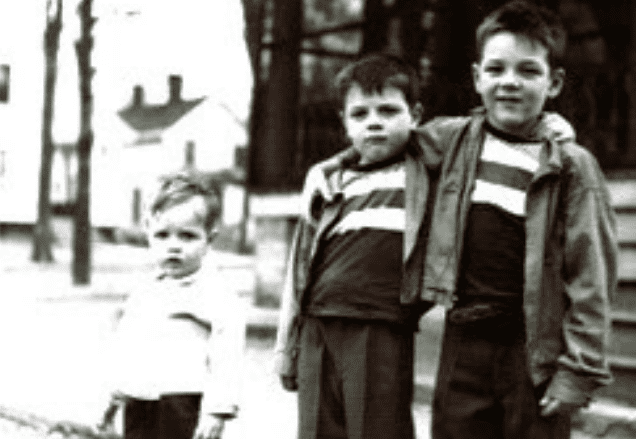
Photo: Steve, Dennis and Michael Murray of Saratoga Springs in 1953.

Recent Comments