
 After the American Revolutionary War (1775-1783), remaining friction between Britain and the United States escalated into another war in North America 30 years later.
Both countries were determined to assert control over Lake Ontario, bringing Fort Ontario to the front lines of the War of 1812 (1812-1815). Britain saw Oswego as an integral connection to New York shipyards that could support future naval battles and supply additional American ships.
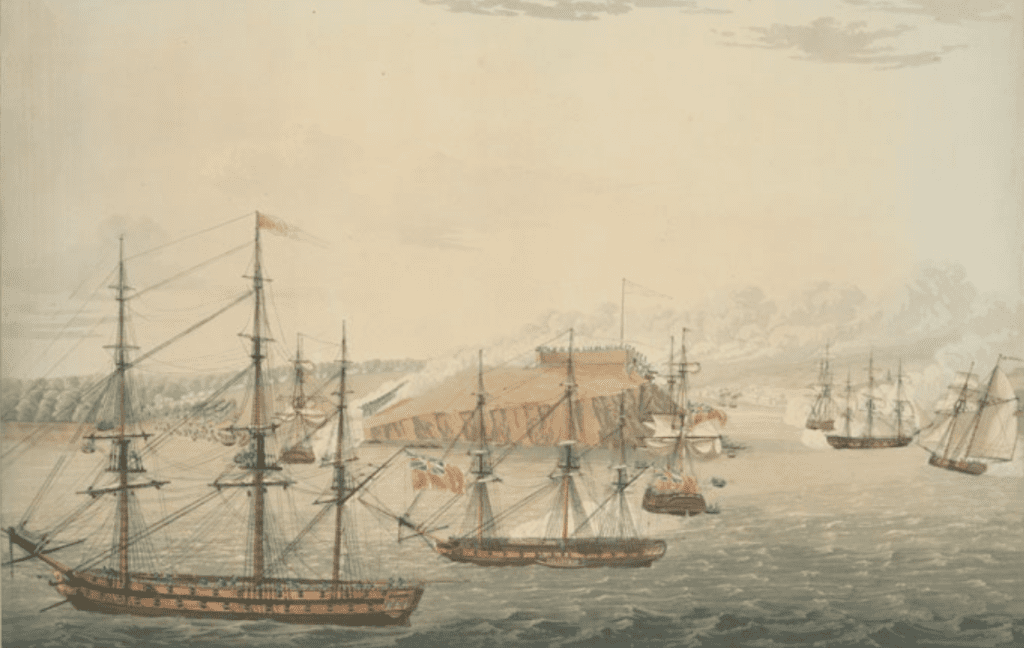
A few Lake Ontario naval skirmishes in June 1813 led to the British naval bombardment and subsequent taking of Fort Ontario on May 3–4, 1814. The occupying British troops burned the wood portions of the reconstructed fortifications and returned to Kingston, Ontario, leaving Fort Ontario in ruins again.
Although Oswego and remains of the Fort Ontario earthworks were returned to the United States after the Treaty of Ghent officially ended the war in December 1814, there were no immediate efforts to rebuild a US military post at the site.
Squatters moved into the former military reservation as the settlements of West Oswego and East Oswego grew in development and population.
Patriot War (1838–1839)
In the late 1830s, the US military again turned to Oswego to protect the country’s border with Canada and the Mohawk-Oneida-Oswego waterways.
Skirmishes between French Canadian nationalists and the British colonial government of Upper Canada (now Ontario Province) and Lower Canada (the southern portion of present-day Quebec) led to the 1837–1838 conflict known as the Patriot War.
 US Major General Winfield Scott visited the US-Canada border and felt the military should protect Oswego’s connection to interior New York and the Erie Canal and curtail any Canadian Patriot support from American sympathizers.
Following Major General Scott’s recommendations, President Martin Van Buren reactivated Fort Ontario in 1838; the first company to reestablish the reservation arrived in November of that year.
Construction of the fourth Fort Ontario began in the spring of 1839. The US Army essentially reconstructed the previous earthworks, but the 19th-century fort included thicker and higher ramparts than the 1759 version.
The fourth fort also featured wood-revetted scarp slopes and parade walls and additional support buildings outside the core fortification.
While Canada’s Patriot War finally ended in 1842 with the signing of the Webster-Ashbury Treaty, construction of the new Fort Ontario wasn’t completed until 1845. The start of the Mexican-American War in 1846 drew Fort Ontario’s garrisoned troops west and left the reservation under the care of a string of ordinance sergeant caretakers and individual companies for the next 15 years.
American Civil War & Fenian Raids
Although the fort was showing its age and signs of disuse by the 1860s, New York Governor Edwin D. Morgan named Fort Ontario as a regional assembly point for Union Army volunteers at the outbreak of the Civil War in 1861.
 In 1863, updates to the fortification began; the aging military reservation continued to host induction and training activities throughout the course of the war. A quarry was opened east of the fort to provide stone for the outer walls.
The American Civil War ended in April 1865, but improvements to Fort Ontario continued as the US military turned its attention toward subduing the US-based Irish national group the Fenians and their plans to overthrow the British-Canadian government. By the 1870s, the Fenians no longer posed a threat to the United States or Canada.
In 1872, Congress declared Fort Ontario obsolete as a defensive installation, and all funding toward improvements at the fort was rescinded. Companies continued to report to Oswego throughout the 1880s, but by 1894, the fort was again abandoned.
The Fort Ontario Military Reservation was deactivated in 1901, when the last garrison was reassigned and all remaining supplies were transferred to Madison Barracks in Sackets Harbor, New York.
Military Buildup and World War I
As part of the reorganization of the US Army, Secretary of War Elihu Root (a native of Oneida County, New York) recommended that Fort Ontario be reopened as a training center as part of the broader military reorganization occurring at the beginning of the 20th century.
The main tenants of what is now known as the “Root Reform Era” were modernizing the armed forces, strengthening the standing Army, and effectively training the US Army to respond to missions outside of war.
 Between 1903 and 1905, the Fort Ontario military reservation shifted from a frontier defensive outpost to a training installation that could accommodate approximately 300 to 400 men.
The outer earthworks and 19th-century buildings outside the core fortification were removed to make space for additional development. A large, kidney-shaped parade ground was created east of the fortification and surrounded with new roadways and 21 brick buildings that would support the companies or battalions training at the reservation.
When the United States entered World War I in April 1917, the regular garrison station at the military reservation transferred out and was replaced with medical personnel who helped convert Fort Ontario into a base hospital.
The Army Medical Corps operated General Hospital #5 at the fort throughout the course of World War I; Fort Ontario returned to its status as an infantry training post in 1921.
 World War II: Training Center and Emergency Refugee Shelter
In October 1940, the War Department decided to make Fort Ontario home to a permanent anti-aircraft artillery unit and invested over $1 million to update the facility and increase its capacity to accommodate up to 3,000 men. Over 60 additional buildings were constructed, and at the peak of the military reservation’s development, 129 buildings stood on the grounds.
One of the first anti-aircraft battalions to train at Fort Ontario was the 369th Coast Artillery Regiment, an African American company based out of New York City that arrived in Oswego in January 1941.
The fort also hosted military police training and a troop literacy program led by instructors from the nearby Oswego Teaching College (now the State University of New York at Oswego).
Emergency Refugee Shelter
By March 1944, the troops had completed training and the fort was again mostly vacant. The town petitioned the War Department and the White House to establish a new and appropriate use for the fort.
On June 12, 1944, President Franklin Roosevelt announced that the largely vacant Fort Ontario Military Reservation would become an emergency shelter for European refugees who were invited to stay in the United States for the duration of the war as “guests” of the president.
In August, a group of 982 people representing 18 different nationalities arrived in Oswego from overcrowded refugee centers in Italy. Wood buildings constructed earlier in the decade to house soldiers were converted into small family apartments and other community buildings necessary for long-term accommodations.
 The Fort Ontario Emergency Refugee Shelter, operated by the War Relocation Authority, officially opened on August 5, 1944.
Over the remaining course of World War II, the War Relocation Authority provided food, housing, medical care, clothing, and education for the Fort Ontario refugees while private aid organizations provided additional social services and amenities.
Following the Allies’ victory in Europe and official end of the war on May 8, 1945, the refugees were faced with uncertainty regarding their legal status in the United States and their potential return to Europe.
In December 1945, President Harry Truman stated that all the refugees at Fort Ontario appeared to meet immigration criteria and could remain in the United States as legal immigrants.
In December 1945, after the Second World War, the last refugee departed the Fort Ontario Emergency Refugee Shelter on February 5, 1946, and the military reservation returned to the War Department at the end of the month.
The property then transferred to the State of New York on April 3, 1946.
This essay was drawn from the National Park Service’s 2024 Fort Ontario Special Resources Study, available in it’s entirety with footnotes here.
Illustrations, from above: “Attack on Fort Oswego, Lake Ontario, North America,” 1815 (NYPL); Detail, “Lower Canada Patriots Nov 1838 Battle of Beauharnois” by Loyalist Katherine Jane Ellice, who was held prisoner by Patriot François Xavier Prieur; “Fort Ontario Details of Detached Scarp and Flank Casements, June 10, 1863” (National Archives); Fort Ontario around World War One; Extent of Fort Ontario Military Reservation during World War Two (Cultural Landscape Report); and Refugee families at Fort Ontario Emergency Refugee Shelter, Oswego, NY, 1944 (Safe Haven Museum and Education Center).
Recent Comments