
 After the cold, and snowy winter we experienced this year in the Empire State, it is difficult to imagine a major league ballclub preparing for the season by holding Spring Training in upstate New York.
Many contingencies emerged from the privations which occurred on the home front during World War II.
President Franklin D. Roosevelt, rationalized that broadcasts and box scores from the National Pastime reaching fighting Americans overseas would buoy morale and provide a sense of purpose. A radio broadcast of a ballgame echoing through the many defense plants would raise spirits there as well.
The quality of baseball play itself was not really at a major league caliber during the war, with so many of the regular players having shed their flannels and donned military uniforms.
 Most participants were classified 4-F, or ineligible for military service due to physical limitations, and the rest were disqualified militarily due to their age. Players were also lost to war work on farms and industry, and many who had retired from the game were recalled.
Spring training for wartime baseball was severely curtailed. Commissioner Kenesaw Mountain Landis (1866-1944), who had ruled baseball with an iron-fist since being installed after the Black Sox scandal of 1919, and Joseph B. Eastman, director of Defense Transportation, compromised on a decree which prevented teams traveling south, instead remaining near their home field.
All major league teams were divided east and west, with spring camps for the eastern contingent located not further south than the Potomac River and, for the western contingent, not further south than the Ohio River, with all teams located east of the Mississippi River.
On March 8, 1943 the Associated Press noted, “It will be no laughing matter for the parties concerned, but baseball is about to open a spring training season that will be remembered as one of the queerest, funniest chapters in the history of the national pastime.”
Spring Training Facilities
Casey Stengel put his Boston Braves through their wartime training camp routine at Choate Rosemary Hall in Wallingford, Connecticut. This school had an indoor batting cage and a number of outdoor baseball diamonds.
Joe Cronin drilled the Red Sox in Tufts University’s Cousens Gym, and when conditions allowed, Fenway Park was less than 10 miles away from the Medford campus.
 Connie Mack disciplined his Philadelphia Athletics at Wilmington Park, which normally hosted the U. of Delaware football games as well as the community’s minor league entry. The Mack-men poker games had a nickel-dime limit during camp.
Their crosstown rivals, the Philadelphia Philles, held training at the hockey arena at Hershey Park where owner Bill Cox called for “commando training.” His idea was to make his ball players “hard as nails.”
The Washington Senators, the only big league club that played their home games south of the Potomac in those days, trained under manager Ossie Bluege on the University of Maryland campus in College Park, Maryland.
The Hoosier State of Indiana had no major league teams, but due to hostilities would now have six.
The Pittsburgh Pirates relocated to McCulloch Park, a minor league facility in Muncie.
The Cincinnati Reds had their spring camp at Indiana University in Bloomington, utilizing Wildermuth Gymnasium.
The Cleveland Indians, under player/manager Lou Boudreau, trained at Purdue University in West Lafayette.
Both Chicago teams, the White Sox and Cubs, headed for the resort hotel in French Lick Springs, Indiana where a ball diamond was enclosed by a two-level velodrome.
The Detroit Tigers used Bosse Field in Evansville, which was built for minor league play in 1915 as the first municipally owned sports complex in the nation, with the only older ballparks existing today being Boston’s Fenway Park and Wrigley Field in Chicago.
The St. Louis Cardinals used Cotter Field, a minor league ballpark in Cairo, Illinois near the confluence of the Mississippi and Ohio Rivers.
The St. Louis Browns (who are presently the Baltimore Oriole franchise) held their training on the grounds of Southeast Missouri State Teachers College in Cape Girardeau, Missouri, which was on the west bank of the mighty Mississippi, but close enough to the design parameter for federal officials to let it slide.
The Yankees held spring training camp at Asbury Park, New Jersey utilizing a local hotel and nearby high school fields for shedding their excess poundage, with the New York Giants under Mel Ott holding spring training on a private golf course developed by John D. Rockefeller, also in the Garden State at Lakewood.
For the Giants organization it was something of a return, having trained in Lakewood during the 1890s.
 The Brooklyn Dodgers at Bear Mountain
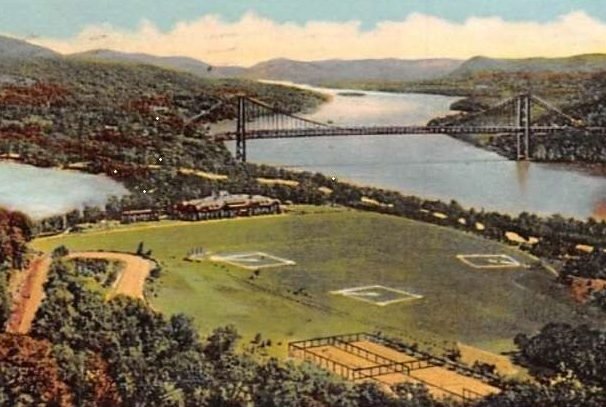
In the picturesque Hudson Valley, with mountainous Anthony’s Nose jutting out across the way, the Brooklyn Dodgers selected Bear Mountain State Park (established in 1913) for their training site.
At that time, in January 1943, someone counted 22 deer feeding on the baseball field. Bear Mountain was a winter sports center featuring ice skating, skiing and a big stone fireplace in the oversize log structure known as “The Inn.”
The Dodgers General Manager Branch Rickey (1881-1965), a former major league catcher, made his first trip to Bear Mountain in February 1943 and his description of facilities was quoted; “Sighted outfield, sank in same.”
The Brooklyn Dodgers players and management had some experience traveling into upstate New York, as the team had had a working relationship with their minor league affiliates, the Elmira Pioneers and Olean Oilers, for several years before the war began.
These expeditions upstate usually set out from New York aboard the Weehawken ferry with Mel Jones, the Dodgers traveling secretary, warning players to expect harsh weather and recommending long-johns.
 Days at Bear Mountain, when the weather was inclement (which was often), the team piled into a bus and traveled five miles to the vast field house of the U.S. Military Academy at West Point.
Manager Leo Durocher led his noisy gang of players into the Army’s baseball “cage,” and under rope netting the Dodgers pitched, bunted, batted and fielded during indoor workouts, with the temperature steam heated to about 70 degrees.
It was understood that at this facility, permission was subject to change and could be revoked without notice, depending on the war effort.
Outdoor workouts at the Hudson River outpost often included ice skating and climbing Bear Mountain. The Dodgers were restricted in their movements while in camp, as were all other civilians. Reports from the team out of Bear Mountain often included ski conditions.
The AP reported that, because of wartime strictures, most big-league teams “forbid players’ wives in the training camp. But the Dodgers, going to Bear Mountain, a Hudson River ski resort sixty miles from New York, have specifically invited the players to bring along the missus. This is because the Dodgers’ base has no movies, bowling alleys or other customary entertainment and Branch Rickey, Brooklyn’s new president, doesn’t want his players to get lonesome.”
Another advantage of training in the Hudson Highlands allowed the “Brooks” to face the ever ready “long gray line” from West Point, and as a handicapping mechanism the squads would swap pitchers, with the big leaguer hurling for the Cadets.
 Brooklyn manager Leo Durocher functioned as an advisory coach at the United States Military Academy before and during the Dodgers’ training. With his short-stop Pee Wee Reese going into the Navy, Durocher announced that he was prepared to re-activate himself, should roster conditions dictate.
One of the biggest problems confronting all of the ballclubs, as it was for the rest of the world, was food availability and avoiding food waste was a major precept. When the Dodgers trained previously in Havana, Cuba, they had steaks flown to the team. At Bear Mountain, the boys of summer would have to fuel their base hits with liver, beans and vegetables.
The fresh bunch of players at Bear Mountain, a motley combination of veterans and athletes with mostly only farm-team affiliations, browsed around the warm spacious lounge rooms of the Inn, eating, gabbing and playing pool. In a corner of the great room Branch Rickey made a jump against scout Tom Greenwade in a game of checkers, while Leo “The Lip” Durocher’s booming voice was heard everywhere.
The rosters were often dictated by the draft status of the younger players and sportswriter Jack Orr would caution his fellow scribes, “Spring is the time of year a baseball writer comes down with an occupational disease known as superlativitis,” which was easy to curb during wartime.
 Lending to the lighthearted and somewhat daffy nature of the training camp was Metro-Goldwyn-Mayer filming a comedy, Whistling in Brooklyn, starring Red Skelton, which included the Brooklyn Dodgers at Bear Mountain camp and later at Ebbets Field in Flatbush.
The war with Japan necessitated other adjustments, such as the lack of silk for uniforms, and the newly developed nylon fabric was introduced.
These redesigned uniforms would be worn that season to make the players gleam during night games, although many Dodger fans thought the uniforms were the only thing on the field shining during the war years.
As a baseball executive, Branch Rickey was known for his extensive player development protocol with several franchises, but perhaps especially with the Brooklyn Dodgers. His oft stated mantra, “luck is the residue of design,” was a tenet he fervently maintained, which led to novel progresses and success.
These unique situations were due to overwhelming global circumstances, and resulted in some unique baseball played on the “snowball circuit” across the nation and in the Empire State during the war years.
Bear Mountain also served as a training ground for the NFL Brooklyn Dodgers, the New York Football Giants, and the NBA New York Knickerbockers.
Read more about baseball history in New York State.
Illustrations, from above: Baseball diamonds at Bear Mountain Park’s spring training complex; “Don’t Bunt,” a war propaganda poster; 1943 spring training camp map (Saratogian, March 15, 1943); View northeast overlooking Bear Mountain Inn, the ball fields and Anthony’s Nose, ca. 1911-1925 (NYS Archives); War-time spring training sports page cartoon (Saratogian, March 15, 1945); Baseball trading card for short-stop Leo Durocher, war-time manager of the Brooklyn Dodgers; and a theater poster for Whistling in Brooklyn (1943).
Recent Comments