

CC-BY, provided by author
Archaeology and its connection with STEAM were the focus of this study, which aimed to encourage engagement with STEM subjects among preschool children aged 3–6. The children first learnt the meaning of the word ‘archaeology’ and then they looked for answers to questions such as “What is archaeology?” and “What does an archaeologist do?”.
The curiosity wall was very useful at this stage. We read and studied the book ‘Archaeologist’, which is suitable for this age group. The term ‘historical monument’ is difficult for children of this age to understand. However, it is important for them to learn about our culture and history. Children especially enjoy studying clay tablets and doing excavation work as it takes them on a different adventure. So, together with my project team, we started working once we felt that the children were ready to address this subject.

CC-BY, provided by author
First, the teacher produces a script and starts to read it to the children. “We found this artefact while the children were working in the schoolyard,” he says, holding up the object. “We think that this artefact dates back to very ancient times. In ancient times, people used this and many other similar items. For this reason, we think that there are other artefacts in our garden too. However, we don’t know enough about them, so it will probably be difficult to find them. We need to do some research,” he says, showing the children images of the tools people used in ancient times.
Using play dough, archaeologists design tools that allow them to remove artefacts from soil without damaging them and to model the artworks they observe. Kinetic sand is used to represent the ground, and excavation practices are carried out. Children are informed about the museum, after which they take a virtual trip to the Göbeklitepe site. Works from other museums in our country are examined. A QR code containing links to museums is created and turned into a bracelet to be sent to homes.


CC-BY, provided by author
A temporary learning centre is set up in the classroom with replicas of historical artefacts. There are dog tags on each of them. The children study these dog tags. This enables them to notice information such as the names of the artefacts, the region where they were found and their artefact number. Then, the children are directed to the restricted area in the schoolyard.
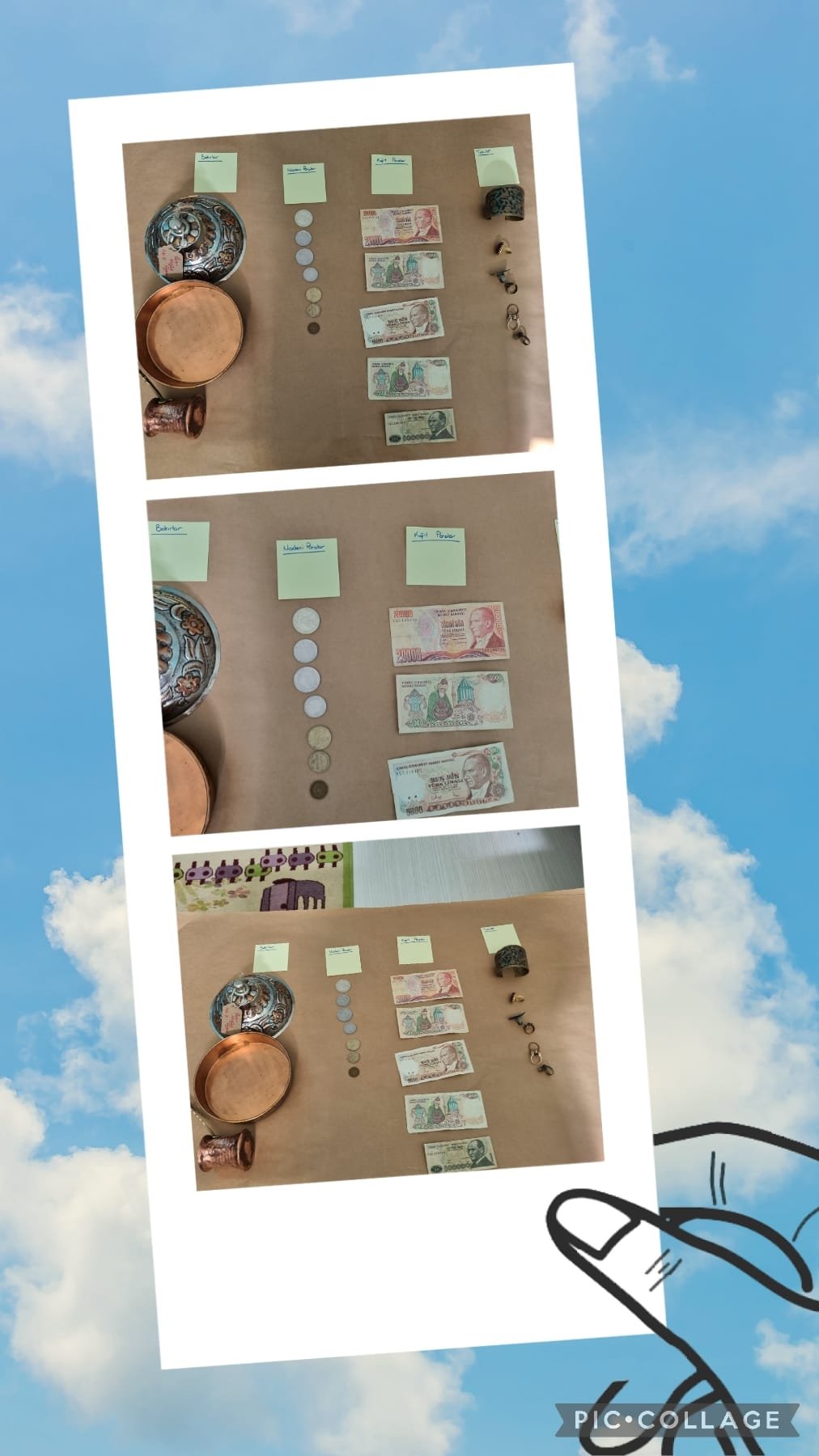
As a result of the excavation, the children found clay tablets, bone fragments, copper plates and so on. All the artefacts were placed in separate groups and classified according to their diversity. At the end of the excavation, the teacher says that a cleaning liquid is required to clean these artefacts, just like archaeologists do. The children then prepare a mixture according to the given measurements (half a cup of vinegar, half a lemon and two tablespoons of baking soda) and clean the artefacts with a brush. The artefacts are placed in the exhibition area.
For the vehicle design, the children are expected to follow the teacher’s instructions. These guidelines state that the vehicle should be easy to move, able to move in rough areas, light and have a signalling system that alerts the user when an object of a certain size is detected underground.
Finally, the children design vehicles with detectors that search for historical artefacts with the help of Lego.

CC-BY, provided by author
About the author
Havva Küçükbaş is a pre-school teacher at the Sinop Boyabat Provinces Service Union Kindergarten and a Scientix Ambassador from Türkiye with a passion for science and mathematics, who enjoys creative work.
Tags: Archaeology, creativity, Cultural and Natural Legacy, excavation, History, Lego, mathematics, Science Museum, soil literacy, STEAM education
Recent Comments