
 The mournful sound of the midnight ferry skittered across the Hudson River, and rain clouds spat a parting gift onto Captain John Frawley as he urged his mules northward and passed out of sight.
Over the last sixteen hours, Frawley had brought the canal boat George W. Lee from the Morgan sawmill in Glens Falls, and forty miles down the Champlain Canal to the Albany Basin, where he deposited the year’s last load of lumber. Despite the rain, his trip down had been uneventful, even getting well-behaved mules when he stopped for a fresh team in Schuylerville.
The crew of a canal boat is small, and everyone, from the captain down, does whatever is needed to keep the boat moving on the towpath. For this trip, along with the captain, the crew consisted of only Daniel Clancy, an experienced canaller, whose main job was steering the boat, and a hoagie, a young boy to lead the mules.
Also traveling on the canal boat for the trip was Frawley’s sixty-year-old mother, Elizabeth, and her thirteen-year-old grandson, Willie, son of the captain.
It was just below Waterford that Captain Frawley’s luck changed, for to reach Albany the canal boat would need to cross the rain-swollen raging Mohawk River.
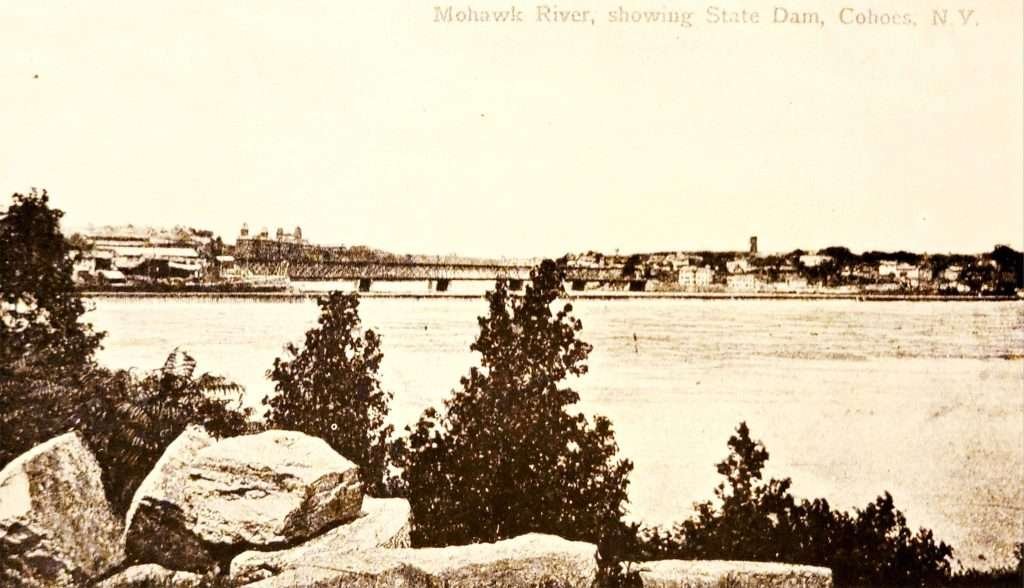
On their trip down, after the canal boat left Champlain Canal Lock 2, the towpath led the mules onto the Cohoes Bridge, where the towline would be secured to a cable strung along the side of the bridge, which kept the boat under control as it was pulled across the river.
With Captain Frawley walking alongside his hoagie to guide the mules, the crossing was successful, and they made the rest of the way to the Albany Basin without incident.
The days of rain that November across the Mohawk Valley caused a rare autumn freshet, a term most often used to describe high water from melting snow in the spring. As these rains poured down, they filled the Mohawk and Hudson Rivers beyond capacity, flooding homes, covering docks, and even keeping smaller boats off the rivers.
By the time Captain Frawley had towed the George W. Lee back to the Cohoes Bridge, the river was even higher than when he had come through only a few hours earlier. It had risen so far that the canal boat cable on the bridge was submerged, making it impossible to use.
Seemingly undeterred by this setback, Frawley again took over for his hoagie and started the mules across. On the canal boat, at first Clancy was able to fight the river’s current and steer the boat, but before they had gone halfway, the tow line broke, sending the boat adrift towards the state dam a short distance downstream.
 In a desperate attempt to save the vessel, Clancy forced the tiller over and turned the boat sideways to the dam. As those along the shore watched in horror, the George W. Lee topped the dam, tilted over, and was carried broadside into the chaos below.
The cabin, which had been lit as they attempted the crossing, turned dark as the canal boat crashed into rocks only twenty feet past the foot of the dam, but soon lit up again with an orange glow, revealing shadowy movements within.
When the boat tilted over the dam, Clancy crashed into the tiller and was momentarily stunned, only to be pulled back to consciousness by the sounds of a desperate struggle below him.
Rushing into the cabin, he found Elizabeth Frawley collapsed amid the boat’s shattered interior, her skirt aflame from a broken kerosene lamp and coals that had tumbled out of the overturned stove.
It was fortunate that the canal boat had taken on water during the slide down the dam, as Clancy quickly grabbed wet bedding and extinguished the flames. In the accident, the bottom of the George W. Lee had been opened in three places, with floodwaters from above keeping it firmly in place.
Once the last of the fire was extinguished, Dennis Clancy re-lit the lantern and went on deck to signal those on shore that they were safe. With the river at flood stage, making an immediate rescue impossible, the three shipwrecked survivors settled down for the night.
With the temperature dropping below freezing, Elizabeth, Willie, and Dennis used every scrap of material they had to stay warm. To keep dry, the three climbed onto anything sturdy enough to support them, though the boat’s tilt forced them to sleep sitting upright.
To make matters even worse, during the night, the floodwaters backed up against the dam, periodically surging in a torrent that partially submerged the stranded boat and raised the water level to their ankles.
The November 22, 1886, Glens Falls Daily Times, in dime novel fashion, painted this vivid picture of the stranded trio’s experience:
“What a night it must have been! How the time dragged on, the minutes seemed hours, and the terrible death struggle with those swirling, foaming waters might be upon them at any instant. They must watch in dread expectancy. Finally, a century it seemed, probably, the morning came.”
The brightening sky on Friday morning brought with it another challenge: hunger. Most of the scant provisions onboard the canal boat when it started across the Mohawk were ruined in the accident, and all that remained was some water-soaked bread and a jar of jelly.
To make their situation even more desperate, though a river surrounded them, the raging flood brought with it so much dirt and debris that any water they collected was undrinkable.
The floodwaters that had caused this disaster continued unabated throughout that morning, with even the bravest rescuers unwilling to risk their lives. It was late in the afternoon when the eight-man crew of a state-owned work boat, a flat-bottomed scow, was finally ordered onto the river.
With two large tow lines attached and controlled by men on the bridge, the rescue boat drifted into the violent torrent, heading down towards the stricken canal boat. It was a slow descent, with over half an hour passing before the bow of the rescue boat came to the top of the dam.
While thousands of onlookers watched from the bridge and along the shore, the scow’s crew was seen communicating the rescue plan with Clancy. An instant later, the rescuers themselves became eight more casualties when the lines holding them in place parted, and the scow went over the dam.
While the surging waters kept it from striking the stranded canal boat, it also carried the vessel beyond reach of a rope tossed by Clancy as they passed. As the scow raced downstream, hundreds of bystanders followed along the Cohoes side of the river, desperate to witness what seemed like the next catastrophe.
As the scow neared Buttermilk Falls, two of the crew jumped into the river, making it to a nearby island. The remaining six crew members braced themselves and rode the swirling waters down the falls and came safely to rest on the shore of Peebles Island.
With this unsuccessful effort, rescue attempts for the day ended, and Elizabeth, Willie, and Dennis settled in for another night.
At the second dawn onboard their stranded canal boat, our shipwrecked trio had been trapped in the waters of the raging Mohawk for over 30 hours.
Leading the next rescue attempt was William McEchron, head of the Morgan Lumber Company, a man with a lifetime of experience on the canal.
Accompanying him from Glens Falls that morning was Congressman Frederick Avery Johnson (1833 – 1893), U.S. Representative from New York, and Jointa Lime Company president Thomas S. Coolidge.
The first rescue effort was to float a bucket of much-needed food from the bridge over the dam to the stranded trio. Unfortunately, this first effort failed when the pail lodged against the side of the canal boat and could not be retrieved.
The next attempt was a large barrel, which, as it floated by, its rope was grabbed with a boathook and pulled onboard. Using this rope, provisions were finally delivered to the starving captives.
With over one thousand feet of line, the barrel continued downstream and was brought ashore at Adams Island. Here, a rowboat manned by two rescuers took the place of the barrel, and the men far upstream on the bridge pulled it back to the George W. Lee.
Once this boat was secured alongside the canal boat Lee, Clancy carried Mrs. Frawley from the cabin to the rowboat with Willie following close behind. With Dennis Clancy manning one of the oars, the boat began its journey downstream.
In an instant, passengers and crew faced imminent peril when Clancy’s oar broke, with the boat carried towards Buttermilk Falls.
Fortunately, tragedy was averted when they drifted close enough to land that men on shore were able to wade into the floodwaters and grab the boat, bringing it to shore thirty-six hours after their canal-boat disaster began.
Amazingly, through the whole ordeal, the only injuries were to Elizabeth Frawley, who suffered bruises when the boat first wrecked and burns to her hip and leg when she dropped the lantern.
After they returned home, Mrs. Frawley wrote a card that was printed in the November 23, 1886, Albany Argus newspaper expressing her “sincere thanks to those who assisted in rescuing us from our perilous position, and gratitude to all those who were active in supplying the means to make us comfortable and remove us to a place of safety.”
The two men who manned the rowboat that carried the three castaways to safety were also given cash awards for their bravery by the Morgan Lumber Company. Dennis Clancy went on to a successful career on the canal as captain of the canal boat W. H. Weaver. Willie Frawley survived the whole ordeal unscathed and returned to Glens Falls with his father.
The canal boat George W. Lee, named for a professional oarsman who had competed on the Hudson during those years, was deemed too old to salvage and left where it had wrecked below the dam. It was picked up by the next spring’s freshet and carried out into the Hudson River, where it sank to a watery grave.
Read more about New York shipwrecks.
Illustrations, from above: “Mohawk River Showing State Dam, Cohoes” showing where the Champlain Canal crossed the Mohawk by a slackwater pool created by the State Dam (Cohoes, with its Harmony Mills in the background, is to the left, the outskirts of Waterford are to the right); and a 1910 Sanborn Insurance map of Cohoes, annotated by the author.
Recent Comments