
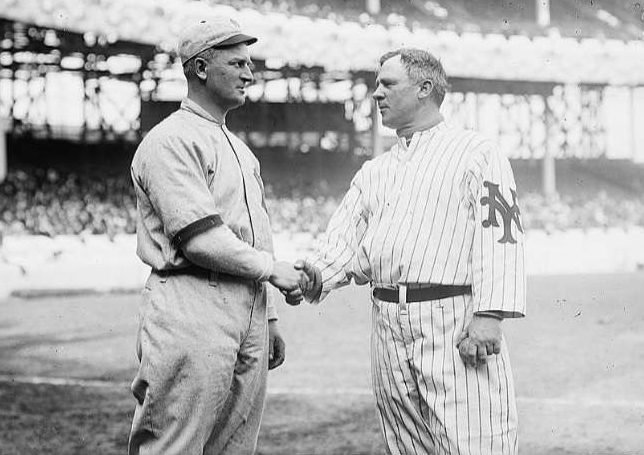
 Cortland County, NY native John McGraw left a deep imprint on professional baseball, first in Baltimore and later New York, before and after the turn of the twentieth century.
In mid-May of 1894 the Baltimore Orioles were visiting Boston’s architectural gem, the South End Grounds, to play the Boston Nationals; the franchise that is today’s Atlanta Braves.
(This ballpark, which opened in the spring of 1888, was thought to have been used as a model by H. Langford Warren for his design of the Saratoga Race Course.)
Already famous for starting fistfights, John McGraw was playing third base for the Orioles, with the score tied at three in a tight ballgame. Tom Tucker, Boston first baseman, led off with a triple. Tucker, a New England native known to his neighbors as “Foghorn Tucker” was eager to score the winning run, and was annoyingly faking dashes for the plate.
 Finally, Foghorn strayed off the bag too far and catcher Wilbert Robinson snapped the ball down to McGraw, who kicked Tucker in the face with his spikes, then tagged him out. With blood pouring down his features, Tucker started after McGraw, while the fans threatened to storm the field, intent on collecting McGraw’s scalp.
Fortunately for McGraw, as the game was underway, a fire started under the stands and the conflagration erupted just as he needed a reason to hastily exit the field. McGraw escaped, as did all other players and fans, but the stately South End Grounds and 12 acres of the Roxbury section of Boston were ruined to ash.
From Baltimore to New York
A Baltimore novelty was the Diamond Café opened by John McGraw and Wilbert Robinson on North Howard Street, where the two Oriole teammates leased space for a tavern with a dining room, bowling alleys, and billiard rooms.
It was one of Baltimore’s hottest attractions, and not only ball players, but also jockeys, horse trainers, owners and bookies were fond of gathering there. The cash-strapped Oriole management willingly compensated their star players with stock, and McGraw and Robinson grabbed not only a piece of the happening action, but also a piece of the team.
The inflationary effects of the Spanish-American War caused the National League to contract after the 1899 season, eliminating four teams, including Baltimore.
 John McGraw spent the 1900 season with St. Louis, where an amusement park and racetrack were part of the home-field complex, where players often placed wagers between innings.
McGraw was back in Baltimore in 1901 to manage and play for the American League Orioles. Yet by 1902 McGraw reported the Baltimore club was losing money daily, and that he had advanced the Orioles his own money to meet salaries.
He asked the Oriole president to call a meeting of the board of directors, and put the matter squarely before them. He later said the directors discussed the matter at some length where no one seemed willing to reimburse him, and at the end of the discussion it was decided to give their manager the unconditional release he demanded.
Through McGraw’s connections in the newly incorporated New York City, he arranged for a transfer of the Baltimore American League franchise to Gotham by establishing a new ownership group headed by Frank Farrell, a Tammany Hall leader who owned a string of racehorses and the Empire City Racetrack in Yonkers.
John McGraw had negotiated his free-agency, and moved on to manage the New York Giants, but with more lasting importance which he engineered, the Orioles relocated to New York becoming the Highlanders, later called the Yankees.
Baseball & Horse Racing
John McGraw was a contemporary of Harry M. Stevens (1855-1934), who was the successful caterer at numerous race tracks, including Saratoga. The knife-and-fork offerings of the racetrack were simplified for ballparks including the Polo Grounds, where legend has it, Stevens introduced the paper soda straw and the hot dog on a bun.
When the skies turned gray and rain prevented play on the big league diamond, ballplayers would play the horses, and John McGraw enthusiastically visited the many nearby racing ovals. At the track McGraw would seek out future Hall of Fame trainer John Madden (1856-1929), formerly a professional ballplayer before turning to the turf, as an advisor in matters speculative.
Reporters were concerned that the Giants manager, having a quiet fly at the horse game, would distract him from his primary occupation. Manager McGraw assured the scribes he would not “keep fooling with blackboards,” the devices used by bookmakers to post odds.
He was quoted in the Morning Telegraph on January 18, 1903 saying “I might put a bet down occasionally when I get some good information, but that is all.”
John McGraw refused to let his New York Giants participate in the 1904 World Series, and no series took place that season. In mid-October he teamed-up with former jockey Tod Sloan (1874-1933) and won handsomely on the victory of Lady Henrietta at Morris Park in the Bronx.
After dining at the Hotel Astor, the jockey and the baseball manager indulged in cigars and a game of billiards, for $100 a side, as they mocked the reporters who did not profit from their racetrack tip.
 Developing new talent was one of John McGraw’s specialties as a manager, and off-season scouting trips were often combined with racetrack visits.
During his lifetime, the Saratoga Race Course ran nearly exclusively in August, as the weather and pennant races were at their hottest, yet the manager occasionally would visit upstate during the meet.
In the early years of the twentieth century, metropolitan New York was literally surrounded by racetracks. Gravesend, Sheepshead Bay and Brighton Beach were in Brooklyn.
In Queens, Aqueduct and Jamaica Racetracks operated and further east on Long Island, where the City Line reached Nassau County, was Belmont Park.
Morris Park was in the Bronx and further north in nearby Westchester County, Empire City in Yonkers ran, providing ball players a chance to try their luck on rainy days, and the national pastime was well represented.
Blanche McGraw would detail in her biography of her husband that early in their relationship, which began in Baltimore, they often spent a day at the races at Pimlico. Blanche would relate these elements that she realized this, “does not solve the moral aspects of betting on horse races, or gambling of any kind. But with John McGraw, it was part of his life and times.”
As an eighteen-year-old minor leaguer who had come of age in upstate New York, John McGraw made his first visit to Cuba, and appreciated the mild climate. Oriental Park opened 1915 at Marianao, eight miles from Havana, Cuba and provided a comfortable winter racing location before things got started in the Miami area.
In 1919 Charles A. Stoneham and John J. McGraw, president and manager of the Giants respectively, purchased a controlling interest in the Cuba-American Jockey Club, which operated the magnificent racetrack known as Oriental Park and its attendant Nacional Casino. Stoneham, the new owner of the Giants, had competed with a string of thoroughbreds before moving into baseball.
 In one respect, purchasing a racetrack in Cuba at this time was very good, as the recently concluded First World War fostered a bumper crop of sugar cane millionaires, and the island was a refuge from recently imposed Prohibition, where the Yankee dollar purchased all types of amusements under the Caribbean sun, including exhibition games by big league players.
This was the end of an era when nothing barred a racing man from buying into a ball club or a baseball man from taking over a racetrack.
In the second respect, the timing could not have been worse, as the Chicago White Sox would be accused of throwing the 1919 World Series to the Cincinnati Reds, and associations with gambling needed to be purged from baseball.
Oriental Park was a racetrack like no other, where Stoneham and McGraw planted groves of banana, orange, grapefruit and mango trees, yet by late 1921 they disposed of their interest. John McGraw would travel to Cuba for horse racing every winter afterward until his final frigid season.
Blanche McGraw would express her regret in print on having to divest of “our” racetrack, and wrote; “Betting on horse races, or owning race horses, was never frowned upon openly in baseball until Commissioner Landis arrived as supervisor in 1921. Then it was a necessary expedient to help convince the public that baseball was pure in mind and deed.”
(Kenesaw Mountain Landis was elected as the first Commissioner of Baseball on November 12, 1920, following the 1919 Black Sox Scandal.)
To assuage the regret of giving-up their own racetrack, Blanche and John McGraw purchased a home at 915 Edgewood Ave in the Westchester County town of Pelham, about eight miles from the Giants home at Manhattan’s Polo Grounds, and also very close to the Empire City Racetrack, which at that time hosted two thoroughbred meetings.
The Giants manager was a regular fixture there, and George Ryall, writing under his pseudonym in The New Yorker, noted his presence in several issues, saying that McGraw commuted from Empire City when the Giants were idle, that he was seen without an overcoat during chilly weather along with Al Jolsen and Mae West, and that McGraw had joined the paddock marching club.
Due to health issues, John McGraw would retire as manager of the Giants in June of 1932. He and Blanche were frequent visitors to Saratoga Springs, and joined the many race fans at the track, while domiciling at both the legendary Grand Union and United States Hotels. John McGraw’s retirement was brief, however, as he passed away in the late winter of 1934.
Read more about New York’s sports history of baseball, horse racing and gambling.
Illustrations, from above: Giants manager John J. McGraw (home whites) welcoming the Highlanders manager Harry Wolverton (road grays ) to the Polo Grounds before the Titanic Game pm April 21, 1912 (Library of Congress); South End Grounds baseball pavilion in Boston, designed by John Jerome Deery and operational 1888- 1894; McGraw as manager of the Baltimore Orioles baseball club (Houston Daily Post, Nov. 20, 1899); McGraw at the Agua Caliente (Mexico) Racetrack, where he saw Phar Lap, the Australian wonder horse known as the “Red Thunder From Down Under” win the $50,000 classic there (Brooklyn Daily Eagle March 26, 1932; and a McGraw caricature, published by Havana: The Magazine of Cuba, January 26, 1929.
Recent Comments