
 On a recent walk through a woodland strewn with underfoot color, my rapt gaze floated, like a bumblebee queen on her first foray after winter, from trout lilies to trilliums to spring beauties, all blooming across the forest floor and exulting in the sun shining through the leafless canopy.
Standing out is hard among such a flashy crowd, especially for one particularly understated spring ephemeral: sessile-leaved bellwort (Uvularia sessilifolia), known more commonly as wild oats.
While the flowers of many of wild oats’ transient companions angle upward or outward to soak in all the sun rays they can before the canopy closes with leaf-out, wild oats hangs its head.
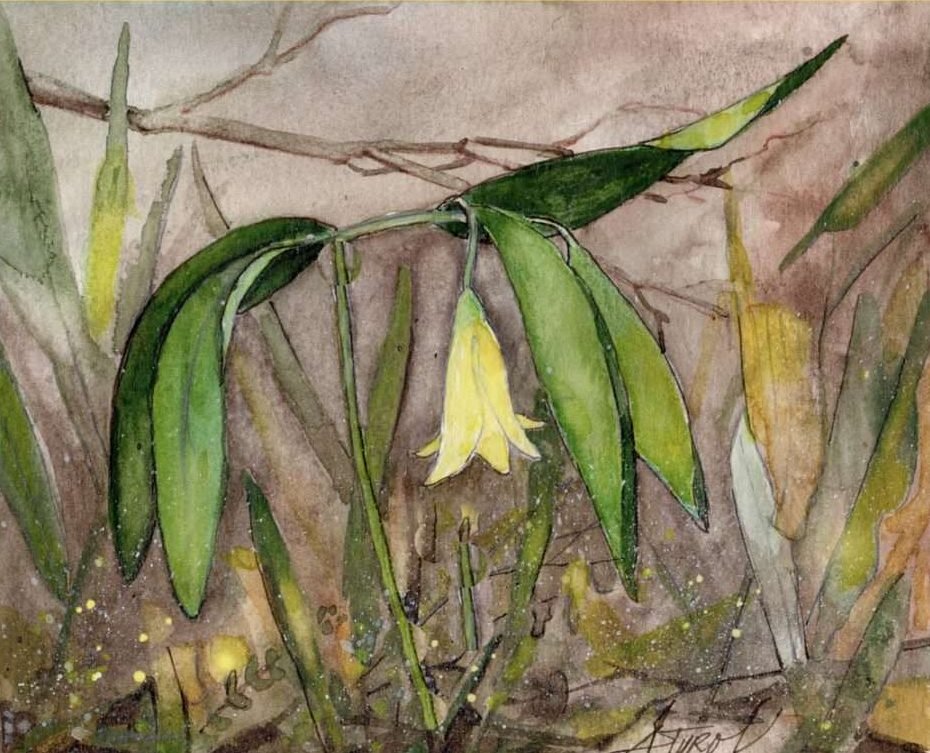
Each plant, which grows up to about a foot tall in colonies in open woodlands with dry or moist soils, bears only one cream-colored flower.
The delicate inch-long droop of six petals points toward the ground, like it might be ashamed of its beauty – or, as Henry David Thoreau more eloquently put it when describing wild oats in 1853, “as if unworthy to face the heavens.”
This single flower also sometimes hides within the whorl of the plant’s leaves, adding to its bashful air.
“Bellwort” comes from the flower’s bell shape, but another likeness inspired the name of wild oats’ genus: Uvularia for the flower’s resemblance to the human uvula, a similarity that also gave rise in times past to the belief that wild oats and other bellworts could help treat throat ailments.
Another of wild oats’ common names, straw lily, refers to the way the leaves alternate on the stalk, reminiscent of the lilies commonly grown in gardens (genus Lilium).
More hints for identifying wild oats can be found in its scientific name. Two other members of the species’ genus, large-flowered bellwort (U. grandiflora) and perfoliate bellwort (U. perfoliata), occur in the same habitat in the Northeast, though wild oats is the most abundant.
The size of large-flowered bellwort’s eponymous blooms distinguishes it easily from wild oats, but telling wild oats and perfoliate bellwort apart is a bit trickier.
To differentiate the two, look to their greenery. Wild oats’ species name, sessilifolia, refers to its stalkless leaves; they are sessile, meaning they attach directly to the plant’s stem.
The leaves of perfoliate bellwort, meanwhile, surround the stem, so that the stem appears to pierce right through the leaves. The tips of perfoliate bellwort’s petals also flare out more than those of wild oats, offering another clue as to which bellwort is before you.
Wild oats, like its ephemeral counterparts, plays an important role in pollinator ecology. When bees emerge in early spring into a still-awakening landscape where nectar and pollen are scarce, wild oats provides an early source of sustenance. Generalist pollinators, such as bumblebees, visit wild oats, and at least one species of mining bee, Andrena uvulariae, specializes on this species and other bellworts.
Wild oats do not die back in the heat of summer, unlike early-blooming ephemerals. The plant persists through fall, accumulating signs of wear as the season progresses. During this time, each individual produces a small, inch-long fruit containing minute seeds.
While wild oats primarily spreads by stolons that fan out from each plant just beneath the leaf litter, its seeds can also be dispersed by ants, a mutualistic process called myrmecochory.
Enterprising gardeners can cultivate wild oats at home. This forest-specialist does best in partial shade to mimic the conditions in which it occurs naturally. Local conservation districts or nurseries that specialize in native plants sometimes sell these demure beauties.
If you succeed in establishing a garden colony, you might also discover wild oats’ culinary value: The early shoots and young leaves are edible when cooked, apparently imparting an asparagus-like flavor.
After a long, snowy winter, the most colorful spring ephemerals may monopolize your attention on these restorative spring days. But do not let their flair eclipse the understated elegance of wild oats, a humble mainstay of the forest floor that is sure to win you over, should you look closely.
Read more about Spring Ephemerals in New York State.
Colby Galliher writes about conservation, ecology, and environmental policy. Visit his website to learn more about his work. Illustration by Adelaide Murphy Tyrol. The Outside Story is assigned and edited by Northern Woodlands magazine and sponsored by the Wellborn Ecology Fund of New Hampshire Charitable Foundation: nhcf.org.
Recent Comments