
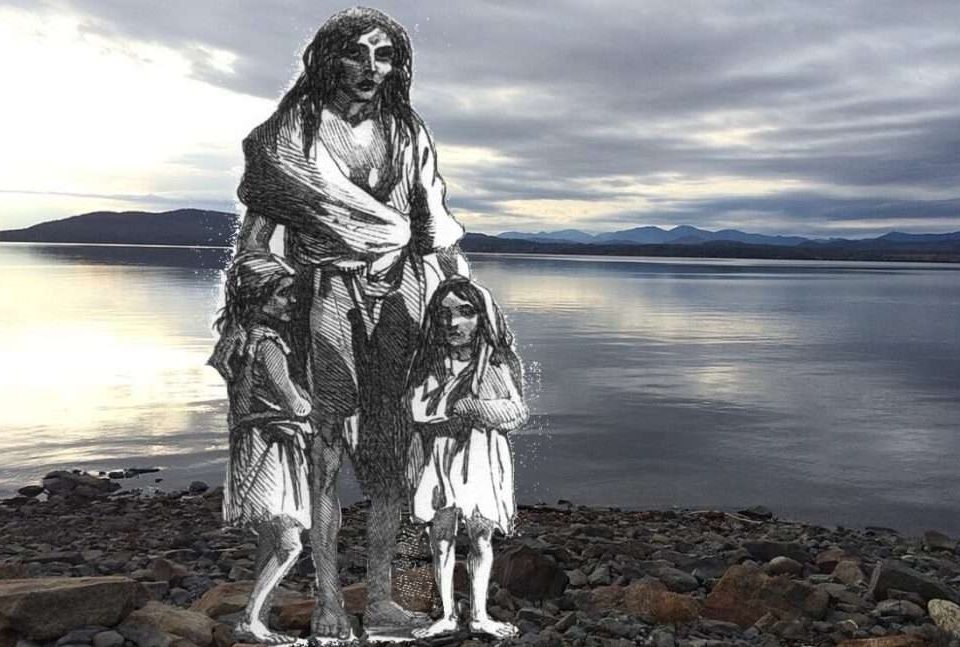
 Between 1840 and 1860, a great wave of Irish immigrants washed up on the shores of Lake Champlain. So many, in fact, that the inland sea was nicknamed “the Irish lake.”
The reason, of course, was poverty and job opportunities. Although Irish Catholics had started arriving in New York and Vermont in numbers by 1820, Champlain truly became the Irish lake in the mid-1840s during the Great Famine.
They landed mostly in Burlington, which in 1850 had an Irish population of 30 percent, and also at the much larger Plattsburgh. Tiny Georgia, a town on St. Albans Bay, was 27 percent Irish that year – all young men, working on the railroad. Rutland had so many Irish the public school was called the Catholic school until as late as the 1920s.
In 1850 one out of every five people in New England were Irish immigrants. In New York, New Jersey, and Pennsylvania, that number of 55%. From 1840-1860, the Irish comprised the largest ethnic minority in the Vermont and New York, thanks in part to the Irish lake. Their immigration sparked a wave of nativist sentiment.
In 1832, Nathaniel Hawthorne visited Burlington and published a sketch of the young city. He noted with a nativist tone “great number of Irish emigrants.” They were everywhere: “lounging” around the wharves, “swarming in huts and mean dwellings near the lake,” and “elbow[ing] the native citizens” out of work.
The Two-Boaters
Some Protestant Irish and Scots-Irish had come down Lake Champlain in the 18th century. Then in 1815 the Napoleonic wars ended, which caused an agricultural recession in Ireland. Times got hard for the farmers then, because the rise of textile mills meant they couldn’t supplement their incomes with homespun cloth.
The British government also wanted to populate its vast Canadian territory. In 1818, the Crown imposed a heavy tariff on ships headed for the United States – where the Irish really wanted to go.
Each of these ships were required to carry only one passenger for every five tons burden. Ships bound for Canada were only lightly taxed making their fares substantially cheaper.
The “Irish two-boater” was the result – Irish immigrants who sailed first to Canada, then came to the United States. These early immigrants often arrived on ships which had carried lumber to Europe – they were largely unsuitable for passengers.
Many Irish Catholics who arrived in Canada then came down Lake Champlain by steamboat, lake schooner, or sloop to help build the Champlain and Erie Canals, completed in 1823 and 1825 respectively. By 1830, the British Army wouldn’t post any Irish soldiers close to the United States because so many deserted and jumped the border.
They’d leave Liverpool or Queenstown (now Cobh, or Cork), Dublin or Sligo or Galway – typically in March and April – and arrive weeks later in Halifax or Quebec. Then they’d travel down the lake to ports of entry in Vermont and New York.
Work on the canals, in mills and factories, and later railroads attracted Irish immigrants, as did the Vermont stone quarries at Barre, Fair Haven, West Rutland, West Castleton and Proctor. Young women – often simply called Bridget, no matter their name – frequently worked as domestic servants.
The first arrivals sent letters home to their families, telling them they could do well in the United States if they worked hard. “The farther you penetrate into the country Patrick,” Thomas Mooney wrote home in 1850, “the higher in general will you find the value of labour, and the cheaper the price of all kinds of living.”
By 1830, 11% of the 3,526 people in Burlington were Irish – so many that the bishop of Boston sent an Irish priest, Jeremiah O’Callaghan, to the city. He built St. Mary’s church in St. Albans, the first Catholic church in Vermont, St. Mary’s, in St. Albans in 1833.
The total population of Clinton County (which includes Plattsburgh) was 19,344 in 1830, about 15% were Irish immigrants.
St. Patrick’s Church, established in 1833, is recognized as the first Catholic parish in Plattsburgh serving the Irish immigrant community. Before that, the Catholic church served the larger population of French-Canadians.
An ongoing cholera epidemic arrived will immigrants in Quebec and Montreal in June of 1832. A quarantine station was built that year at Grosse Île in the St. Lawrence River below Quebec City was established that year in a failed attempt to prevent the disease from spreading.
Vermont authorities posted broadsheets warning that anyone with the disease couldn’t land on the shores of Lake Champlain.
Black 47
In 1845, the potato crop failed, and then in 1846 it failed again. Two successive years of crop failure caused famine, which is how the year 1847 got the nickname Black 47. That spring the massive migration began, with slightly more Irish headed to Canada than to the United States.
The staff and facilities at Grosse Isle couldn’t handle the sudden influx of Irish immigrants, many of whom had come down with typhus. Neglected for days, 5,000 died in horrific surroundings. Grosse Ile today has the largest burial ground for famine refugees outside of Ireland.
Many of those who survived came down the Irish lake to settle. On the New York side of Lake Champlain, by 1850 Plattsburgh remained 15% Irish, Essex 8% and Ticonderoga 9%.
On the Vermont side, Swanton was 16% Irish, St. Albans 17.5% and Middlebury 15%. Nearly one in three residents of Burlington had Irish ancestry.
The famine wave down the Irish lake continued until 1860, when the Civil War broke out. Many Irish immigrants served in the United States Army. Vermont and New York’s populations continued to grow, making their presence less noticeable.
John Warren contributed to this essay, a version of which was first published at the New England Historical Society. The Society celebrates all things historic about the New England states. You can subscribe for free here.
Read more about Irish Immigration in New York State.
Recent Comments