
 Spread over an archipelago of islands nestled amongst the marshes of the northern Adriatic coast, Venice was founded in the fifth century AD by refugees who fled the “barbarian” onslaught after the collapse of the Western Roman Empire.
In 811 its seat of government transferred from the island of Malamocco (one of the earliest settlements) to an area corresponding to present St Mark’s Square which was less vulnerable to attacks from sea.
The move marked the start of a grand engineering experiment. Settlers dredged marshes to create land fit for cultivation. They dug canals, drained swamps, and reclaimed land.
The “floating” city symbolized man’s ability to control his surroundings. Jacopo Sansovino (1486-1570), Andrea Palladio (1508-1580) and other master-builders turned Venice into an architectural jewel.
First Italian American
In 1630 Venice suffered a serious outbreak of the bubonic plague. The disease was spread by rats and fleas which made this trading hub vulnerable. The city suffered dreadful losses; almost a third of its residents died during the epidemic. The decline in population would contribute to Venice’s eventual downfall as Europe’s leading political and commercial power.
 Pietro Caesar Alberti was born on Malamocco in 1608 at the height of Venice’s might. A successful merchant, he decided to leave the devastated city in 1635 and seek a new career elsewhere. He traveled to the Dutch Republic where he converted to Protestantism. Having signed on as a merchant mariner aboard Den Coninck David (The King David), he set sail in July 1634 to cross the Atlantic.
Alberti made New Amsterdam his home. Even though the situation in the city was worsening as the West India Company (WIC) neglected its duty of governance, Peter Caesar Albertus (his newly adopted name) integrated quickly into the settlement’s multi-lingual environment.
In 1639, he negotiated with Pieter Janse Montfoort (a Walloon immigrant) to cultivate part of the former’s plantation on the Long Island shore of the East River. Four years later, he secured the deed of ownership. By then he had married Judith Manje (Magnée) in the Dutch Reformed Church. Born in Amsterdam in 1620 into a family of French-speaking Walloon refugees, she had arrived in the colony with her parents some years previously.
The couple first lived on Broad Street, Manhattan, before moving to the plantation in 1646. They had seven children, all of them born and baptized in the colony (one of them died in infancy). Both were killed by Native Americans on their plantation in November 1655, casualties of Willem Kieft’s ill-conceived “Indian War.”
 The Dutch authorities appointed a guardian to look after the orphaned children and records show that all of them prospered. Over the centuries, the Alberti family name recurred with variations in spelling.
Some Americans bearing the surnames Alburtis or Burtis can trace their ancestry back to Pietro Caesar Alberti. A marker in his memory stands at The Battery, Manhattan. The first Italian settler in New York State was a Venetian.
Venetian Inspiration
A Venetian immigrant sparked New York’s passion for opera. Lorenzo Da Ponte (1749 – 1838) was born Emanuele Conegliano on March 10, 1749, at Ceneda in the Republic of Venice. Jewish by birth, his widowed father (a leather merchant) converted to Roman Catholicism in 1764 as he planned to remarry.
Having studied at Ceneda’s Seminary, Lorenzo was ordained a priest in 1773 and then moved to Venice where he became a poet and language teacher. A friend of Giovanni Casanova (1725-1798), he lived a life of scandal.
Once defrocked, he fled to Vienna and wrote the words for Mozart’s three celebrated operas Don Giovanni, Le nozze di Figaro, and Così fan tutte. With the death of his patron Emperor Joseph II and the passing of his creative partner Mozart, Da Ponte’s career took a dive.
Forced to leave Vienna, he moved to London (via Trieste). Fearing arrest for indebtedness, he fled to the city of New York by way of Philadelphia in 1805, lived for seven years in Sunbury, Pennsylvania, and returned to Manhattan where he remained until his death.
 The story of Da Ponte’s adventures (a libretto in itself) has obscured the contribution he made in transposing European Enlightenment ideals from Europe to America. He was the first Professor of Italian Studies at Columbia College; he welcomed the first Italian opera troupe to the United States; and he founded the New York Opera House, the nation’s first company dedicated to opera.
Venice also manifested itself in Manhattan’s building history. Palladian architecture (in the style of Andrea Palladio) is renowned for its elegant balance and classical elements. While its roots lie in sixteenth-century Venice, its design principles have been relevant throughout the ages, both in Europe and America.
Having established trading links with Venice, Flemish merchants reported the magnificence of “La Serenissima” (the most serene) to citizens in Bruges. Their accounts fired the local ambition to create a “Venice of the North.” When Amsterdam began to prosper, ambitions were unleashed to combine style with functionality. The concept of a “city beautiful” entered the urban consciousness.
Venetian Gothic dominated English architecture from around 1850, a vogue championed by John Ruskin in The Seven Lamps of Architecture (1849) and The Stones of Venice (1851).
There were Manhattan architects who worked in this mode too. Born and raised in New York City, Peter Bonnett Wight admired Ruskin’s ideas. His blueprint for the National Academy of Design at the northwest corner of Fourth Avenue and 23rd Street drew attention.
 It was one of the designs selected for the New-York Sketch-Book of Architecture (1874), featuring twelve issues of plates with explanatory text. He played a leading role in the introduction of High Victorian Gothic in New York.
Although few Venetians lived in New York, social observers pointed at parallels between the two island-like port cities built by immigrants. This affinity found expression in architecture.
Designed in 1876 by the New York City firm of Jarvis Morgan Slade, the five-story surviving property at 8 Thomas Street between Broadway and Church Street functioned as a store for soap manufacturer David S. Brown. Built in brick with columns, arched windows, a gabled roof and an oculus on top, the slender building was three bays wide and ornamented with a variety of colors and patterns.
Manhattan once boasted numerous similar examples of Venetian Gothic, but few have survived.
Venetian Skyscraper & Magic Marble
In the late 1880s, the Metropolitan Life Insurance Company evacuated its headquarters in Lower Manhattan and moved uptown to a newly erected eleven-story building at Madison Square and 23rd Street.
Having acquired the entire block by 1907, the company’s president John Rogers Hegeman commissioned a tower that would symbolize its success as the world’s largest insurer. Its architect Napoleon LeBrun (of French Catholic descent) modeled his design of the Metropolitan Life Insurance Tower after the Renaissance bell tower (“campanile”) of San Marco in Venice.
 The iron-built tower held classical details and a massive chiming clock on each of its four sides. The pitched roof had a cupola on top and a lantern that flashed a signal to ships at sea (the “light that never fails”).
In 1909, the “Venetian skyscraper” was the world’s tallest office building. Ruthless restoration during the 1960s ruined its ornate presence by removing the classical features. Limestone panels replaced Tuckahoe marble.
Venetians had a passion for marble. Due to soggy ground, architects designed buildings with light-weight bricks on top of wooden piles. Marble was too heavy for structural use and applied as cladding only or for ornamental elements.
Venice imported a variety of marbles from across the Mediterranean, including porphyry from Egypt, Carrara from Italy, Parian and Pentelic white, and green-veined marble from Greece and Anatolia. This diverse sourcing contributed to the cosmopolitan look of Venetian buildings.
New York City could boast its own quarries. Until the early nineteenth century the village of Tuckahoe was part of Eastchester. It was then that stone cutter Alexander Masteron, an immigrant from Forfar, Scotland, discovered high-quality reserves along the Bronx River.
His firm began large-scale production of Tuckahoe Marble in 1812. With the New York & Harlem Railroad opening stations in Tuckahoe, the local industry flourished. Immigrant workers flocked to the area in search of work.
Manhattan was covered in marble. The Metropolitan Life Insurance Tower had been preceded by other landmarks such as St Patrick’s Cathedral in 1878. Built in 1895, the Arch in Washington Square Park is one of Manhattan’s iconic monuments.
Standing at the base of 5th Avenue, it was made of Tuckahoe marble quarried just over twenty miles away. After a near century the precious reserves were finally exhausted, causing production to end.
Lewis Hine’s “Sky Boys”
Mass Italian immigration into Manhattan began in the 1880s, establishing Little Italy (Piccola Italia) as a buzzing district. Most of the newcomers came from the poverty-struck southern regions and settled in Manhattan according to the regions they came from.
 Neapolitans concentrated around Mulberry Street, Sicilians chose Elizabeth Street, and residents of Calabria and Puglia formed their enclaves around Mott Street. These close-knit communities kept their home traditions (social structures, festivals, and celebrations).
Most men worked in transportation, manufacture, or construction; others were street vendors (musicians) or shopkeepers. While a minority of migrants came from northern parts of Italy, few of them descended from the Venice region.
In October 1929, the demolition was set in motion of the Waldorf – Astoria, the world’s largest hotel, laying the foundations for the Empire State Building. Started during the Great Depression, the pace of construction was phenomenal.
The Art Deco project was under immense time pressure, with workers building approximately four floors per week to meet the deadline. Completed in 1931, it became an enduring symbol of New York City’s resilience and a tribute to immigrant labor.
The workforce of around 3,500 men featured large numbers of Italian and Irish migrants. The participation of Mohawk iron workers (“men of steel”) from the Kahnawake First Nations reserve near Montreal was crucial.
Experts in working at great heights, these skilled iron workers were employed in building the city’s landmarks since the 1920s. Ever since the building of a bridge over the St. Lawrence River in the mid-1880s, these Mohawk we workers had gained a lasting reputation for their skill and bravery.
Born in Wisconsin, Lewis Wickes Hine’s political views were honed at Chicago University. He brought this belief in progress and reform to New York when, in 1901, he began teaching at The Ethical Culture School at West 54th Street (founded in 1880 by Felix Adler as the Workingman’s School and reorganized in 1895 under the new name).
Around this time, he took to photography convinced that images could be more striking than words. He first carried his camera to Ellis Island to document the waves of immigrants that arrived there. He also dedicated a series of photographs to the horror of child labor.
 In March 1930 he was asked to produce a visual record of the Empire State Building’s construction. In a project lasting six months he followed the “sky boys” engaged in the perilous job of erecting the steel and concrete structure.
Several iconic photographs, taken from enormous heights, were published in his book Men at Work (1932).
One remarkable shot shows a worker in mid-air connecting two cables which he gave the title “Icarus atop Empire State Building,” a reference to the Greek mythological character who flew too close to the sun and fell to his death.
It was an implicit warning of “titanic” human hubris. The alert was ignored. Manhattan became defined by slender skyscrapers (“pencil towers”) with a Venetian legacy.
Venetian Blinds
Venetian blinds date back to the ancient Egyptians who tied reeds together as coverings to shield their windows from the harsh desert sun. In China and Japan slatted bamboo designs had been in use for similar reasons. The Romans are credited with the creation of the first fabric versions. Blinds with horizontal slates were (probably) developed in Persia and introduced to Venice by merchants trading in the Middle East. In France, they were known as les persiennes.
By the eighteenth century blinds had spread to America. Venetian wooden slats first appeared stateside in 1761 when St Peters Church in Philadelphia used them to complement their large windows.
 Six years later London immigrant John Webster began trading venetian blinds from his upholstery shop in Arch Street, Philadelphia. Blinds seemed to have first appeared in paint in 1787 when Jean-Leon-Gerome Ferris depicted “The Constitutional Convention” at the time of the signing of the Declaration of Independence.
By the early 1900s, Venetian blinds had been introduced into public buildings. After completion in 1933 of the former RCA Building at Rockefeller Plaza, the first American skyscraper to use them for light and air control, they became a fixture of New York City architecture.
The Empire State Building boasted a profusion of windows, allowing for vast amounts of natural light to enter. The challenge to designers was to master the fierce glare of light during separate times of the day. Versatile blinds were a solution for controlling light variation, a feature that proved essential for the functionality of a skyscraper.
The Burlington Venetian Blind Company was a prominent Vermont manufacturing business set up in 1884 and running until 1953. In 1931 the Company received an order to supply shades for the Empire State Building, the largest request for Venetian blinds ever placed in history.
It safeguarded Burlington from the horrors of the Great Depression. The industry boomed: in 1936, manufacturers sold $210 million worth of blinds in New York City alone. Venice had conquered the Manhattan skyline.
Read more about architecture in New York.
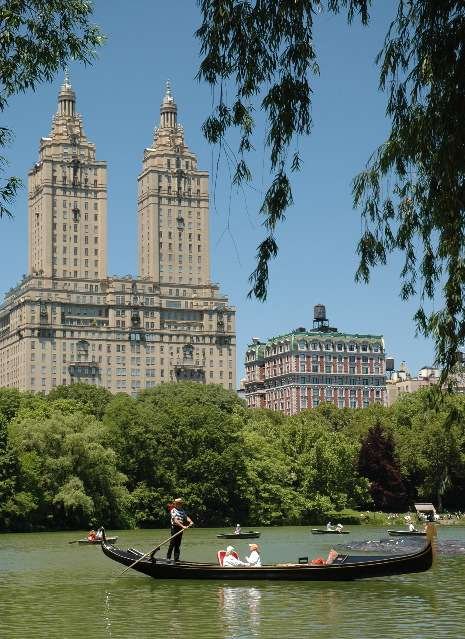
Illustrations, from above: A gondola ride in Central Park, with the iconic San Remo apartment building in the background; Venice, Italy, ca. 1735, by artist Canaletto; Peter Caesar Alberti marker in The Battery, Manhattan; Lorenzo Da Ponte portrait by Samuel Morse at the New York Yacht Club, ca. 1830; Designed by Jarvis Morgan Slade, the five-story Venetian-inspired building at 8 Thomas Street between Broadway and Church Street; Metropolitan Life Tower, postcard 1912; “Street Arabs in Mulberry Street, Little Italy” by Jacob Riis, 1889; Lewis Wickes Hine’s “Icarus, high up on Empire State,” 1931; and Jean Leon Gerome Ferris, “The Constitutional Convention,” 1787.
Recent Comments